Rachel A Rosen is interviewed by author Dale Stromberg, and talks about the process of designing his cover, her favourite designs, and her spicy opinions on terrible covers. Read it (unpaywalled) here!
Rachel A Rosen is interviewed by author Dale Stromberg, and talks about the process of designing his cover, her favourite designs, and her spicy opinions on terrible covers. Read it (unpaywalled) here!
Every Tuesday, get to know a bit about the stories behind the books you love, and discover your next favourite novel.

Rachel: I have been quietly freaking out about this book since I read it in manuscript form, and now it’s finally time for you to tell our readers about it. Do so!
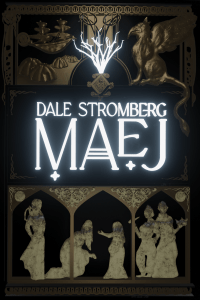
Dale: Mæj is a high fantasy novel that one early reviewer has called “a work of very unapologetic genre fiction that’s equally unapologetic in its intelligence and dedication to doing strange, creative things with language.”
Madenhere sells mæjwerk; Taræntlere sells sex. Both young women have grown up seeing people starved and children kidnapped in their tentslum. When Madenhere learns of an imprisoned hundred-day child, her heart burns to act—but the consequences of freeing the girl will be dire.
Meanwhile, Taræntlere’s molten fury leads her to join a secret insurrection whose implications neither woman is ready to face. Tying everything together is a power older than history which threatens to revolutionize an economy and spark a war—the power of mæj.
Rachel: Many authors depict the idea of matriarchy as something inherently softer and gentler than a patriarchy. You went a very different route. Why?
Dale: First of all, I find it perfectly believable that a given matriarchy could be softer and gentler than a given patriarchy. But I want to emphasise “given”: specific, particular. One problem we face when we imagine alternate worlds is that we, or our readers, can fall into the trap of essentialism: “Because women are all this way, a woman-led society would always work out like this.”
We wouldn’t say the same thing about patriarchy. For example, in the twentieth century, which was dominated politically by men, we saw the coexistence of liberal democracy, fascism, totalitarianism, democratic socialism, Islamic republicanism… as well as kibbutzes, hippie communes, you name it… There were all sorts of ways people were organising human affairs politically. Men were the bosses of the big systems, but those systems didn’t all function the same, and some were arguably softer and gentler than others. There’s no reason to suppose women-led systems would not also differ in this way.
This is the source of my resistance to the notion that, you know, “if we just put women in charge, there’d be no more wars,” et cetera. That sort of thinking is insultingly reductive. But it would be equally simplistic merely to swap the pronouns and portray matriarchy as a perfect mirror of patriarchy. So I wanted to think, not about how “female nature” would dictate political systems, but about how this particular matriarchy would have evolved to operate. Because the world in Mæj is not a world without exploitation.
What matriarchy and patriarchy have in common is the –archy, the rule of some over others. The particular matriarchy I wrote about preserves such hierarchy, such power differentials—and human beings are rarely at our best when given arbitrary power over others. If one group is up, another group will be down, and those with power will display a range of attitudes towards those beneath them, from sympathy and solicitude at one end to supercilious callousness at the other. Sadly, the crueler sort of people tend to be more adroit at manipulating and benefiting from power.
Rachel: Maej features extreme acts of linguistic acrobatics, with language denoting class and caste in a skillful way. How did you design your various dialects?
Dale: Oh, we could get nerdy with this one… I’ll try to rein myself in.
Before I wrote this novel, for years I nursed the notion of “my fantasy novel”, a book I would someday write. I love the language of Shakespeare and decided beforehand that, when I wrote my fantasy novel, I was going to throw in everything I liked, so “thee” and “thou” had to go in.
The Hwoamish language is a mashup of Tudor English with various other dialects, including traces of characteristics of Japanese (which I happen to speak) such as sentence-ending interjectory particles and rhyming four-word aphorisms which are meant as homages to four-character idiomatic compounds found in Chinese and Japanese. Also, I live in Malaysia and hear so-called “Manglish” on a daily basis, so bits and pieces of that went in as well.
As for using language to denote characters’ classes and backgrounds, I think life in Malaysia has greatly influenced me. In addition to English, people here speak Malay, Canto, Tamil, Hokkien, Hakka, Mandarin… all to varying degrees, and I don’t think there’s a single language common to everybody in the nation. Characteristics from one language will ooze into another, but there is still a mélange of linguistic difference which links people to a multiplicity of backgrounds.
I think of things like this, and I also think of an Irish guy I once knew, from Belfast; every time he met another person from Belfast, he’d listen to them speak for a moment, then declare (generally with great accuracy) which neighbourhood they had grown up in. This fascinated me as a U.S.-born person because I speak a dialect of English that spans time zones, lacking such geographical specificity. So I am intensely interested in focusing in on such things. If we maintain an awareness of what our voices and words say about our biographies, we can craft dialogue for individual characters which hints at such histories and differences.
Other made-up languages in Mæj are mostly translated into contemporary English, but when I wanted to show a few lines of untranslated Ennish, for example, I’d take an English sentence, reorder the words to Japanese grammatical order, then have fun with spelling and diacritics.
Yes, “fun with spelling and diacritics”. Freak flag: flying.
Rachel: As the cover designer, I was of course struck by the visuals—the art, architecture, and fashion of your invented world. Did you have a strong sense of the aesthetics when you started writing, or did that come later?
Dale: It came gradually as I drafted the manuscript. Before starting a new scene, I would do “pre-production” work, including lots of image searches for clothing, buildings, artwork, and so forth. I’d also sketch things out on paper, such as the exterior of West Hospitium or the floor plan of Nighpetal Manse. I stink at drawing, but having a visual helped me discover how I wanted to paint things in words.
I’m also an inveterate word collector, and for Mæj I compiled a list of more than 2,500 words and phrases I just had to use. Many of these were wonderfully evocative of a visual, which helped me fill out my imagery.
Rachel: Maej is highly literary. Is it a challenge to balance the expectations of epic fantasy as a genre with your own proclivities towards literary fiction?
Dale: To be honest, I am rather naïve about genre expectations. When I began working on Mæj, I had no idea how publishing worked. I figured, “You write the kind of book you’d love to read, and then somehow (vague waving of hands) it gets published.” I remained blithely uncognisant of the idea that publishers and ultimately readers would measure the book against genre expectations.
So any such “balance” of expectations and proclivities happened by accident; I wanted magic spells and talking gryphons, and I also wanted Shakespearean dialogue and jawbreaker vocabulary words… and everything else I personally like also got tossed in. Maybe “mishmash” is a better word than “balance” here.
Rachel: This brick of a novel is such a tremendous feat. What are you working on next?
Dale: Shorter works! After wrapping up the bulk of Mæj, which occupied me for (I cringe to say it) about ten years, I sat down and wrote a literary novella titled Gyre in just a couple of months. Now I’m working on a science fiction novella (with bathyscaphes, sea monsters, mind control tech, etc.) which, again, above all else, I hope to keep brief.
Spending a long time slow-cooking a massive novel was, in its way, highly rewarding, but now I’m enjoying the change to a quicker pace of writing. Gyre is about a woman who is born a second time with some knowledge intact from her prior lifetime, and it is currently seeking a publisher. If the Fates smile, in the fulness of time it may see the light of day.
Rachel: Where can readers find you, Maej, and your other work?
Dale: Mæj will be published on 21 October 2024 by tRaum Books. You can preorder the book on Amazon (ebook and paperback) or Bookshop.
The publisher and I are also keen to find people who are willing to receive a free advance review copy (ARC) in exchange for posting an honest review; anybody interested can sign up for that here. I send an infrequent newsletter called The Seldom which you can sign up for on my website. My favourite social media platform is called “email” but I also lurk on Bluesky and Goodreads.
Fiction To Sink Your Teeth Into, a feature normally written by professional chef Rohan O’Duill, has been taken over this month by Rachel A. Rosen, who co-wrote a book about being bad at cooking.
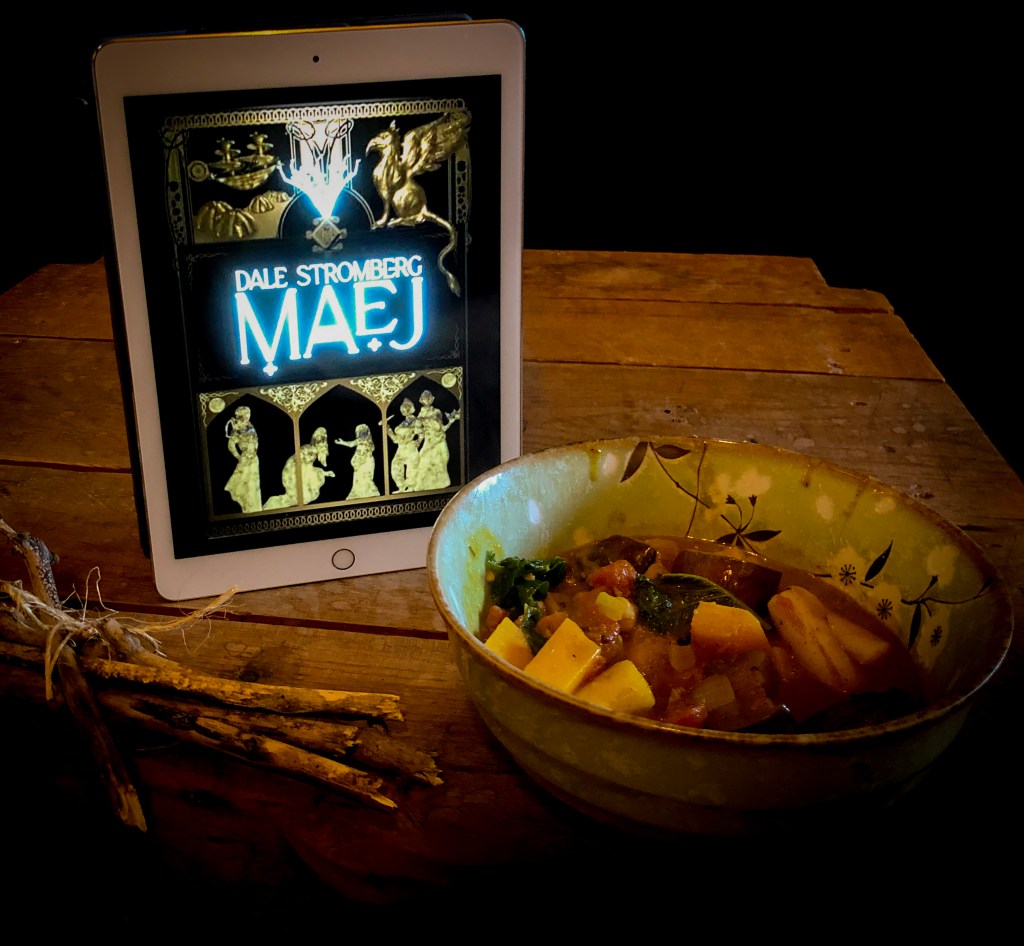
In Dale Stromberg’s Maej, Madenhere and Taræntlere eat meersaw-gossamy, described as a flavourful stew of “squash, aubergine, egg, and garlic.” I asked him for details about what it tastes like, and he told me they were never afraid to throw in chilies, and that “any dairy was rhinocerote milk and eggs are likely peahen eggs.” Lacking access to rhinocerotes and being vegan myself, I created a slightly less ambitious version.
Fiction To Sink Your Teeth Into, a feature normally written by professional chef Rohan O’Duill, has been taken over this month by Rachel A. Rosen, who co-wrote a book about being bad at cooking.
a + e (Seasons Book 1: Spring) by Ryszard Merey is a haunting and luminous tale of doomed queer love and friendship. If you’ve ever had a teenage crush on your best friend, snuck into a club wearing fishnet, or otherwise got your mess splattered over everyone else in your life, this book is for you. In it, Ash seems to subsist entirely off orange Tic Tacs, while Eu eats everything he won’t touch.

Every Tuesday, get to know a bit about the stories behind the books you love, and discover your next favourite novel.

Rachel: I’m obsessed with Zohar Jacobs’ short stories, and every time she publishes one, I have to send the link around to everyone I know and yell at them until they read it. Today, she’s joined us to tell our readers about her work!
Zohar: I write science fiction and slipstream, and so far have had stories published in the Sunday Morning Transport, Small Wonders, Analog and Clarkesworld. I also have a story forthcoming in Asimov’s.
Rachel: I’m always impressed by the religious and cultural questions you address in your writing, whether it’s about the role of religion on a Soviet lunar base or the question of whether a paired intelligence counts as one person or two in a minyan. Religion is such an under-explored concept in sci-fi—what draws you to exploring it?
Zohar: Mostly I’m getting back at Gene Roddenberry for how badly he dealt with religion in Star Trek. Although I’m an agnostic, religion has always been part of my life, and it’s one of the most complex social and intellectual systems that humanity has created. Why assume that we’d leave all that behind? You could actually argue that the feeling of being unmoored by distance from Earth and the scale of the universe might make people turn to religion more.
Rachel: Another theme I see in your writing is the engagement with real-world issues such as the climate crisis or the war in Ukraine? What are the challenges of writing about a future that is so grounded in our present?
Zohar: Oddly I’ve never thought of it as a challenge. I sometimes think that I’m not a very creative person: reality is always where I get my inspiration, because it comes up with much more complex and bizarre scenarios than I ever could. By hewing close to reality, I can expect my readers to bring their own set of rich, independent associations to my work. I guess the challenge is that I can’t predict how people will take my writing – but I’m not sure I could do that anyway.
Rachel: How important is literary voice in science fiction?
Zohar: Many SF readers prefer transparent, pacy prose that doesn’t get in the way of the story: think Andy Weir’s The Martian. So maybe it’s not that important. On the other hand, some of SF’s best writers have been great prose stylists – Ursula le Guin, Samuel R. Delany, M. John Harrison – so it’s clearly no obstacle to success either. Literary voice is important to me, but then I sometimes joke that I’m actually a literary author who just likes spaceships too much.
Rachel: What’s your next writing project?
Zohar: Funnily enough, a literary novel. It feels odd to temporarily step back from the SFF community, but this is a story that I’ve been wanting to tell for nearly 20 years. (It has spaceships too.)
Rachel: Tell us where the Night Beats community can find you and find your work!
Zohar: Apart from the magazines where I’ve been published, you can find me on Twitter @zoharjacobs and BlueSky @zoharjacobs.bsky.social. One of these days I will set up a website but this is not that day yet.
Every Tuesday, get to know a bit about the stories behind the books you love, and discover your next favourite novel.
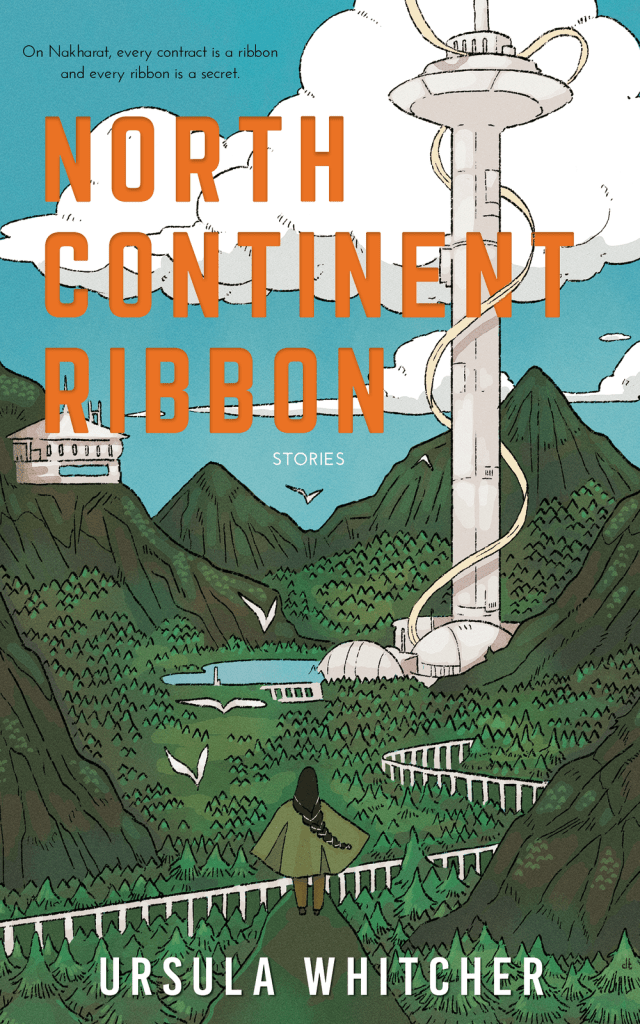
Rachel: I’m a sucker for intelligent, literary sci-fi, so when I finished reading North Continent Ribbon, I immediately asked Ursula if they’d be interested in telling our readers about it so that I’m not screaming about how good it is all by myself.
Ursula: North Continent Ribbon is a collection of connected, queer short stories that’s coming out in August.
Here’s the blurb:
“On Nakharat, every contract is a ribbon and every ribbon is a secret, braided tight and tucked behind a veil. Artificial intelligence threatens the tightly-woven network. Stability depends on giving each machine a human conscience—but the humans are not volunteers.”
Rachel: I was struck by the theme of connection and relationship, both visible and hidden, in North Continent Ribbon. Did this theme emerge organically or did you intentionally build the stories around it?
Ursula: It’s organic! The intentional organizing theme is different parts of Nakharat society—I wanted it to be clear why one person would hate the judges or the army or the Companies but another person might try to join up. But I wrote queer romances while thinking through facets of my own identity, and I was curious about the role bigger social groups like student clubs and groups of drinking buddies play in social change, so I’m not surprised you see a more intricate web.
Rachel: The collection covers multiple eras of Nakharat history, which feels very rich and lived-in. How much worldbuilding exists off the page?
Ursula: In some places there’s a ton, while other parts of the world are more of a mystery. I have lots of thoughts about the culture of the titular North Continent, plus miscellaneous facts (ask me about ocean ecology or grammatical genders!) Other locations are wide open.
Rachel: My absolute favourite element of your world was the grim wire technology in the trains and spaceships, and what it says about labour, class, and automation. Where did that idea originate?
Ursula: The very first writing I did about Nakharat involved an even more furious adult version of the “Last Tutor” protagonist, Isekendriya. I knew that Isekendriya grew up on a mountain estate overlooking wide, empty plains, that the thought of their parents filled them with rage and guilt, and that nevertheless they wore a ribbon in the family colors hidden in their hair. I asked myself what kind of wealth leads to an estate in the middle of nowhere, and the answer was transportation—specifically, trains.
The combination of ribbon imagery, train tracks, my character’s fury at their complicitness, and my own feelings about the US justice system led to the creepy technology you see in the book. I’m glad you found it compelling! I definitely did—compelling enough that I kept writing stories set on Nakharat, and eventually wrote my way back around to Ise.
Rachel: One of the challenges of short stories is creating characters that the reader can bond with, and who experience growth and change, within a very limited number of words. How do you balance economy of storytelling with creating complex and compelling characters?
Ursula: I cheat and write novelettes! As a poet, I expected that my natural fiction range would be very short. But I love the freedom that a novelette (about twice the length of a traditional short story) allows me to explore the psyches of characters who are uncertain or conflicted about what they want.
Rachel: Will you be revisiting Nakharat? What are you working on now?
Ursula: Right now I’m working on a couple of different historical fantasy projects (Napoleonic wars? Byzantium?) But I haven’t ruled out a return to Nakharat! One of the stories is about an artificially intelligent book, and I’m curious about whom else the book might meet.
Rachel: Tell us where the Night Beats community can find you and find your work!
Ursula: You can pre-order a hardcopy of North Continent Ribbon from Neon Hemlock Press.
If you want an alert the moment the ebook pre-order goes live, or you’re curious about what else I’m working on, you can subscribe to my newsletter:
And I’ve been spending lots of time hanging out on Bluesky ( @yarntheory.bsky.social ).
Fiction To Sink Your Teeth Into is usually a feature from author and chef Rohan O’Duill, but this month, Rachel A. Rosen is hijacking it.
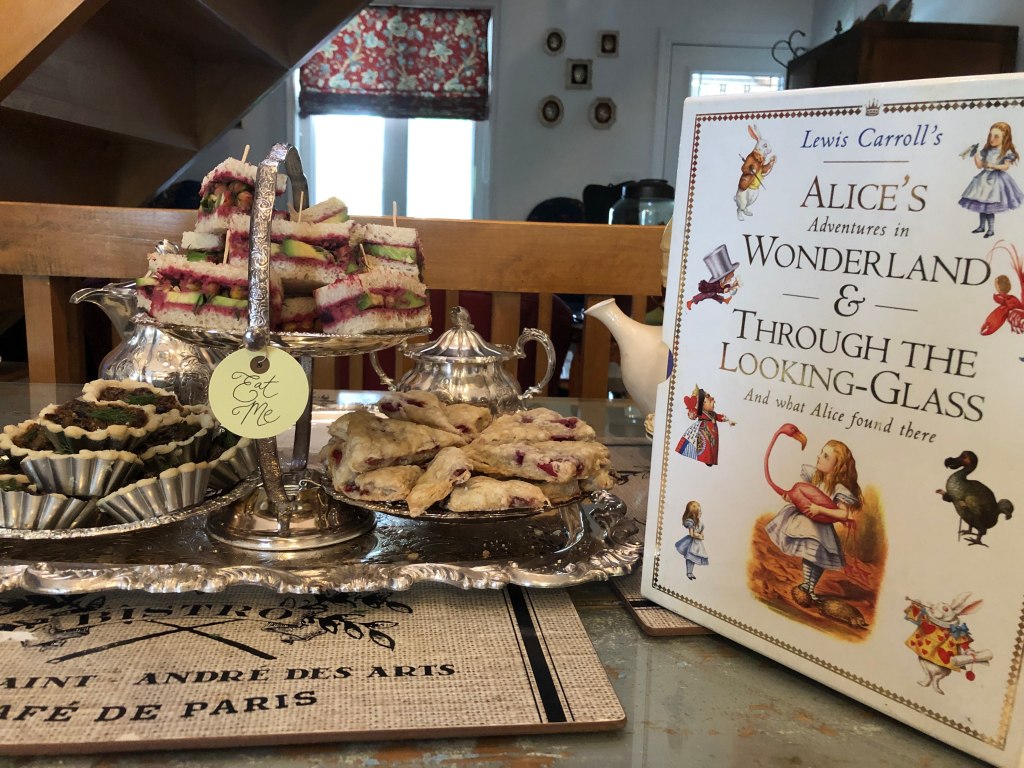
I was obsessed with Alice’s Adventures in Wonderland and Through the Looking-Glass before I could even read, and paired with my love of baking shows, I have been dying to do a Mad Hatter Tea Party for ages. It’s complicated by the lack of cooperation from the small woodland creatures in my vicinity, plus the fact that I’m vegan. I made several recipes for this, with varying degrees, and I’ll share the most successful ones here.
Queer SFFH (Science Fiction, Fantasy, and Horror) has been with us for a very long time. One of the first English-language science fiction novels is Frankenstein, 1818, and it was written by bisexual author Mary Shelley. And representation has recently reached new heights, in both how many queer creators there are, but also the number of queer characters appearing in SFFH, in books and media, but also in the quality and impact they have in storylines.
Rachel A. Rosen joins Troy and David, to discuss the topic on their podcast, Two Old Farts Talk Sci-Fi. Listen here!


Night Beat’s own Nicole Bezanson is sharing her wisdom on how she’s published her multi-genre books—and how you can think about publishing your own works!
Author/publisher Anne Louise O’Connell and multi-genre author Nicole Bezanson will address various ways to get your book published. Anne will address hybrid and self-publishing and will take you step-by-step through the process of getting a book set up on IngramSpark ready for printing and distribution. Nicole will focus on traditional publishing and how to query agents and publishers, as well as author collectives and serial fiction websites. For more information on these online workshops, check out OC’s website.
Fiction To Sink Your Teeth Into, a feature from author and professional chef Rohan O’Duill!
Gideon only wants to go to Magnus and Abigail’s 11th anniversary party because she really wants to eat a dessert. So I thought it fitting that we prepare that dessert to go with reading Gideon the Ninth. The dessert described is cream with fruit and sugar, which sounds a lot like an Eton Mess. Bonus, that’s a super simple recipe to make!

 Night Beats Extended Universe