Every Tuesday, get to know a bit about the stories behind the books you love, and discover your next favourite novel.
Rachel: Nick Mamatas is a fantastic author and a longtime friend, and every time he puts out a new book, I know I’m going to love it. This one is no exception, and I’m thrilled that he’s here to tell you about it. Nick, please tell us about yourself and 120 Murders.
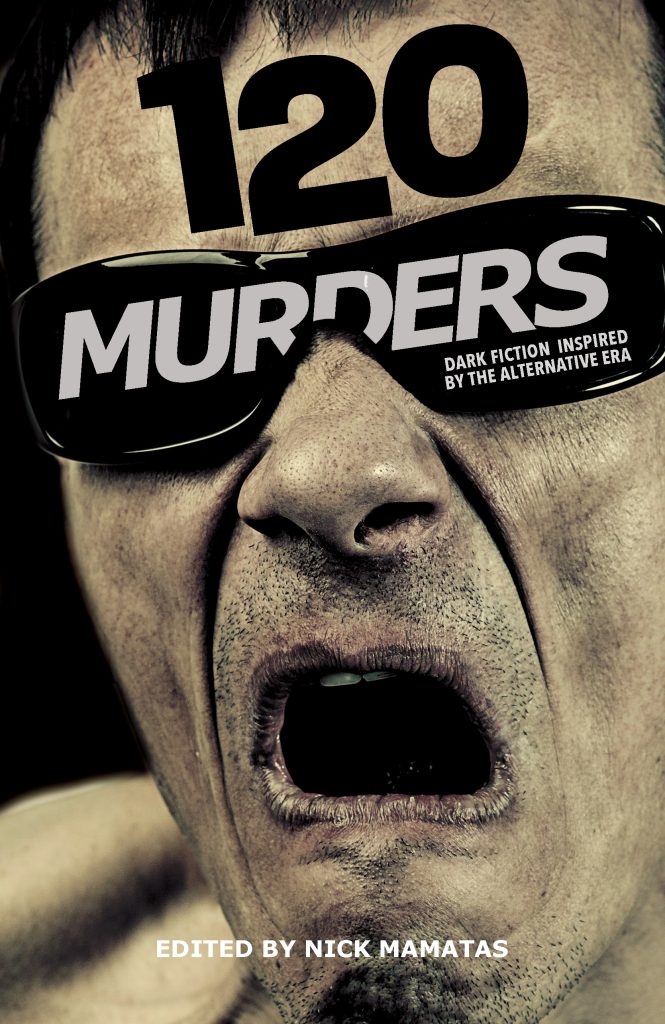
Nick: I’m Nick Mamatas, an author and editor. My most recent editorial work is the editing of the anthology 120 Murders: Dark Fiction Inspired by the Alternative Era. I asked top writers of noir, gothic, and horror fiction to write a story inspired somehow by the songs played on college radio and “alternative” music video programming blocks, and, boy howdy, did they!
It’ll be published by a new independent press, Ruadán (pronounced ROO-ah-dawn) Books, which focuses on all manner of dark speculative fiction.
120 Murders includes brand new stories by William Boyle, Selena Chambers, Jeff Chon, Libby Cudmore, Jeffrey Ford, Meg Gardiner, Todd Grimson, Cara Hoffman, Maxim Jakubowski, Alex Jennings, Cyan Katz, Josh Malerman, Michael Marano, Silvia Moreno-Garcia, Zandra Renwick, Jason Ridler, Veronica Schoanes, Elena Mauli Shapiro, Brian Francis Slattery, Molly Tanzer, Chris L. Terry, and Paul Tremblay, as well as little notes about their musical tastes.
Rachel: One of the hazards of growing older is that delusion that the pop music you listened to when you were 17 was truly the best pop music ever produced by humanity. For GenX, of course, that is objectively true. In Ghosts Of My Life, Mark Fisher talks about the material conditions that led to post-punk, and how they no longer exist to produce music with the same originality and emotional resonance. Is there something about the alternative era that lends itself particularly well to horror, dark fantasy, and noir?
Nick: There might be some biases built into that conception. I remember when Don’t Tell a Soul came out; most Replacements fans I knew thought something along the lines of “What the hell is this?!” and now that album is a classic, I guess. Do people still listen to Helium? I suspect not. I just tried and almost made it through “Superball.” Yow!
But I do agree; the 80s and 90s were the last time when rents and rehearsal space were cheap enough, but recording equipment expensive enough, that bands would write and play out and perfect their sounds, and then be discovered and signed. The incubation period for songwriting has been drastically shortened thanks to self-releasing, and labels for lack of something to spend their capital on so focus on brand development over band development, and high-priced producers and songwriters/punch-up artists that flatten sounds and eliminate lyricism. You can’t mass produce “It’s so easy to laugh, it’s so easy to hate/ It takes strength to be gentle and kind.” It doesn’t rhyme!
Deeper lyrics tend to be darker. Analog production tends to sound dirtier. Reagan, Thatcher, and Kohl, those great annihilators of society, gave everyone plenty to write about. Now everyone’s a Reaganite—1980s Reagan in economics and queerphobia, 1960s Reagan in racism. One can hardly even object to it anymore; what’s a ruin when it’s your cradle?
Rachel: Horrifying, though I am relieved it’s not just because I’m old. What was your process for assembling the collection? Did any authors have to fight it out for a particular song?
Nick: I asked the writers whose short stories I like, and begged some famous friends whose short stories I like, to lend me their names and then went hunting for money. For the most part, everyone wanted something different to riff off of, though for a moment there 120 Murders looked like it might have ended up 120 Murmurs–an R.E.M. tribute.
I was also quietly open to query letters, which, back in the old days, every anthologist was. The SATization of submissions by editors, who claim to be interested in new voices, mean that many anthologists don’t entertain query letters, which I think is a huge mistake. Slush piles are an extremely inefficient way to find new voices, but they do serve to make editors objects of respect and fear among hundreds of hopeful submitters, which is often rather the point of launching some anthology or magazine project. You get prominent writers to love you by giving them money, and would-be writers to fear you by holding forth on social media about how writers aren’t following submission guidelines or are otherwise being bad boys (almost always boys, of course).
One might say that querying serves as an in politic, as someone needs to know how to write an effective business letter, but that’s a skill one can master in an afternoon. Others suggest that it serves as a barrier against writers who are shy or lack confidence. I’ll say that several people tweeted/commented to me, publicly, to ask when/if/why wouldn’t I open to slush submissions. Anyone nervy enough to ask an anthologist to quintuple his workload, and to attempt a bit of public shaming while they’re at it, is certainly brave enough to just write and privately send a normal query letter.
Three of the stories in the final book were query acceptances, and a fourth was the author’s fiction debut. Cyan Katz was a student in an online workshop I ran and I was impressed enough with their work, which was wild and raw and had a very “punk” feel, that I solicited them for a story and worked to get it into great shape. Other authors generally needed light edits, or some rewrites, or were given a second chance after the first story wasn’t great.
Rachel: With BookTok and niche online communities, the many genre markets are increasingly segmented, and trend-chasing publishers seem to be leaning towards cozy, hopeful stories. What were some of your motivations and challenges when pushing back against these trends?
Nick: I’m very skeptical of the cozy trend, though every subgenre and movement has its virtuosos and its hacks. The top three percent of anything is going to be great. I do think there are two trends—plenty of cozy and hopeful, but also a lot of dark stuff. Barnes & Noble here in the US has a horror section again, major publishers have relaunched horror lines for the first time in thirty years, and neo-noir is pretty huge. There may even be a cozy story in 120 Murders, though the author and I disagree about how cozy it is. I think any story with a closetful of desiccated corpses is pretty dark.
In crime fiction, there’s been a microtrend toward anthologies in tribute to this or that musical artist. I even have a story in one, Lawyers, Guns, and Money, which is obviously a Warren Zevon tribute. Some of the book themes are a little shakier, honestly. I thought a broad musical range—all of college radio and alternative—and a thematic range of noir, science fiction, crime, and gothic—would make more sense, or would at the very least put a bullet in the head of the trend.
Rachel: I would never ask you to pick favourites, but are there any particular images or moments from any of the stories that live rent-free in your head? What are they?
Nick: Bunches! I’ll list a few. One of the stories begins with its author contemplating being solicited for the story she is writing and the reader is reading. My name is in it, so of course I love it. We have queer cyborgs who actually do queer things on the page, alleyways full of broken glass sparkling under the streetlamps, a big pile of sloppy joe mix plopped atop a cardboard chore wheel (ew!), poor Jeffrey Ford writing about a very Jeffrey Ford-type guy being shot in the head for being annoying (Jeff, no!) a horrific historical scene of butchery and cannibalism, and much much more.
Rachel: Cara Hoffman’s author’s note references “collective loneliness,” and “art from garbage and lack,” concepts that as a cynical Gen Xer immediately resonated with me. What does this era of music—and the stories inspired by it—tell us about our struggles today?
Nick: There’s a weird social media trend in which Gen X people describe themselves as feral and tough because they were latchkey kids and roamed the streets freely and had to get up and walk across the room to change the TV channel. It’s extremely tedious, if you ask me, and obviously just whistling past a graveyard.
But art from garbage and lack is totally it. The internet is dead; this interview may well be the only non-AI tainted thing a reader may come across today, and even then they’ll likely just find it via links you and I post to our social media accounts. Does anyone just stop by any website anymore to see what’s up? Amazon Prime Day, maybe! Ugh. So we are back to where we were in 1992—photocopy machines (many books are print-on-demand, that’s just big photocopying!) and homebrew movies (albeit with phones and not VHS camcorders) and singing over beats. If the Sisters of Mercy had Doktor Avalanche (the first Dr was a Boss DR55 drum machine that could produce all of four sounds) and toastmasters and MCs had the first twenty seconds of a vinyl track to work with in the 1980s and 1990s, well, so do we. The struggle is going to be to find our humanity between gaps in the algorithm, and as the last people to hit adolescence in an analog world, Gen X and Xennials have something to say and something to share.
Rachel: I’ve already read it, but where do normal readers get a copy? And how do they find you?
Nick: Find me on Bluesky at nmamatas!
On Instagram I mostly post license plates and pizza slices, but there I am concentrateandtryagain. You can get 120 Murders at a nice discount, with a bonus story by me bundled in with your receipt, at the publisher website. I would also highly recommend special ordering a copy from your local independent bookstore, though the book will also be available via the megachains—emphasis on the word chains, if you catch my drift. You don’t want to be chained, do you?