| This month’s suggestion is 1984 as a beach read. This month’s suggestion comes from @hownovelstarts on Twitter. Tweet us and if Rachel likes your suggestion, she’ll make it in a future issue. |

| This month’s suggestion is 1984 as a beach read. This month’s suggestion comes from @hownovelstarts on Twitter. Tweet us and if Rachel likes your suggestion, she’ll make it in a future issue. |
by Rohan O’Duill.

Being a chef for the last 25-odd years means I have amassed a vast collection of hundreds of cookbooks. I have all the classical French cookbooks. I have cookbooks from cuisines around the world. I have cookbooks on ancient techniques and ones on modern cooking hacks. But The Sad Bastard Cookbook is the only one tos ever made me laugh out loud.
While this book provides very handy and quick recipes, it is so much more than a cookbook. It is a companion through tough times, a crutch when you are struggling, and a shared smile when you need just that.
Saying that, these recipes still provide essential nutrients and energy. The Peanut Butter on a Spoon recipe is a great example of that. Two tablespoons of peanut butter provides you with almost 200 calories, it is high in healthy fats and protein. It is a dense, high-energy food source that also tastes great and requires no preparation whatsoever.
The frozen yoghurt recipe is another favourite of mine. The yoghurt provides you with protein and calcium to keep your body running. The freezing process does not destroy the probiotics, so you still gain the digestive benefits and the advantages to your immune system. The added banana is packed full of vitamins and minerals to really round out the meal.
These are not gourmet recipes, and it would be advisable to create more diverse and balanced food plans when you are able. But this book will get you by and introduce variety when you just can’t make that extra effort.
The real beauty of this book is that many of the recipes and anecdotes were crowd sourced. There is an unquestionable authenticity to them that is refreshing and charming. This book is a survival guide written by survivors. It is a heartfelt resource that many people will draw on for years to come.
Get your free e-book PDF here.
Every Tuesday, get to know a bit about the stories behind the books you love, and discover your next favourite novel.
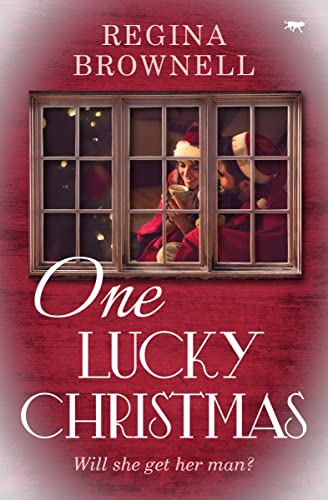
Sabitha: Today we’ll talk to Regina Brownell about her newest holiday romance, One Lucky Christmas. Regina, can you introduce us to your book?
Regina: One Lucky Christmas is about Kasey Johnson, a twenty-four year old woman who wishes her mother would accept who she is and not run her life. She agrees to go on blind dates set up by her mom. After several failed dates she meets date #31, a pastor’s son, Tobias Scott. She expects it to all go wrong but he takes her by surprise. He and his family accept her with open arms unlike her own, but with her meddling mother, his ex-girlfriend, and an accidental discovery, things might not turn out the way she hoped.
Sabitha: What inspired you to write this book?
Regina: I was inspired by a Wattpad short story contest. The prompt was that your MC went on 121 dates and found the one. What started out as a short story soon turned into a whole book. I could not let go of these characters.
Sabitha: We have a lot of writers in our community. What’s your writing process?
Regina: I’m a pantser, so things tend to get a little chaotic at times. I mostly jot down a few ideas, make a mood board and just start writing when it feels right—when the characters won’t stop talking. I write notes like characters’ names, their appearance, their likes, random chatter that goes on in my head, into a notebook. After my first draft, I let it sit and then do a reverse outline of sorts, writing everything down chapter by chapter in my notebook too. Then when that’s all done and it’s kind of edited I send it to my betas, then the pulling it all apart begins and the developmental edits happen and line edits after.
Sabitha: Do you have a “fan-cast” – do you have actors you’d cast as your main characters?
Regina: Yes! I have always pictured Tobias the love interest as Nathan Parsons. He did a movie on Hallmark channel and the female lead Jonna Walsh also looked exactly how I pictured my MC Kasey.
Sabitha: What book do you tell all your friends to read? Besides yours of course!
Regina: The Kiss Quotient by Helen Hoang and Josh and Hazel’s Guide to Not Dating by Christina Lauren are my comfort reads. Will always recommend those.
Sabitha: Thanks for sharing your story and your process. We’re looking forward to reading! Where can the Night Beats community find you and your book?
Regina: You can buy my book on Amazon. You can find me at my Amazon author page, my Twitter, my Instagram, or my website.
by Nicole Northwood
The Sad Bastard Cookbook, reviewed in Tiktok form. A work of Art.
Get your free e-book copy here.
Every Tuesday, get to know a bit about the stories behind the books you love, and discover your next favourite novel.

Sabitha: Maria Bouroncle joins us to talk about her fascinating new-crime novel, It Came to Me on a Whim – The Story of Ingeborg Andersson, Child Murderess. We’re very lucky to have her, since this story was just published in English for us to enjoy! Maria, can you tell us about your book?
Maria: It Came to Me on a Whim tells the story of my great-aunt who killed her three children in a small Swedish village in 1929. The story and what happened that day was a well-kept family secret for seventy years. I stumbled upon it back in 1999, as one of my cousin’s patients asked if we were related to “that old murderess Ingeborg”. We both knew her very well as children, since Ingeborg lived with our grand-mother, but we had no idea she had been married or had any children, let alone three.
I was 34 years old at the time and had just given birth to my daughter. I simply couldn’t grasp the news. It wasn’t until my father passed away twelve years later that my thoughts of Ingeborg resurfaced. I finally decided to ask my relatives what happened, and I began digging through the archives.
Sabitha: I can’t imagine what that would feel like. Is that what inspired you to write this book?
Maria: It was never my intention to write a book about Ingeborg. However, after years of research to shed light on the tragedy and trying to understand how a woman I’d loved as a child could have committed such a horrific crime, I got truly obsessed with the story. It wasn’t until an old relative passed me the letters she wrote to her husband from prison that I knew I had to put her words on paper. I’ve included these letters in my book. In one of them, she writes, “I think about the children all the time and about you but forgive me I didnt know what I was doing O God if it could be undone.”
Sabitha: How did you choose the title? Is that part of the story?
Maria: When asked why she killed her children, Ingeborg simply replied, “It Came to Me on a Whim”.
Sabitha: What do you most want your readers to take away from reading your book?
Maria: Ingeborg was born in 1901. Her parents were farmers, and she was the second to youngest of seven siblings. She went to primary school for six years and when she was 23 years old, she got married to the boy next door, who was a relatively well-to-do farmer. Artur was seven years her senior and seems to have been a modern and kind man. Pretty soon after their beautiful wedding, they had three children together, two boys, and one girl. But Tor only lived to be five years old. Efraim was three and Lucia was only one year old when their mother killed them.
I’ve tried to capture this troubling story without too many gruesome details. By letting my narrative jump back and forth between different time periods, as Ingeborg’s thoughts probably did, I hope to put the reader inside her mind to understand her, just like I’ve tried to do. Despite the rigid structures of the prison, I also wanted to show the kindness of the staff who cared for her. I’ve dedicated my book to Tor, Efraim and Lucia, and it’s my sincere hope that Ingeborg’s story will bring mental health issues into the light.
Sabitha: Thanks for sharing your story—such a fascinating and tragic tale. We’re looking forward to reading! Where can the Night Beats community find you and your book?
Maria: It Came to Me on a Whim is available on Amazon. Links to my socials can be found here.
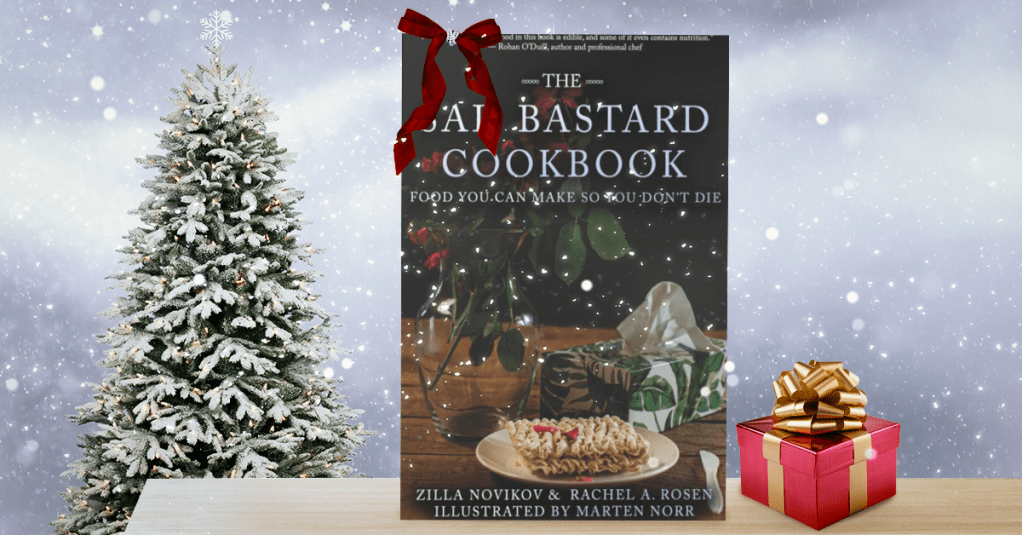
What could make a better Christmas gift than a copy of The Sad Bastard Cookbook: Food You Can Make So You Don’t Die?
The e-book is free on our website. If you print it out on the work printer, the print edition is free too. If you like professionally bound books, check out daddy bezos.
There’s a brand-new story just published in the Night Beats Extended Universe!

When Talia and her best friend, Jaeger, agree to host a small graduation dinner party together at their rental house, Talia doesn’t anticipate that she’s going to end the night by admitting she’s fallen in love with him.
What starts out as a quiet night over plates of perfectly cooked salmon, listening to acoustic music on the back patio, quickly turns into intoxicated conversations over stacks of dishes after the guests have left. Though Talia tries to hide her feelings, after a few too many glasses of wine she can no longer deny the way she feels. An innocuous discussion with Jaeger around the future of their friendship following the end of the semester soon dives into deep emotions, leaving the two sharing an intimate moonlit dance, a warm bed, and maybe even more.
Read the latest addition to Night Beats canon. Run Me Down: A Romance Novella by Nicole Northwood is free on Wattpad.

Watch Rachel A. Rosen talk about Cascade at the Brighton Public Library on Tuesday, Dec. 6. It’s on Zoom—get the link through their calendar!
by Zilla Novikov
Most advice for dealing with depression makes depressed people feel worse.
Fish oil supplements, running, and meditation help some people. Maybe they even help you. But for the rest of us, they deliver a simple message. Your depression is your own damn fault because of your bad lifestyle. If you ate better, exercised more, and changed your negative attitude, you wouldn’t have this problem.
If you, like we did, look online for depression-friendly recipes, you will find almond-crusted barramundi and walnut-crusted maple salmon, promising Omega-3s to fight brain fog and B vitamins to boost mood. If you happen to be an inland-dwelling vegan, such personal lifestyle tweaks are inaccessible to the point of satire. This is a feature, not a bug. The thing these recipes have in common is that the cost of ingredients, difficulty of preparation, and incompatibility with numerous dietary restrictions mean they are inaccessible to most mentally ill people. If only you would do this, they promise, and then it becomes your fault because you do not, and so you must not really want to be well.
If capitalism is driving your employer to exploit you and the rich to destroy the planet, the solution is not to do Pilates about it. No amount of chia seeds are going to fix how you feel. You need some empathy and some survival strategies. Surviving means you have to eat, even if you don’t want to, even if there’s no food in the world worth the effort of lifting a spoon to your mouth.
Many of us also have stigmas and taboos when it comes to food. Maybe someone has told you to avoid “bad” foods, or questioned if you really needed a second cookie. Maybe for you, the concept of eating is complicated by feelings of guilt or shame. But judgment doesn’t help. It’s better to eat than not, and we are not the sum of our worst days.
My depression is not my fault. My brain chemistry is fucked and I need medication to function. I tried lifestyle changes for years, delaying as long as I could before I acknowledged what felt like a moral failing. Before I accepted my inability to will myself cured. Diet advice gave me one more thing to try before taking that step. But crushed flax seeds weren’t what I needed. What I needed was a hug, and guidance to get through day by day until I was ready to admit my truth.
Depression cooking for me is low-effort, cheap, easy foods, with minimal ingredients that I probably already have in the house. It’s carb- and spice-heavy. It’s eating popcorn out of a bag or boiling instant noodles. It’s food that’s tasty enough to be appealing even when the thought of eating seems exhausting.
Of course, this isn’t the same for everyone! Some people have to avoid carbs or gluten, others find high levels of spice challenging at the best of times. Contrary to the advice you’ll find online and in diet books, there’s no silver bullet for our problems, individually or societally. But we can do our best to make things better for each other as a community.
Collective change starts at a local level, and for us, dealing with the social problem of depression begins with acts of mutual aid. Whether it’s reminding folks that they’re not alone or sharing the coping strategies that have worked for us and our friends, we’re here with each other as we battle not just the Big Sad, but the environmental, political, and economic context that enables it at its worst.
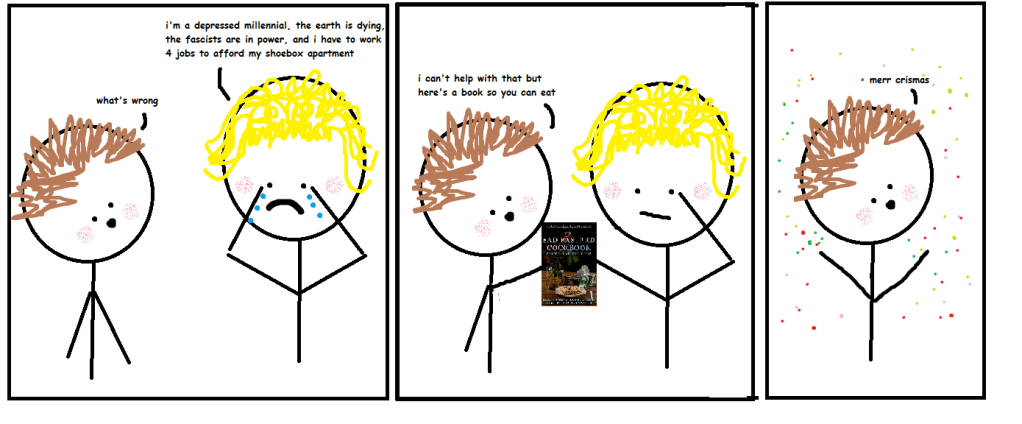
I wrote a rant (see above) but I also—with my community—wrote a cookbook to share our coping strategies. The Sad Bastard Cookbook is funny, realistic, and kind. Also the e-book is free. We gotcha.
Fiction To Sink Your Teeth Into, a feature from author and professional chef Rohan O’Duill!
Fermín breathed deeply, with relief, and I knew I wasn’t the only one to be rejoicing at having left that place behind…
“Listen, Daniel. What would you say to some ham croquettes and a couple of glasses of sparkling wine here in the Xampañet, just to take away the bad taste left in our mouths?”
This month I have chosen the atmospheric and beautifully written Shadow of the Wind and paired it with Spanish croquettes. I hope that this recipe, along with a nice glass of rioja, will immerse you into the Barcelona vibe that comes through so strongly in the book.
Traditional Spanish croquettes are made with a béchamel sauce and involve a two-day cook, so I have simplified this a bit by using potatoes for the croquettes. Apologies to our Spanish readers for the abomination.

 Night Beats Extended Universe