Every Tuesday, get to know a bit about the stories behind the books you love, and discover your next favourite novel.
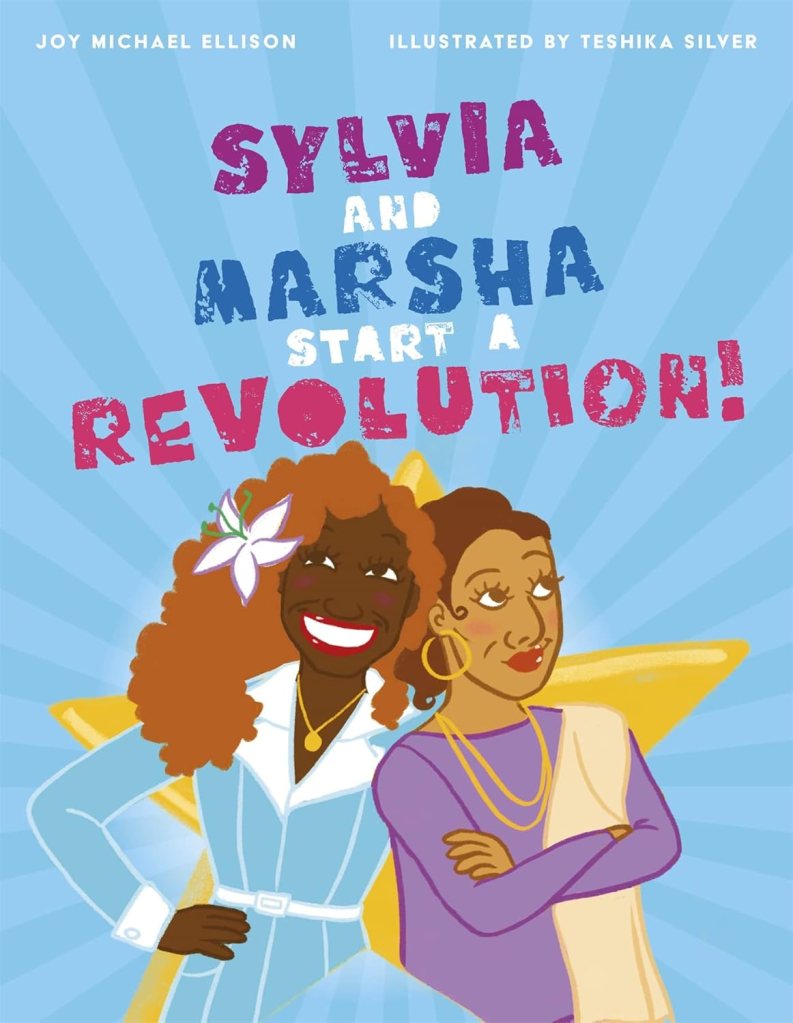
Rachel: With us today is Joy Michael Ellison to talk about a book I’m so excited about. Joy, can you introduce yourself, and tell our readers a little bit about Sylvia and Marsha Start a Revolution!?
Joy: Hey there! I’m Joy Michael Ellison [they/them]. I’m a white, disabled, queer and trans person currently living on the traditional lands of the Narragansett nation. I am a writer, a professor of Gender and Women’s Studies at University of Rhode Island, and a life-long grassroots, community activist. My approach to organizing is shaped by the three years I spent in Msafer Yatta, Palestine supporting Palestinian- led popular movements and my experiences working in transformative justice movements in Chicago, Illinois. As an author, I am interested in using stories, both fictional and true, to build community, document social movements, and imagine a liberated world. I believe that storytelling is integral to healing, transformation, resistance, and survival.
Sylvia and Marsha Start a Revolution! is my first children’s book. It tells the story of Sylvia Rivera and Marsha P. Johnson, two trans women of color who made history during the Stonewall Rebellion, kickstarting the movement for acceptance of queer and trans youth. Sylvia and Marsha help trans girls like them by sharing what they have in abundance: friendship. They show us all that beside our best friends, we can change the world.
Rachel: Tell us about the journey from concept to publication. What was your process, and how did you collaborate with Teshika to bring the story to life?
Joy: Sylvia and Marsha Start a Revolution! is an unintentional case study in what it takes for queer and trans people to break into conventional publishing. In fact, this book started out as a joke—one of those unfunny things you tell yourself when you’re afraid to try because you know how much systemic oppression is against you. I decided that I was going to write a picture book about the Stonewall Rebellion that would never be published. I had been reading every primary source I could about Sylvia and Marsha as a part of my graduate studies and I yearned to share what I was learning with a wider audience. So, I wrote and revised the text, took a class on picture book publishing, (the teacher seriously told me that I should write a book about “trans seahorses” instead), revised more, and submitted to a dozen publishers. After receiving as much rejection as I could stand, I decided to self publish.
I knew that my community would buy this book. I approached a local artist’s collective and hooked up with Teshika. Together, we crowdfunded the book. Naturally, as soon as we proved that there was a market for it, capitalists came knocking. Because I had discovered that self-publishing is a nightmare for my anxiety, we sold the book to a traditional publisher. Because of that, I was able to find an agent who turned around and sold four more picture books about queer and transgender history, the first of which is “Willi Ninja: Vogue Legend,” coming out May 2026.
Now I spend more time writing and more time…let’s call it “gentle-parenting” publishers into letting me do right by the historical figures I write about. My experience shows how much we’re trapped by capitalism, and what queer and trans people can do when we go outside of normal channels.
Rachel: Obviously, the history of the Stonewall Riots and the fight for queer and trans liberation is a beautiful one, but also one that involves state repression and police violence. How did you go about telling the story in a way that is appropriate for a young audience?
Joy: The first decision I made was to center Sylvia and Marsha’s friendship and mutual aid politics. Sharing and working together are ideas that children immediately understand and they encapsulate some of the central principles of trans liberation politics. Then I used all of the tools that children’s authors use to tell a good story: repetition, lively dialogue, and pictures that elevate the action further.
I firmly believe that any form of violence that children go through is something that we have to talk about with them. It’s not kids that struggle with these topics; it’s adults. Picture books can be a powerful tool for starting those conversations because they provide grown ups with the information and the conceptual and emotional framework to start talking. Once that conversation begins, adults will discover that it’s really not that scary.
Rachel: I love how much you respect your young audience. It’s also so cool that you included a reading guide and teaching materials! As a teacher myself, I always appreciate when authors do this. Do you envision this book being used in classrooms?
Joy: Yes! I’m lucky to be a part of the Lambda Literary LGBTQ Writers in Schools program so I’ve visited many schools where teachers and librarians are using Sylvia and Marsha Start a Revolution! to talk about queer and trans movements. I firmly believe that picture books are for everyone and my classroom visits have proved it’s true. Teachers from third grade through high school are using Sylvia and Marsha Start a Revolution! to teach about queer and trans history and social movements, in the face of intensifying repression in public school and library systems. It’s honestly healing for me to see children loving this book and adults bravely sharing it.
Rachel: We are seeing book bans and censorship of BIPOC and queer histories in both the US and Canada, especially in school libraries. If readers love your book (and they will) what can they do to ensure that new generations get to read about Sylvia and Marsha?
Joy: Yeah, censorship has been a pressing issue for a very long time, but it’s getting worse and worse. The most important thing you can do is get involved with a local network that’s protesting book bans and protecting teachers and librarians in your community. This issue is primarily fought in our neighborhoods.
If attending a library or school board meeting isn’t within your capacity, there are lots of other small actions you can take. Buy books by queer, trans, and BIPOC authors. Pre-order them and write reviews. Check them out from your local library or request that they purchase them. Donate books to a little free library near you (Is that a thing in Canada? It’s big here in the U.S. and I kinda live for middle-class parents getting into mutual aid without even realizing it).
Rachel: It’s totally a thing in Canada.
Joy: Ask a teacher if they would like copies for their classroom. Read banned books out loud to anyone who will listen. Invite me to speak to your children (I’m available in person in the Northeastern United States, but I do a mean Zoom story hour. I’ll even do it in drag, if you like!).
It’s also of vital importance that we support small presses. Most of the censorship of queer and trans authors takes place inside the publishing industry, firmly out of sight and pretty much impossible to track. Wonderful books are rejected because they’re too political or because publishers don’t understand that they will sell. If a book is acquired, publishers often pressure authors to remove content they see as a liability. I’ve had publishers say absolutely astonishing things to me, like telling me that I couldn’t define LGBTQIA2+ in a glossary because it would get the book banned—a pretty nonsensical claim for a novella about the Stonewall Rebellion that already gave plenty of ammunition to bigots. Small presses can be a powerful way to fight this kind of censorship and mistreatment of marginalized authors.
P.S., if you’ll forgive me for going further: right now, trans authors in the United States like me, along with BIPOC, disabled, and immigrant people of all sorts, really need solidarity from people outside of our country. The most marginalized people in our communities are already facing violent repression from our overtly fascist government and the situation is getting worse. White people in the United States, including leftists, are often pretty crap at engaging in transnational movements and unpracticed in actually asking for support. Frankly, I don’t blame anyone who feels we hardly deserve it. But fascism is growing globally. Ousting Trump is an international issue. I really hope we can start having conversations about transnational strategies, like boycotting U.S. sports, refusing to travel to the U.S., and working to support people who are deported from the U.S. and U.S. citizens who may need to immigrate elsewhere.
Rachel: This is hugely important, and I hope our little platform can be part of that transnational movement. Where can readers find the book—and you?
Joy: Sylvia and Marsha Start a Revolution! is available anywhere you buy books, but the best place to buy it is on my Bookshop page. Buying your copy there gets me a little more $$$ and supports local bookstores instead of the billionaires who want to ruin this planet and then move on to ruining Mars. You can find me on Instagram, where I very reluctantly allow the algorithm to feast on my social anxiety, or my website. I have a lot of books in the pipeline right now, starting with Willi Ninja: Vogue Legend (May 2026) and then my first academic book The Trans Midwest: Trans Feminist Coalition Building Since World War II (January 2027), which will be thick enough to use as a weapon. So please, stay in touch. I’d love to hear from you!

