Every Tuesday, get to know a bit about the stories behind the books you love, and discover your next favourite novel.
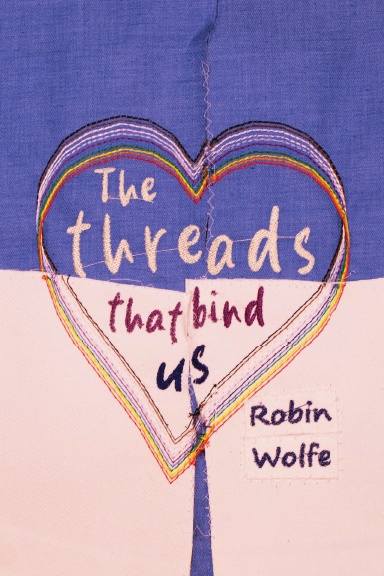
Rachel: I was blown away by Robin Wolfe’s new book, The Threads That Bind Us, and immediately contacted them to ask if they’d be willing to talk about it for our readers. Graciously, they accepted, so thank you for joining us today, Robin!
Can you tell our readers a little bit about the process? What is the book, and how did it come to be?
Robin: The most honest answer to “what is this book and how did it come to be” is that this book is my embodiment of community, and it came to be because I’m a nonbinary queer who struggled with finding community.
I’ve always been too much: too out for my very anti-queer area when I was growing up, too bi (biphobia from both sides of the aisle is very real), too woman-perceived for the leather community in my city, then too disabled for in-person queer community. And yet I kept looking, because I ached to belong.
About two years ago, I was lucky enough to stumble across a weekly online leather night. The host, a leather historian who works with the Carter/Johnson Library and Collection (the CJLC is a US-based library dedicated to preserving 2SLGBTQ+ and leather history), assured me I would be welcome and this wasn’t a men-only space. That first night I realized that I’d found the community I’d been seeking for decades.
And they found me, too. They quickly realized I was a skilled leatherworker and textile artist, and they ensured that Vi Johnson, who runs the CJLC, knew all about me. About half a year later, I was asked to be one of the CJLC Artists in Residence for 2025. The plan was for me to do a project to increase leather accessibility by making custom leather for four disabled people and then creating a how-to book for leatherworkers. (As a disabled person myself, the inaccessibility of leather is a constant source of frustration. It crushes me when people come to me for custom leather and they’ve been turned away unnecessarily by other leatherworkers.)
In March 2025 I realized that with the literal erasure happening in the US and elsewhere, there could be no project more important to me than recording our lives. Accessibility in leather would have to wait.
So with nine months remaining, I made a new plan: find 10 or so 2SLGBTQ+ and/or leather people who were willing to share their memories with me (kept in their own words). Do the editing and transcription required to be able to use their stories. Create an original embroidery for each story, inspired by their story. Photograph the embroideries and turn them into illustrations. Finally, turn the whole thing into a fully accessible ePub and a print book…
…and do all of that in less than nine months (before my artist year ends). Never let it be said that I lack ambition. I figured, “I used to be a small-press publisher and fiction author; I have the skills. It’ll be fine.”
(Now imagine me with a thousand-yard stare, because that’s how I looked during much of March through December 2025. The stress was epic.)
The book did come out on time though, and I’m so proud of it. This book is community itself; the foreword is by the leather historian who welcomed me, Vi herself donated a story, and the other stories are from eleven people who chose to gift me with their honesty, vulnerability, and courage. Yes, I created the art, did a lot of back-end work, and designed and formatted the book. But without the gifts of my collaborators, there would have been no art and no book to make. This was co-created by all of us.
Rachel: In the introduction, you situate your work in the context of political textile art, including Chilean arpilleros, the AIDS Memorial Quilt, and the use of quilts by enslaved people to escape to freedom. Why is textile art so often the voice of the unheard?
Robin: With regards to the art, it had to be embroidery. Embroidery was and is seen as “women’s work” in many cultures, which meant women weren’t policed about doing it. This led to many women in awful situations – enslaved, indentured, locked up in prisons and asylums – using embroidery to record their experiences and share information with each other in coded ways. With this project, I added my own threads to the global community that used (and uses) this art form to resist oppressors for centuries.
I used to hand-embroider but my joints can no longer handle it, so I taught myself to do digital art, digitize them into machine embroidery instructions, and then have a machine do it. (For the curious: it took about 15-25 hours per illustration, and I included an Appendix in the book with step-by-step instructions of my process.)
Rachel: How did you collect the stories?
Robin: I started out with an online Call for Submissions. Then I started posting online events titled, “LGBTQ people, come tell me your stories.” The Zooms ended up going on for hours. I’d curl up and sob afterward, both in gratitude—these complete strangers trusted me with their memories!—and with emotional exhaustion. Creating a safe space for people to share their stories took a lot, especially for an introvert like me. They told me so many things; I even had two people come out for the very first time in those Zooms. (Those stories are not in the book. They both decided afterward they weren’t ready to share their life with the world yet. I respect their wishes, and am still honored that I got to be the first to validate their truth and welcome them to the community.)
Rachel: This almost feels like an oral history (and in some cases was, with the interviews conducted on Zoom). Can you tell us a little about the responsibilities and considerations involved when collecting these stories?
Robin: There’s a lot of stress involved with a project like this. I’m literally carrying people’s memories. They’ve given me part of what makes them, them, and I need to do it justice. It needs to be kept in their own words. But it also needs to be edited for readability and to avoid the book being deemed pornography. (Young people desperately need access to supportive media too, so I wanted it available to an audience of mid-teens and older.)
So I had to decide on all my rules early on. Would I edit for grammar and word choice? (No.) Punctuation? (Yes.) Obscene words and slurs? (Censor them with stars, if egregious.) How much sex is okay? (Brief references are fine, but no in-depth descriptions.) When using a Zoom transcript, is it okay to remove side chats that had nothing to do with the narrative? (Yes. Nobody wants to read three pages of us commiserating about the pain of Payless Shoes closing.) Can I adjust for flow, because when people are talking they jump around non-chronologically and keep returning to earlier bits to add previously forgotten details? (Yes. Cut-and-paste entire sentences and paragraphs, moving them elsewhere in the story to ensure it’s reasonably chronological. Send it to the person afterward for review and possible further editing by them if they want.)
Rachel: The use of embroidery as an art form signals, to me, incredible care for these individuals and communities—the sheer effort it takes to create each piece, as you describe at the end of the book, elevates each memory, no matter how small, to the level of art. Are these extraordinary people, or do we all have the extraordinary within us? Who are some of the people who shared their memories?
Robin: Before starting this project, I believed everyone had an interesting story in them. During this project, I realized I hadn’t gone far enough; the truth is that every “everyday person” contains the extraordinary. Perhaps that’s a young trans person finding a way to hold their true identity close – with their new name written in created symbols that only they can interpret – until it’s safe to share it when they escape in the future. Or a teen who spent his days offering comfort, validation, and love to men dying of AIDS. Or people who heal enough from religious trauma and conversion camps to live authentic lives. All of those experiences are within the book, and so much more. When I was given these stories, many made me cry. Many made me smile. Most made me do both.
If I learned one thing about my community during this process, it’s that we are survivors. We are courageous and so very determined. We cannot be erased, and we cannot be destroyed. This community is stronger than anyone can imagine. This book is my love letter to all of us.
Rachel: I am begging readers to check out The Threads That Bind Us.Where can they find it (and you, if you want to be found)?
Robin: All profits from the book (both the accessible ePub version and the print version) are being donated to the CJLC. If people wish to purchase the book, direct links can be found at https://robinwolfe.com/store.html . I avoid social media these days, but readers can email me through the website.
I’m currently collecting memories for the second/final volume of this project, so if you are 2SLGBTQ+ and wish to donate your story, please reach out. I can’t use every memory in the book, but those that I can’t use are still sent to the CJLC, where they are made available to researchers and visitors.

