Behind the Screens: Tuesday Author Interview

Every Tuesday, get to know a bit about the stories behind the books you love, and discover your next favourite novel.

MEDIANICAL AGE: Drifting through the tides of time by M.A. Alvarez, showing a group of characters in a space setting.

Zilla: M.A. Álvarez brings us a time travelling blend of science fiction and fantasy, Medianical Age. M.A., can you tell us a bit about your novel?

M.A.: Medianical Age: Drifting through the tides of time is my first work to be translated into English. The book was launched on February 28, 2025, the same day as the great planetary alignment of seven planets!

The book includes illustrations by me, such as the one featured on the cover, depicting the characters in the novel. Medianical Age is a play on words composed of medieval, age and mechanical. This is because the story takes place in medieval times and in a distant mechanized future as follows:

One promising day, sometime in the Middle Ages, a deceitful and charlatan surgeon goes to a castle and assures the lord that he can cure his son’s madness by removing a stone from his head. Since childhood, he has claimed to see strange beings, which only he can perceive, and this has led to his confinement by his ashamed family.

In the distant future, a renowned visionary known as K-79 receives an important award for his work in the world of science: the construction of cyborgs from people who were about to die in the past, for different purposes.

Everything seems to be going according to his plans; however, K-79 detects an anomaly in the Middle Ages and discovers that its existence is in danger …

Zilla: What inspired you to write this book?

M.A.: I enjoy writing historical fiction, and for this novel, I was inspired by the contrast between a bygone era, like the Middle Ages, and a distant, technological future. I wanted to explore the conflict between superstition and science. It also gave me the opportunity to combine different literary genres.

Zilla: Getting historical fiction right isn’t easy! How much research did you need to do for your book?

M.A.:This book required a lot of research, especially for the Medieval period. Fortunately, I am passionate about history, and I love researching information for my books. Additionally, I often attend historical tours, and I have visited many medieval castles!

Zilla: How is the plot structured?

M.A.: The structure of the plot is like a puzzle, where the pieces fall into place in the end, affecting all the characters. This is due to the time travel elements—particularly one that is quite unexpected…

Zilla: Thanks for sharing your story and your process. We’re looking forward to reading! Where can the Night Beats community find you and your book?
M.A.: The book is available on Amazon and you can find more information about it, as well as my social media links, on my website.

Behind the Screens: Tuesday Author Interview

Every Tuesday, get to know a bit about the stories behind the books you love, and discover your next favourite novel.

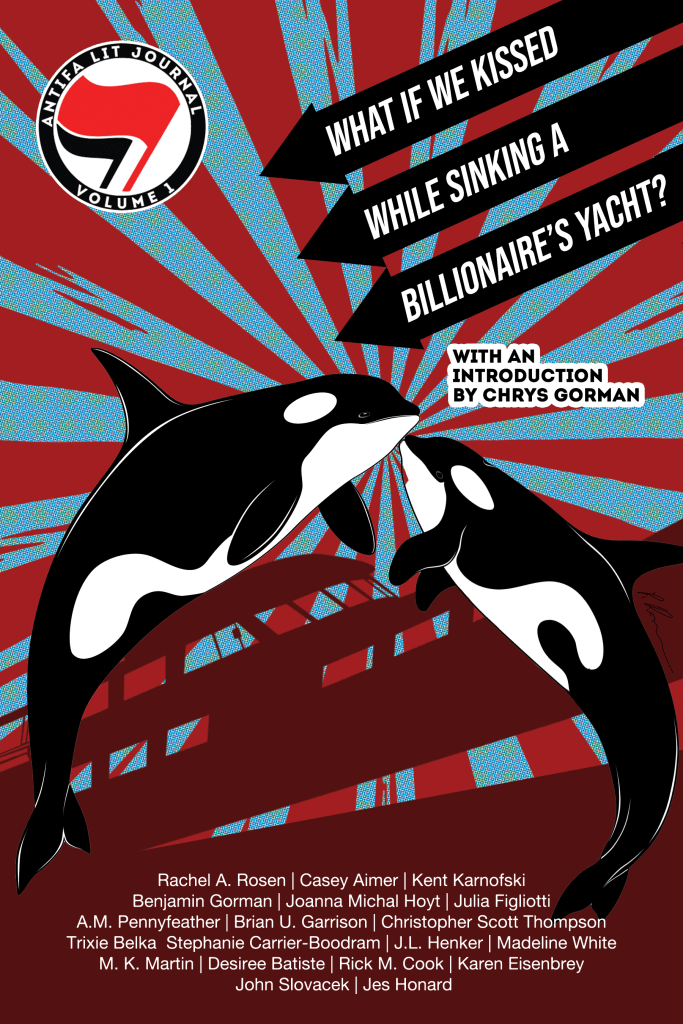
Antifa Lit Volume 1: What If We Kissed While Sinking a Billionaire's Yacht? with an introduction by Chris Gorman. The logo has the red and black antifa flags with the text around a circle. There's a starburst in red and blue. A silhouette of a yacht is going down in the background, with two orcas leaping up in the foreground. There's a long list of authors.

Rachel: With us today is Benjamin Gorman, editor and contributor to the Antifa Lit Journal, which, if I do say so myself, is a rad book. Tell us a little about the anthology, Ben! What is it, and how did it come together?

Ben: We had decided as a family that we would need to leave the US if Trump won the election, so between Election Day and Inauguration Day, we liquidated our possessions and Chrys (who wrote the introduction to Volume 1), our kid Franke, our three dogs, and our two cats relocated to Spain. In the midst of all the insanity of the move, I processed it by writing an explanation that started as a draft of a Facebook post, then a longer blog post, and became a whole book, Dear America: A Breakup Letter. It was published by Not a Pipe Publishing just as we were safely across the border, and it did surprisingly well. A lot of people were in the same headspace, though I understand not everyone can leave the country. Watching all that interest in the book while we were absorbing the daily nightmare of American news, Chrys suggested publishing an anthology of anti-fascist poetry and short fiction. Not a Pipe has published themed anthologies before, like Written with Pride, the all-LGBTQIA+ anthology, and Strongly Worded Women, by exclusively women authors. The response from authors and poets was overwhelming. So many talented writers were desperate to have a venue to speak out against fascism, to process their fear, and to provide readers with an alternate vision of the future. As we poured over all the submissions, we realized we could easily populate a regular journal with high quality short fiction and poetry. So the anthology became Volume 1. And our intention is to keep it going as long as there’s an appetite for it. I don’t foresee this regime going away nearly as quickly as some people expect, and I think we’ll see increases in fascism, especially in terms of would-be-autocrats leveraging anti-immigrant sentiment, all over the wealthy world as the people from countries we’ve made uninhabitable through our climate colonialism decide to move to the places where they can still live above water and below 130° F/ 55° C. There will be very real consequences in terms of housing, supply chains, etc., and I fear that instead of trying to be welcoming, a lot of countries will turn to demagogues. We’ll need people of conscience to speak out, and writers often fill that role. 

Continue reading

Behind the Screens: Tuesday Author Interview

Every Tuesday, get to know a bit about the stories behind the books you love, and discover your next favourite novel.

The book The rise and fall of rhythm and rhymes sitting on a table at a bookstore.

Zilla: Poetry is a delight for all ages—Yewande Akinse has written some for children. Today, Yewande is here to talk about it!

Yewande: I am excited to introduce my latest poetry collection, The Rise and Fall of Rhymes and Rhythms. This book is a heartfelt exploration of life’s essential lessons, crafted specifically for children. Comprising 100 poems, it aims to engage young readers through playful language and vivid imagery, while imparting valuable insights on themes such as kindness, resilience, curiosity, and self-discovery. Written in the structured form of dizains, each poem is designed to be both rhythmic and memorable, making it accessible and enjoyable for children. The collection reflects my deep love for my daughter, serving as a guide to help her navigate the complexities of growing up. The Rise and Fall of Rhymes and Rhythms is not just a collection of poems; it is an invitation for children to explore their emotions and the world around them. I hope that through these verses, readers will find inspiration, joy, and a sense of connection to the lessons that shape their lives.

Zilla: You write about birth and death. Do you see this as a linear passage or as a cycle?

Yewande: I  see the themes of birth and death not as a linear passage but as a profound cycle. This cyclical perspective reflects the interconnectedness of life, where each ending gives way to new beginnings. Birth represents not only the physical arrival of life but also the emergence of ideas, experiences, and transformations. Similarly, death is not merely an end; it signifies a transition, a release that allows for renewal and growth. In my poetry, I explore this cycle by highlighting the beauty and complexity of both birth and death, emphasizing how they coexist and inform one another. This perspective encourages readers to embrace the full spectrum of existence, recognizing that every moment of joy and sorrow contributes to the richness of the human experience. Ultimately, viewing life as a cycle fosters a deeper understanding of resilience, continuity, and the enduring nature of love and memory.

Zilla: What do you want to teach people through your poetry?

Yewande: Through my poetry, I aim to teach people about the beauty of resilience, the importance of empathy, and the power of self-discovery. I want to encourage readers to embrace their emotions, whether they are joyful or painful, and to recognize that each experience contributes to their growth and understanding of the world. I also seek to illuminate the richness of cultural heritage and identity, fostering a sense of pride and connection among individuals from diverse backgrounds. By exploring themes of belonging and community, I hope to inspire readers to appreciate the shared human experience and the stories that unite us. Ultimately, I want my poetry to serve as a catalyst for reflection and dialogue, prompting readers to consider their own journeys and the impact they can have on others. Through my work, I aspire to create a space where individuals feel seen, heard, and empowered to express their own truths.

Zilla: Your poems are about community. What communities nutured you during your life?

Yewande: Throughout my life, I have been nurtured by several communities that have profoundly shaped my identity and creative voice. First and foremost, my family has been a foundational community, providing unwavering support and encouragement for my artistic pursuits. Their love and values instilled in me a deep appreciation for storytelling and cultural heritage. Additionally, the literary community has played a significant role in my development as a poet. Engaging with fellow writers, attending workshops, and participating in readings have allowed me to share my work, receive feedback, and learn from diverse perspectives. This sense of camaraderie and collaboration has enriched my understanding of poetry and its potential to connect people. These nurturing communities have collectively shaped my journey as a poet, providing the support, inspiration, and context necessary for my growth and creative expression.

Zilla: Thanks for sharing your story and your process. We’re looking forward to reading! Where can the Night Beats community find you and your book?

Yewande: My books are in bookstores and online on Amazon and Google books. My books can primarily be found on my website. I am on social media @adwande on Facebook, X and Instagram.

Behind the Screens: Tuesday Author Interview

Every Tuesday, get to know a bit about the stories behind the books you love, and discover your next favourite novel.

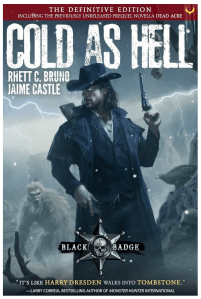
Black Badge Trilogy book 1 Cold as Hell cover. A Sheriff type fights ice monsters.

Zilla: Jaime Castle is here with a horror full of demons and angels. Jamie—can you introduce your book to us?

Jamie: On the run and out of time…

Everything changed back in Crescent City when Crowley made his choice to stand up to his angelic handler Shargrafein. It was either her or Rosa, and the choice was clear. Now, there’s no going back.

Something about Rosa has everyone scrambling—a hidden power. It’s up to Crowley to bring her back to land of the living, and discover exactly what she is. Only then might they have a chance against the forces of Heaven and Hell, both of whom want her for their own devices.

So what if that makes him a traitor to the White Throne? They kept the truth about her from him. Made him a pawn in their endless war.

But those above and below aren’t the only ones after Crowley and Rosa. An old rival has resurfaced and he’s out for vengeance, no matter what takes.

If they hope to evade capture, Crowley will need to trust old friends and allies. And trust doesn’t come easy to a man shot to death by his own boss.

Zilla: What inspired you to write this book?

Jamie: I’ve always been a fan of westerns, and I believe that’s true for most people, even if they don’t know it. In the science fiction and fantasy community, shows like Firefly, Mandalorian, West World, and The Witcher are huge—and they are all forms of westerns. Sure, they don’t all have cowboys with pistols, but the concept remains the same: a sole individual rides into town, beats the hell out of injustice, and rides off into the sunset. For me, what could be better than smashing together a true western with the fantastical elements you might find in a Harry Dresden novel?

Zilla: How much research did you need to do for your book?

Jamie: Black Badge, the series, required a ton of research and a historian on hand. We wanted these books to feel authentic to the era in all possible ways. We researched guns, ammo, city maps from the time period, technology, and did all we could to incorporate those things into the story in a believable way.

Zilla: Is your work more plot-driven or character-driven?

Jamie: My books, including those I write with Rhett Bruno, are heavily character-driven. I believe a plot can only take someone so far if the character feels like cardboard. Meanwhile, I’ll read a book about nothing if the character is someone I can get behind.

Zilla: What’s your next writing project?

Jamie: I’m currently working on book two of a literary role playing game novel. Book one, An Unexpected Hero, is out and if you enjoy comedic fantasy with heart, it’s for you.

Zilla: Thanks for sharing your story and your process. We’re looking forward to reading! Where can the Night Beats community find you and your book?
Jamie: You can find my books at www.jaimecastle.com. Additionally, we own aethonbooks.com. You can find me anywhere on socials at Jaime Castle.

Book Report Corner

by Zilla Novikov

Transmentation—Transience: Or, an Accession to the People's Council for Nine Thousand Worlds cover with a spinning transition between universes

Transmentation—Transience: Or, an Accession to the People’s Council for Nine Thousand Worlds is Darkly Lem’s richly woven tapestry of a science fiction novel asks us who we are, deeper than the flesh and memories that imprison us, and if we can ever escape the societies that we belong to. Characters jump from universe to universe, from shell to shell, seeking to hold on to core identity that they’re not always confident exists. In lieu of the certainty of self, they lean on that of belonging to something greater than themselves–even when their society betrays them, they cling tightly to this sense of meaning in their lives. As someone who suffers from mental illness, I found the themes of identity fascinating.

And as a fan of expansive, thrilling science fiction, I was equally drawn in. There were universes of political scheming to match the White Tower, and others of fighting bug-eyed monsters with stolen swords. There was love, or friendship, or some ambiguous tangle that’s both and neither, lost beneath ambition. Each fantastical world is as richly detailed as the characters that inhabit it, and they’re combined to tell a captivating, satisfying tale.

Behind the Screens: Tuesday Author Interview

Every Tuesday, get to know a bit about the stories behind the books you love, and discover your next favourite novel.

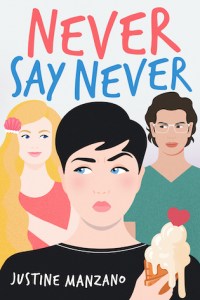
Cover of Never Say Never with 3 teens, one of them holding an ice cream

Zilla: I fell in love with Justine Manzano’s books when I first read her YA fantasy romance Never Say Never. When I got the chance to interview her about her works, I jumped at it! Justine, can you tell us a bit about your books?

Justine: I’m the author of four YA Fantasy novels. I have an action/adventure series, Keys & Guardians, about a teenager entering a corrupt monster-hunting organization and fighting to overthrow it from the inside. I also have a standalone romantic comedy, Never Say Never, which is about a girl who, after the divorce of her parents, declares she’ll never fall in love. But Aphrodite, disguised as her human teenager friend, sees that as a challenge.

Zilla: What inspired you to write these books?

Justine: Never Say Never was inspired by being a child of divorce, but not just any divorce. I was a kid who grew up knowing my parents didn’t belong together and would be better off without each other. But I’d never read a book about a family like mine. So I wrote one.

For Keys & Guardians, the series was about the abuse of absolute power in its many dynamics. I grew up in an abusive household, and there’s the exploration of neglect, and child abuse, abuse of power in society, in politics…I wanted to explore all of the ways I felt helpless in my life…and then I wanted to craft a character who would stand up against that. In many ways, the main character, Jacklyn, was my hero too.

Zilla: I can see how characters play an important role in your stories—is there a character in fiction that’s been important to you during your life? 

Justine: Batman is my special interest. I love the idea of a hero who chose to protect people. He doesn’t have any special abilities to protect him. Everything about him he chose to hone and to dedicate toward the people of Gotham. He’s a hero built from the strength of his brain more than anything else and I love that.

Zilla: You’ve got so many stories inside you—what’s your next writing project?

Justine: I currently have two writing projects in progress. The first is a short story collection that takes place in the Keys & Guardians series. I’m unsure about the title currently. I’m still sorting that out, but it’s in edits. I believe it will be called Tales of the Dawn.

The other project I’m working on is a new book called Reality Check. It’s a YA Contemporary novel. Leah Marinello deals with an abusive life by throwing herself into imaginary worlds—but when her school theater club offers her an actual escape, she discovers her imaginary friend might not be so imaginary—and he doesn’t really want to let go.

Zilla: Thanks for sharing your story and your process. We’re looking forward to reading! Where can the Night Beats community find you and your book?

Justine: My books are available anywhere books are sold. My website is justinemanzano.com, and you can find me on social media as @justine_manzano on Instagram and Threads, @justine_manzano1229 on TikTok, and as @justinemanzano.bsky.social on Blue Sky.

Behind the Screens: Tuesday Author Interview

Every Tuesday, get to know a bit about the stories behind the books you love, and discover your next favourite novel.

Cover of The Band with a broken guitar on the front.

Zilla: Emotions run high at music shows, and anything can happen—which makes a touring band the perfect setting for David Kummer’s horror novel The Band. David, it’s great to have you back! Can you tell us about your latest book?

David: While my last two bestselling novels were part of a series, my newest book, The Band, is a new and exciting novel about a cover band touring in Appalachia. The novel is from one character’s point of view, Aidan, who follows the band as their sound guy. He’s in love with Kate, the lead singer, and when they all stay in Oakville for a week, they run into sinister and mysterious danger. To make matters worse, they brought their own with them.

Zilla: What inspired you to write this book?

David: I got the initial inspiration for this book after my wife and I took a trip to West Virginia. We explored the New River Gorge and one of the small towns nearby. This adventure and these places inspired me to write this story with a touring cover band and all the secret, dangerous history they carry with them.

Zilla: Aidan, Kate, and Johnny each sound like fascinating characters. If you could meet them, what would you say to them?

David: I would love to meet the characters, because they’re one of the best cover bands anyone has ever seen. I love concerts, and it would be a lot of fun. I’d probably just ask them about the tour. And how they’re still alive!

Zilla: And what would they ask you?

David: Probably, “Why did you try to kill us off?”

Zilla: Hah! So would you say that your books are character-driven stories, then?

David: My books are driven by both plot and characters. While tons of crazy stuff happens in The Band with a thrilling and unpredictable plot, the characters are the best part, and they’ll likely stick with you. I always wanted to focus on my writing style for this book and try to mimic some of my favorite authors who write such beautiful prose, especially Denis Johnson and other minimalist authors like him.

Zilla: What’s your next writing project?

David: My next writing project is to finish The House on the Hill trilogy! The first two novels have been bestsellers, and I’m super excited to finish working on The Empty Room, coming this October.

Zilla: Thanks for sharing your story and your process. We’re looking forward to reading! Where can the Night Beats community find you and your book?

David: I’ve got a blog where I review lots of horror movies (and other types), as well as active social media pages on Facebook and Twitter. You can find me at davidkummer.com or check out my books on Amazon or Goodreads.

Wrong Genre Covers

The Parable of the Sower as a quirky childhood introvert comedy was suggested by @DrWhippersnap. Have a funny idea for a Wrong Genre Cover? Email us at nightbeatseu@gmail.com, and if Rachel likes your suggestion, she’ll make it in a future issue. Or @ us on basically any of the socials.
It's Parable of the Sower by Octavia E. Butler in the style of an old school Harriet the Spy paperback. Lauren, a young Black woman in a hoodie, examines a piece of paper by a fence while behind the fence, the city is on fire.

Behind the Screens: Tuesday Author Interview

Every Tuesday, get to know a bit about the stories behind the books you love, and discover your next favourite novel.

Nine to One cover with symbols of men and women in pink and blue text

Zilla: Science fiction exists to show us an alternative future—and sometimes, an alternative past. That’s what we get in Peter Fatouros’ novel, Nine to One: A New Generation. Peter, can you introduce us to your book?

Peter: Nine to One: A New Generation is a story that takes place in an alternate universe where starting in 1965, the birth ratios changed so that instead of boys & girls being born in essentially equal numbers, from that point on, nine girls were born to every boy. The book follows several characters as they navigate their lives in a world that’s struggling to adjust not only to the changes of the 60s, 70s & 80s, but also the fact that the new generation is 90% female.

Zilla: What inspired you to write this book?

Peter: It started before the pandemic when I was riding the bus home from work. One day, I noticed that even though the bus was packed like a sardine can, there were only two or three guys on the bus. I ignored it at first, just a funny thing to notice. But then it kept happening, every night, five days a week. No matter what time I took the bus, it was the same thing, a bus load of women with a handful of men. I started wondering what was going on. That led to me imagining if the whole world were like this & what that would be like. That then led to me wondering how such a world might have come about. Before I knew it, the ideas for a book were coming to me.

Zilla: What a neat beginning! From there, did you do a lot of research?

Peter: A good bit. I spent a good deal of time looking up historical figures, election results, and government agencies that don’t exist anymore. Towards the end of the book & into the sequel that I’m writing, historical accuracy isn’t as important as things have changed wildly. However, at the beginning, a number of things happening in history would still be happening in the book, even with a change as wild as this book’s premise. So I wanted the beginning of the book at least to be as historically accurate as I could get it.

Zilla: Is your work more plot driven or character driven?

Peter: Character driven. There are a few subplots here and there, but it’s mostly a story about these characters and the world that they are living in. A look into how they’re changing themselves, trying to change society, or just growing up in a situation unlike anything that the world has seen before.

Zilla: What’s your next writing project?

Peter: The sequel to this book, which will pick up where it left off in 1985 and continue the story. I’m also working on a science fiction podcast called What Could Have Been.

Zilla: Thanks for sharing your story and your process. We’re looking forward to reading! Where can the Night Beats community find you and your book?

Peter: I can be found on Bluesky, Instagram, Threads, and Tik Tok. My Book can be found as an Amazon eBook, Amazon Paperback, or read about it on Goodreads.

Behind the Screens: Tuesday Author Interview

Every Tuesday, get to know a bit about the stories behind the books you love, and discover your next favourite novel.

The cover of Transmentation | Transience with worlds spirilling together.

Zilla: Transmentation | Transience is a novel of a science fiction multiverse that blew me away with the rich characters and deep worldbuilding. Its creators are collectively known as ‘Darkly Lem,’ a five-author collaboration consisting of Josh Eure, Craig Lincoln, Ben Murphy, Cadwell Turnbull and M. Darusha Wehm, who make up part of the larger writing collective Many Worlds. Being a huge fan of writing collectives in general and Darkly Lem in particular, I was delighted that they agreed to join us for an interview. Before we get into my questions, can you tell us a bit about the book?

Darkly Lem: Transmentation | Transience is the first book of the Formation Saga, a novel trilogy set within the Many Worlds shared multiverse. The trilogy is an introduction to the much larger Many Worlds narrative universe, which already consists of short stories by numerous authors, which can be found on the Many Worlds website and in the Many Worlds print anthology.

The publisher’s blurb for Transmentation | Transience is:

Over thousands of years and thousands of worlds, universe-spanning societies of interdimensional travelers have arisen. Some seek to make the multiverse a better place, some seek power and glory, others knowledge, while still others simply want to write their own tale across the cosmos.

When a routine training mission goes very wrong, two competing societies are thrust into an unwanted confrontation. As intelligence officer Malculm Kilkeneade receives the blame within Burel Hird, Roamers of Tala Beinir and Shara find themselves inadvertently swept up in an assassination plot.

Meanwhile, factions within Burel Hird are vying for greater control over their society in a war of cutthroat machinations–at a heavy price. Elsewhere, two members of rival societies lay their own plans for insurrection–with ramifications that will ripple across the Many Worlds …

Zilla: I was fascinated by the mode of travel between dimensions, where characters inhabit different bodies. I’ve often thought about the distinction between my “self” that is my identity and the chemical and physical “self” that is my meat prison. I come at it from the perspective of mental illness, but I’ve often had these conversations with disabled and trans friends. As authors of these characters, and as humans in your own right, how do you grapple with this duality?

Cadwell: I think this has been a big question for us, and something we’ve only cracked the surface of. In our stories and within the Formation Saga we’ve explored the cognitive dissonance of entering bodies that don’t quite match the traveler’s sense of self. Often the differences are more superficial: muscle mass, hair and eye color, height. But these differences can also be fundamental: ethnicity, gender, orientation, formative memory, even personality. We’ve done a lot with memory and personality, but there’s still so much we can explore with other aspects of identity. That sort of exploration can be tricky, so we’ve been very careful so far. But as the project progresses, we’ll be looking for more opportunities to push our boundaries.

Darusha: If I had to choose my single favourite part of the Many Worlds narrative, this is it. I’m obsessed with questions of individuality, authenticity, selfhood and how those intersect with embodiment and time. I feel like there is no one answer, not in our reality or in the reality of the Many Worlds multiverse, but it is in asking the questions and interrogating our experiences we can come close to glimpsing a grimy reflection of the truth.

Craig: I find the implications of traveling meaning you’re exposed to new environmental and chemical stimuli, from the world you enter as well as the new tailor-made body for you to inhabit, to be exciting and worth exploring. Part of my personal experience with this is also related to my son’s journey with ADHD, and how different medications vastly altered his demeanor until we honed in on one that worked for him. I imagine similar things can and will happen to people who get new bodies, whether it be subtle or overt and obvious.

Zilla: Your world building is stunning, with multiple distinct societies that cross dimensions, and each flavoured subtly differently depending on the universe where we encounter them. But one commonality is that most (maybe all) of your characters are compelled by a desire to belong to one of them—to be part of a society that’s bigger than themselves. Are all people susceptible to this? Would it be better if these characters could escape it?

Ben: I think this is partly a product of simply being the first book in a series, so we’re keeping the difficulty (relatively) low. As such, things like unaffiliated travelers or “city-state localities” just haven’t shown up yet–but they’re certainly out there! At the same time, you’re pointing to a topic that we explore with greater depth in subsequent books; these characters exist within the context and the schema of the “society,” and they don’t necessarily see all that many viable alternatives to it. In much the same way that the nation-state feels like a rather inescapable paradigm to many of us in our own earth-type locality, the society is likewise (seemingly) pervasive as the default unit to organize people in the multiverse.

That’s not to say it’s a rational way to organize people, any more than the nation-state necessarily is, but it’s hard for some of our characters to conceive other ways of being. Whether we’re all susceptible to that pressure I couldn’t say. As one of your previous questions suggests, it’s worth asking how much of our identities are a product of the chemical cocktail percolating in whichever meat-mech we’re piloting at a given moment, and whether such considerations are even meaningful. But I do hope some of our characters can find a place they’re happy–whether it’s within a society or without.

Craig: Some of our travelers’ societal memberships come about not so much from desire as it is that these societies are monolithic presences within the localities people travel to, so you have to interact with them frequently if you travel. Of course there are also plenty of true believers.

Josh: We do have a character in the Formation Saga who does not initially belong to any given society, but you’ll have to wait to read about them.

Zilla: I look forward to it! Looking at reviews of this book, one common element is readers commenting on how, despite 5 authors contributing, the story read as a seamless whole. I completely agree. What process did you use that resulted in a novel with such coherent plot, characters, and world building?

Cadwell: I’m curious what others of us might list here, but I think the big thing we did to create a consistent voice was simply spending a lot of time talking with each other. We planned the series together, outlined together, edited together, and (especially in the beginning) wrote sections of the novel together on a singular Google document. That process was as chaotic as it sounds. But because we were motivated by the same/similar goal, we played off each other really well. When we didn’t align, we debated, talked it out. Sometimes that process was challenging, but almost always it resulted in a more synchronized view of what the story and characters needed.

Ben: What Cadwell said. We’re conditioned to think of writers as lone, towering geniuses, but there’s no reason the process of writing can’t be as collaborative as making music. It’s just a very, very, very slow form of improvisation.

Craig: Slow improv is a great way to put it! I’d say our process also evolved from lessons learned, and we weren’t afraid to change things when things didn’t work as well as we hoped.

I also feel like having an odd number was a real boon for us. Debating some things can take a long time, and if we’re under time pressures we can simply take a vote on it. Ultimately, though, we try to satisfy everyone’s concerns as much as possible, even if someone gets out-voted.

Josh: The band analogy is the most accurate for sure. We also evolved the process over the years to the point where we give each other grace re: writing tendencies which aren’t singularly our own. One of us may tend to write with more or less commas, for example. Or one of us uses character interiority while another tends to drill down into setting detail. We let the fullness of our writing selves bloom—creating a new self, I suppose.

Darusha: Oh, commas! How many hours have we lost to commas? The other thing no one has mentioned yet is that we all touch every word. It’s a demanding process but by the end of it there’s no part of the book that hasn’t been informed by each of us, creating what is ultimately a unique voice: Darkly Lem.

Zilla: Where can people find the book? And where can they find y’all on the internet?

Darkly Lem: Links to most stores are here and you can find Darkly on our website here. We post very sporadically on BlueSky.