Behind the Screens: Tuesday Author Interview

Every Tuesday, get to know a bit about the stories behind the books you love, and discover your next favourite novel.

Cover of Reckoning

Sabitha: Nick Wilford’s here to tell us about Reckoning, the last book in the Black & White trilogy. Nick, take it away!

Nick: Reckoning is the last part of a YA dystopian trilogy entitled Black & White. The series explores two nations, Harmonia and Loretania, one of which is spotlessly clean while the other is full of dirt and disease. At the beginning of the series, the residents of each country are unaware of the other, until my protagonist Welles makes a discovery that unravels the secrets the government of Harmonia has been keeping. Through various twists and turns, in this last part we find the members of that government on trial for what amounts to genocide.

Sabitha: How did you choose the title?

Nick: I don’t really choose titles, they normally suggest themselves at a certain point – usually after the first draft is finished! This was definitely one of those cases. Reckoning suggested itself and was a natural fit for the story, so it stuck. It comes up in the work of Terry Pratchett, my favourite author quite a bit, in the phrase “There will be a reckoning” – in other words, a judgement, someone is going to get what’s coming to them. It’s got a great sense of foreboding to it, and obviously it suited the narrative of the courtroom and the former government being on trial.

Sabitha: You have good taste in favourite authors! What was your favourite thing to write in the book?

Nick: I enjoyed what happens to my main character, Welles, in this book. It’s the last part of the trilogy, and for most of the series he’s been this beacon of goodness, standing up for what’s right and striving to change things. Without wanting to give away spoilers, in this last part he becomes compromised, through no fault of his own, and goes off to the wrong side, which really jeopardizes what his partner, Ez, is trying to accomplish. I wasn’t sure whether or how I was going to bring him back, and I really enjoyed that sense of peril, things going wrong, which creates the stakes and tension in the story. I’m like a lot of writers. For some reason, we like being sadistic and putting our characters through hell!

Sabitha: What advice would you give to someone who’s writing or querying?

Nick: Can I tackle both? It’s really important to keep them separate. When you’re writing, you should try not to think about querying or about how someone else might receive it. That can be hard to do, but when you’re drafting you need to think of it as telling the story to yourself first. Without outside pressure, you’ll enjoy it a lot more, it will be more authentic, and that will hopefully translate to the reader. If you start thinking about what someone else will think, or about trying to write to trends, it’s a sure way to cripple your creativity and momentum. When it comes to querying, the most important thing to do is keep busy with something new rather than obsessing over responses, which is easier said than done!

Sabitha: Thanks for sharing your story and your process. We’re looking forward to reading! Where can the Night Beats community find you and your book?

Nick: Reckoning is available for preorder here and links to my socials can be found here.

A Favour

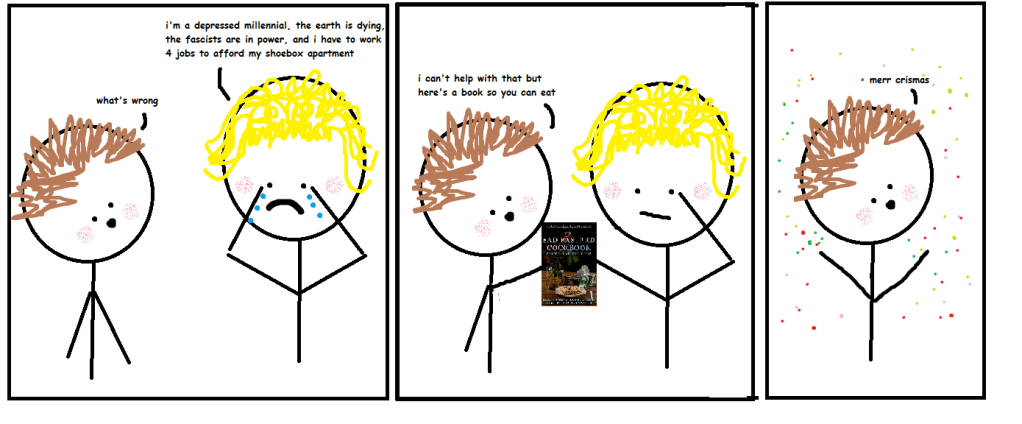
We poured out heart into writing The Sad Bastard Cookbook, and we’ve been amazed by the reaction. It’s touching people—reminding them that doing your best is enough, that it’s okay to have bad days, and that you can make something tasty out of things you forgot were in the back of the freezer.

A picture of the Sad Bastard Cookbook cover, covered in mess. It says Coming Soon.

We want to share this cookbook as widely as possible, and it seems like a lot of you want to help, so everyone who could benefit from it can find it. You can help us make The Sad Bastard Cookbook a success.

Work with us to game the book-recommendation algorithms so more people see the cookbook in their suggested “To Read” books. Right now, mark it on Goodreads or Storygraph as “Want to Read”. Once we publish, get your copy (free e-book here). When you’ve read it, leave us a review. The algorithms rate reviews higher than anything else, so saying what you honestly thought of the book is incredibly valuable to us—and to other readers. It’s one of the best things you can do to promote our work.

Thanks.

Behind the Screens: Tuesday Author Interview

Every Tuesday, get to know a bit about the stories behind the books you love, and discover your next favourite novel.

The Phantom of Nob Hill Theater cover

Sabitha: We have John Luke Maxwell on the blog, with an absolutely delightful novel, Jean Locke Holmes: Pornstar Detective — The Phantom of Nob Hill Theater. John, tell us a bit about your book please!

John: For Rafael, the hits keep coming—losing his job, quarantine lockdown, bills piling up, and now…dumped by his boyfriend.

When a bad day seems only destined to get worse, something finally goes right. Retired porn legend Jean Locke Holmes stops by the used bookstore where Rafael managed to pick up a few hours. This is a man Rafael idolizes and has had many dirty fantasies about. Shockingly, Holmes seems to take a liking to Rafael. Sparks soon fly between the two men.

But sparks also fly on stage. During a charity performance featuring Locke at the recently-closed Nob Hill Theatre, a set of lights comes crashing down—and it’s clear this was no accident. Someone is out to murder porn stars.

But Holmes is a man of surprises. With his keen eyes and a knack for spotting details others miss, he soon leads Rafael hot on the trail of clues in a deadly chase. But will they catch the murderer before the murderer catches them?

Sabitha: This book sounds like such a fun combination of things. What inspired you to write it?

John: I’ve been a fan of mysteries for almost as long as I have been alive. My favorite cartoon show as a toddler was Scooby-Doo! lol I wanted to be a mystery writer for years and finally took the plunge.

Sabitha: We have a lot of writers in our community. What’s your writing process?

Jonathan: Usually, I plan a lot before I ever get started writing. I can never write just one book. An idea grows into several before very long so I lay out the overall plot before I get down to business. I also like to have a couple of book titles worked out because they help serve as a kind of memory road map. Even then, though, a lot about a book and the series as a whole can change while I’m writing it. I’ve learned to expect the unexpected.

Sabitha: How did you choose the title?

John: I wanted the “detective” character to have a career that no one would take seriously. And I had tossed around the idea of a porn star who stumbles upon a murder mystery plot. The Nob Hill Theater has a lot of history to it in the queer community. That influenced the setting and title as well. Plus, a lot of us like a good ghost story. 😉

Sabitha: Yes we do! When you picture your ideal reader, what are they like?

John: I hope that people enjoy a bit of fun with their mystery like I do, and they have fun following along with a mystery story as well.  🙂

Sabitha: Thanks for sharing your story and your process. We’re looking forward to reading! Where can the Night Beats community find you and your book?

John: You can find my book on Amazon. I’m on Twitter and Smashwords.

Book Report Corner

by Zilla N.

A picture of a city that says Night Beats

We’re reviewing The Ghost in the Vending Machine, by Saevelle

Have you ever wondered what it’s like for authors when they read fanfiction of their work? When someone takes a thought they had and turns it into something bigger and brighter, a living, breathing story? The answer is: overjoyed.

Saevelle writes Night Beats stories. Not just stories with Night Beats in them—she writes paranormal investigations starring Lilith the vampire medical examiner, Jane the werewolf cop, and Jordan, the boring human cop. If that wasn’t fantastic enough, Ghost in the Vending Machine gives us both sides of the story. Not only do we see the investigation of Trix’s murder on the show, we also see the actors, stunt doubles and special effects creators as they create the magic, and as they live their own lives with their own dramas.

Both sides of the story are perfect. Saevelle brings all my favorite moments to life (or at least to undeath), from Brent the ghost making bad puns to the political implications of cryptids taking refuge in your city. I found myself invested in the murder mystery, not just seeing it as a plot device. And the actors’ stories are equally delightful. There’s an ongoing gag with Ao3 and rabbits that had me cackling with laughter, and a truly heartfelt romance between Fynn the enby deathly make-up artist and Derrick the presumed-straight stunt double.

This story is a must-read for Night Beats fans, and also anyone who likes the paranormal, investigation, humour, and romance, not always in that order. You can read it for free on Wattpad.

Behind the Screens: Tuesday Author Interview

Every Tuesday, get to know a bit about the stories behind the books you love, and discover your next favourite novel.

children of the black cover

Sabitha: Today we have William Long with us, author of the science fiction novel Children of the Black. William, can you start us off by giving a summary of your book?

William: Children of the Black is a fast-paced SciFi/Action thriller set in a universe recovering from a millennia-spanning war between interstellar superpowers. Claude, a former soldier, and Vision, an eleven-year-old orphan with psionic abilities, have been shaped by this conflict and now struggle to keep the lights on in their modest apartment. It is only when shadows offer much-needed credits in exchange for information on a lost superweapon that Claude and Vision begin to realize that some things are more important than money.

Sabitha: What inspired you to write this book?

William: I first wrote this tale in a series of notebooks while I was bored in class. It was an escape that I fell in love with but ultimately placed on the back burner for decades while I tried my hand at filmmaking. But a few years ago, I had a stroke and was forced to come out of work and face several significant changes in my life. That brought me back to my love of writing, and the first story I wanted to revisit in novel form was this one.

Sabitha: If you’re a filmmaker, do you have a “fan-cast” – do you have actors you’d cast as your main characters?

William: I’m not sure I have a full-fan cast involved, but there are some very interesting thoughts I’ve had about the characters and who I want to play them. For Claude, I built him around Harrison Ford circa 1986, but I see Alexander Dreymon (from The Last Kingdom) in that role. With Vision, I think Mckenna Grace would knock it out of the park, and I’ve always seen Aisha Tyler as my villain, Miranda.

Sabitha: How did you choose the title?

William: The original title for the story was Silver, but when I decided to turn it into a novel, I just felt like that title brought to mind images of shirtless men in the moonlight with the eyes of wolves, which is very far from what my story is. So, I decided to name it after humanity’s position in the novel’s universe. They are all children lost in the darkness of space, without parents to guide them or a map to lead them home, hence Children of the Black.

Sabitha:  When you picture your ideal reader, what are they like?

William: As ideal readers go, I wrote the book to appeal to anyone who likes rich characters, detailed worlds, and pulse-quickening set pieces. If I’m honest, I wrote this book with the idea that it might be someone’s first foray into science fiction, whether they have read consistently since childhood or were inspired because they just saw the new Dune film. So, if you’re reading this interview, you are my ideal reader.

Sabitha: That’s a lovely sentiment! What do you most want your readers to take away from reading your book?

William: I wrote this book to be entertaining above all other considerations, but if there’s one thing I’d want anyone to take from my novel, it’s that life is messy. It’s brutal, and it’s hard. There’s far more gray than either black or white. Navigating through it changes us all, but that’s not necessarily a bad thing.

Sabitha: Thanks for sharing your story and your process. We’re looking forward to reading! Where can the Night Beats community find you and your book?
William: You can find my book here, or on Amazon. I’m on Twitter and Instagram.

Red Kibble paired with Nemesis Games

In which Rachel hijacks Rohan’s Fiction to Sink Your Teeth Into column!

“[Naomi] opted for red kibble from a scarred kiosk with adhesive from generations of nightclub flyers caking its sides. It came in a brown pressed-shred container that fit in her left palm with a plastic spatula like a flattened spoon to eat with. The first bite filled her mouth with cumin and her mind with dust-covered memory. For a moment, she was in her bunk on Tio Kriztec’s ship, huddled over the white ceramic bowl she had loved then and forgotten for years, eating quietly while the others sang in the galley”  (Nemesis Games, Chapter 9)

“The meal was the heavily spiced and deep-fried balls of bean paste that Belters called red kibble “(Persepolis Rising, Chapter 26).

Red kibble is featured prominently in James S.A. Corey’s Expanse series, particularly Nemesis Games and Persepolis Rising, where Naomi Nagata enjoys it in stark contrast to her crewmates on the Rocinante. It’s a dish favoured by the Belters, the downtrodden civilization raised and adapted to living in the asteroid belt between Mars and Jupiter. They frequently must make do with the limited ingredients available, adding interest through spice and texture.


Many Expanse fans have tried their hand at recreating the recipe, which was also featured on the show. I had to give it a try!

Continue reading

Behind the Screens: Tuesday Author Interview

Every Tuesday, get to know a bit about the stories behind the books you love, and discover your next favourite novel.

An Icy Road to a Warm Heart

Sabitha: Today we’ll talk to Nichol DeCastra about her first novel, An Icy Road to a Warm Heart. Nichol, lovely to have you here! Can you introduce us to your book?

Nichol: The first book I ever published is called An Icy Road to a Warm Heart.  The book is about a young woman named Dominique Miller, who is fleeing her abusive ex over the holidays and runs into a trucker, Edgar Himura, who offers to drive her to her family’s house. Along the way, they fall in love. 

Sabitha: What inspired you to write this book?

Nichol: The ending scene of the original Texas Chainsaw Massacre, where the heroine is helped by a trucker, honestly inspired me. 

Sabitha: We have a lot of writers in our community. What’s your writing process?

Nichol: Somewhere between a pantser and plotter. I am mainly the former, but occasionally I will make notes about what I want to happen in the future.

Sabitha: What do you most want your readers to take away from reading your book?

Nichol: That there is hope in escaping an abusive relationship and finding love again.

Sabitha: That’s a lovely message. Thank you for sharing your interview. Where can the Night Beats community find you and your book?

Nichol: You can buy the book on Amazon. You can find me at Twitter, Facebook, Instagram, and my website.

Behind the Screens: Tuesday Author Interview

Every Tuesday, get to know a bit about the stories behind the books you love, and discover your next favourite novel.

Latent State cover

Sabitha: We have Ben Winter with us, author of the cyber-thriller Latent State. Tell us about your book!

Ben: Latent State takes place in the near future of Neo-London where drugs have made Virtual Reality feel like real life and the populace are hopelessly addicted. Within this crumbling cyberpunk dystopia, a couple of junkie brothers stumble on hidden tech that leaves one catatonic and the other, Daryl, suffering from episodes where time comes to a standstill. Now, to save his brother, Daryl must uncover the mystery of what’s happening to him, all the while battling his drug problems and the shadowy forces that are hunting him.

Sabitha: What inspired you to write this book?

Ben: The initial idea for Latent State was quite abstract. At the time I was watching a lot of superhero movies and was getting bored by them. I liked the idea of a main character with special abilities but the normal fantasies seemed too easy. It got me thinking about the downsides. What if someone could stop time? What would it mean? To my mind, it would be incredibly perilous; the air would be frozen and everything would be like stone. Those dangerous scenarios created lots of fascinating plot points, and everything else soon fell into place, including the cyberpunk dystopia, and the characters’ addictions to drugs and technology.

Sabitha: That’s a fascinating concept, and I bet there’s some great worldbuilding in the book. How did you choose the title?

Ben: I wish I’d known the title before starting as finding something that said everything I wanted was a challenge. The goal was for it to evoke the main themes: time manipulation, dystopia, control, and cyberpunk. Perhaps I set my expectations too high! In any case, I recall spending hours pouring over a thesaurus searching for synonyms. Then it finally came to me one night in the moments before sleep. I hastily made a note and couldn’t remember what it was until I checked my phone the following morning.

Sabitha: That is so relatable—finding the perfect title is a huge deal. We have a lot of writers in our community. What’s your writing process?

Ben: I broke every rule when writing Latent State. One of the biggest being I didn’t get feedback until I was more or less done. That was tough and lonely, but after many false starts I learned that unless people know about writing, they tend not to give helpful feedback, and all that does is ruin your motivation. I found the right kind of feedback later and had to change some parts, but I’m still grateful for the focus I achieved writing this way.

Sabitha: What do you most want your readers to take away from reading your book?

Ben: Latent State is set in a dystopia populated with flawed humans, but most of the characters are still hopeful for better and battle against the odds to achieve it. That’s the sort of mentality I think everyone can benefit from; the idea that no matter how bad things are, or how far you are from your goal, there’s always the chance to strive for better.

Sabitha: This book sounds very cool—we’re looking forward to reading! Where can the Night Beats community find you and your book?

Ben: Latent State is out now on Amazon , and you can also sign-up at my website or follow me on Twitter for updates.