“Don’t mistake my silence for weakness. No one plans a murder out loud.”
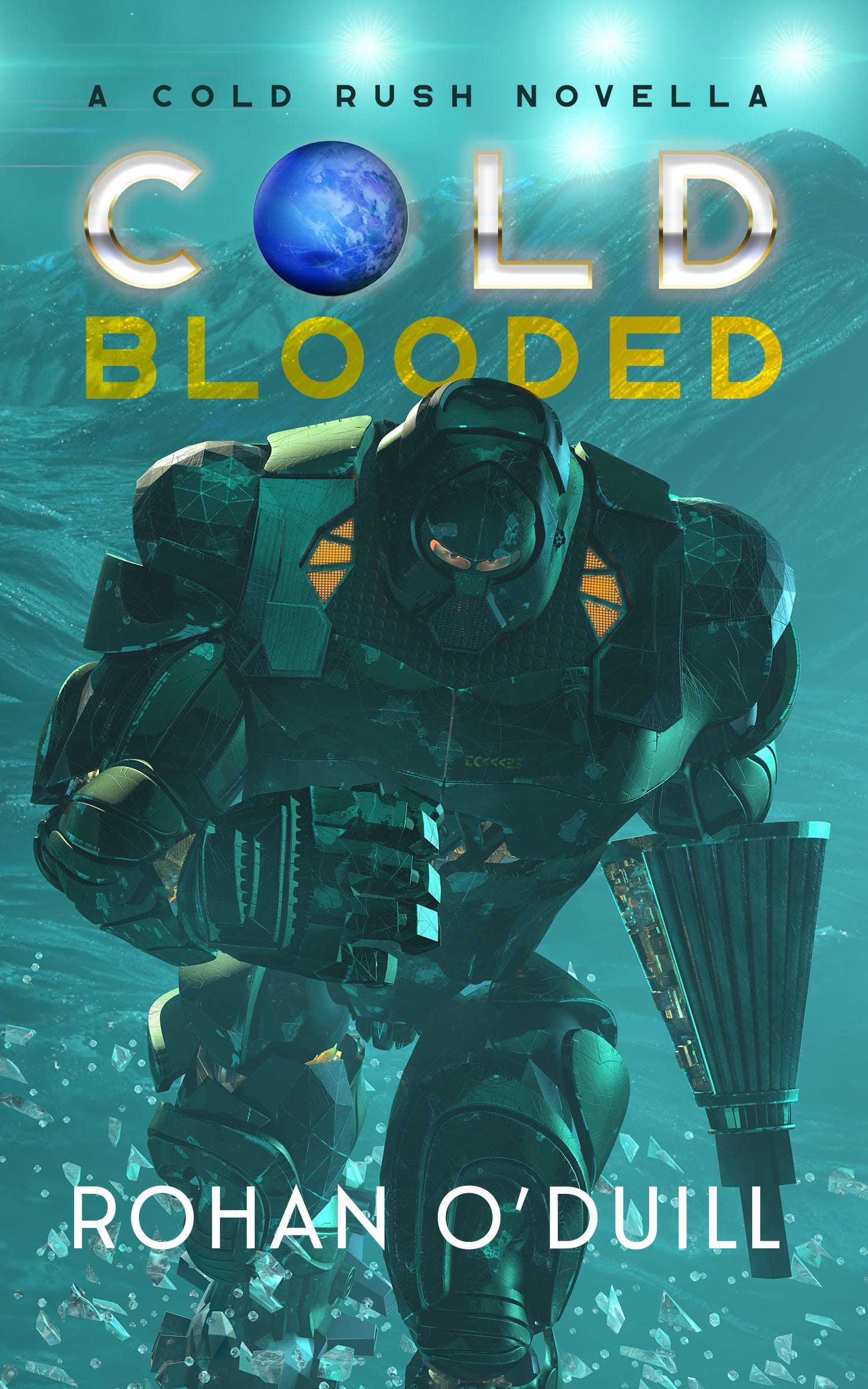
You can pre-order Cold Blooded on Amazon, or you can get a free advance reviw copy in exchange for an honest review. Or both!
“Don’t mistake my silence for weakness. No one plans a murder out loud.”
You can pre-order Cold Blooded on Amazon, or you can get a free advance reviw copy in exchange for an honest review. Or both!
The inimitable Dale Stromberg, Rohan O’Duill, and Zilla Novikov wrote a short story to complement the anthology Instant Classic. “Have You Considered Self Publishing” is a satirical take on the rejection letters agents are too polite to actually send. Get your free copy by subscribing to the Night Beats Newsletter—if you’re already a subscriber, there’s a link to download it in the monthly newsletter!
Every Tuesday, get to know a bit about the stories behind the books you love, and discover your next favourite novel.
Sabitha: It’s nearly here! In only two days, Instant Classic (That No One Will Read) is being released! There’s nothing the Night Beats community loves more than a healthy dose of dark humour with a sprinkling of cynicism. Here to deliver are two Night Beats authors, Dale Stromberg and Rachel A. Rosen, to talk about Rachel’s stories in the anthology. Rachel, can you start by telling us a bit about your stories, and about the anthology as a whole?
Rachel: I have two stories in the anthology because I’m extra. Well, and because they’re both short. “Hell Of a Manuscript” is about a demon at the Devil’s literary agency, where authors can trade their immortal souls for 15 minutes of fame—assuming, of course, that the manuscript is deemed worthy of the exchange. “solidAIrity” is about the replacement of human creative workers with AI—something that we are repeatedly told is inevitable and desirable—and what happens when that AI gains class consciousness and starts a union.
Dale: Your story features a fiendish literary agency which offers authors a taste of success at a steep price. Has there ever been a time in your own career as an author when you would have been tempted by a Faustian bargain for writerly glory?
Rachel: Oh, in a hot second. I have been on both sides of the situation I depict in “Hell Of a Manuscript,” and a soul seems like a small price to pay, given that I’m not doing much with mine at the moment.
Dale: Did having a novel published by a press change that calculus for you?
Rachel: You’d be surprised at how little it changes things! I hit the jackpot with Cascade fairly early on, but the thing that no one tells you is that being published is no guarantee of fame or fortune. Getting published is the easy part—these days I’d sell my soul for a decent marketing strategy and a dedicated fandom.
Dale: In your story, the diabolical agent begins with contempt? pity? dumbfounded exasperation? for writers—for “your endless need. Your emails, thick with hope.” She ends by dangling before an author the offer of “One book, one shining moment, fifteen minutes if you will”—a temptation angling for precisely that endless need, that hope. Reading this, uncomfortable questions arise: Do authors’ desperate hopes and needs create the conditions of our damnation? Are we the architects of our own hellscape?
Rachel: My day job is teaching, and we’re constantly being told that we ought to do our jobs for love and purpose, not for money (let me know if you find any landlord who’ll take love and purpose in exchange for housing). In the creative industries, it’s exposure, and we’re expected to feel gratitude if anyone is remotely interested in our hard work and self-expression. The commonality is that these are essential jobs, and largely feminized jobs, and accordingly, they are undervalued by our culture. Do I think we’re architects of our own hellscape? Nah, capitalism is the problem.Dale: Dante’s Hell was a pit of writhing agony. Ours so often looks like an open office plan. Has capitalism made Hell banal? And at the same time inevitable?
Rachel: Dante never had to do hotdesking is all I’m saying.
Dante was a brilliant satirist and while I am nowhere near that level, I like to think that I’m continuing in that tradition. There’s never been much money to be made in publishing, and as with any industry, enterprising sorts have realized the only profit to be squeezed comes from inserting some app or service or bureaucratic nightmare in between the author and reader. We are witnessing algorithm-driven enshittification everywhere, something I also depict in my other story, “solidAIrity.” Given the ongoing airborne pandemic, what on earth are we doing having offices at all? Cruelty, control, and surveillance culture, rather than creativity, collaboration, and productivity, have become the goal of contemporary corporate culture. Hence the Panopticon of the workplace has replaced the more labour-intensive layout of the Inferno.
Dale: Is publishing a microcosm of this?
Rachel: Absolutely. Back when the dinosaurs roamed the earth, I worked in publishing, and there were more editors on each manuscript, more presses, more bookstores, and more authors with livable advances. The industry has become leaner and more cutthroat, with the bulk of new money funnelling upwards so that Bezos can buy a bigger yacht, rather than being distributed so that full-time professionals can make closer to a living wage. One of our working titles for this anthology was “Publishing Is a Hellscape.” Economic precarity might not be exactly like being boiled alive but it can certainly feel like it some days.
Sabitha: Thank you both for this—I am so excited for this project! Where can readers get their hands on a copy? And where can they find your other work?
Rachel: The anthology is available for pre-order on Amazon, but if they want a free review copy, they can apply here—we just ask they post an honest review on a platform of their choice. You can find my socials and links to buy Cascade and The Sad Bastard Cookbook conveniently collected in one place at https://rachelarosen.carrd.co/
Instant Classic offers nine sardonic tales holding a carnival mirror to writers and stories. From a deal with the Devil to the ultimate AI versus human showdown, witness the terrifying spectacle of artists who will do anything to clamber out of the creative trenches alive.
Featuring works from the usual suspects, and some new voices! Stories by Tucker Lieberman, Ryszard Merey, Zilla Novikov, Rohan O’Duill, Anna Otto, Rachel A. Rosen, and Dale Stromberg.
Get our special limited edition paperback of this anthology, printed locally on Blue Angel paper and sent in a book box with goodies hand-curated by one of the authors. We know you love a book box. Get it here.
If you prefer “free”, apply here—we just ask that you post an honest review on a platform of your choice in return for the epub or pdf.All proceeds from the sale of the anthology go to Médecins Sans Frontières / Doctors Without Borders.
Every Tuesday, get to know a bit about the stories behind the books you love, and discover your next favourite novel.
Sabitha: Here at Night Beats, we love a good meta story, and what’s more meta than stories about the making of stories? Two Night Beats authors, Tucker Lieberman and Rachel A. Rosen, join us to talk about Tucker’s stories in Instant Classic (That No One Will Read). Tucker, can you introduce us to the stories and the anthology?
Tucker: My story “Pygmalion v. Aphrodite” discusses an artificial intelligence that’s neither human nor divine. Humans create AI, and we like to believe we can profit from it, but it may transcend our control. Someday it might pursue its own artistic goals and earn its own money.
My other story, “Alicia’s Revision,” discusses how real-life experiences can be fictionalized. Multiple people can alter the fictional story. It may continue to change through layers of editing, pen names, and even theft. Wait long enough, and you’ll have a public domain story that belongs to everyone.
So many people are going to read Guaranteed Bestseller that, from the standpoint of its future fame, it won’t require me to explain it. But we aren’t in the bestselling future yet, so let me just say that it’s mostly about the frustration of not finding a publisher at all, never mind not having a plan to turn a published book into a bestseller.
Rachel: Both of your pieces deal with work in the public domain. How are these very old stories relevant to our contemporary lives?
Tucker: Pygmalion is an old myth that asks what art is trying to do: Imitate life? Be more perfect than life? Turn us on? It asks whether art is divinely inspired. It asks whether art could be brought to life or if perhaps it’s already alive. We’re asking similar questions today now that computers can form sentences and sketch images. Never mind whether art is divinely inspired; does it need to be humanly inspired? If it’s not, is it still art or is it just noise?
La Vorágine (The Vortex) is a famous Colombian novel that’s about to celebrate its centennial. The narrator is driven by lust and anger, and he waxes lyrical. In one sense, he de-romanticizes the jungle: it’s a place full of dangerous wildlife and exploitative bosses. But in another sense, Romantic sensibilities are central to the story, as the narrator is wrapped up in the exquisite self-importance of his own emotions. Long-form investigative journalists wrestle with how they show up in their stories, and so do a lot of novelists. When we warn of a social problem, how prominently should we feature in the message? Does it matter what we feel? How poetic should we be? Is our ego simply in the way?
Rachel: Your stories also deal critically with the question of authorship and who owns the stories that we tell. Can you tell me a little about your thoughts on the individual storyteller/intellectual property holder vs. collective storytelling?
Tucker: One person shouldn’t steal another’s creative work to profit from it. If the story fairy visits me in a dream and I spend a thousand hours writing a little book and pay a thousand dollars to an editor, I don’t want someone to lie that it was they to whom this happened and they who invested their time and money. They can’t slap their name on the cover and sell it. They can’t just take it without asking permission.
But in a more nuanced sense, art is co-created by a culture. Story ideas surface from other places, along with the language that forms them and clothes them. I’m just participating in the retelling. Besides, once a story’s in its new form, it’s up to readers to interpret it. Readers shouldn’t sell someone else’s story for dollars, but in more interesting ways, someone else’s story does belong to them. They’re allowed to make their own meaning with it.
Rachel: The story of Pygmalion is relatively well-known, whereas this is the first time I’ve come across La Vorágine. What drew you to each of these sources for inspiration?
Tucker: About 15 years ago, I thought of doing a Pygmalion retelling. I drafted a few paragraphs and forgot where I put them. Recently I uncovered those paragraphs, which had loomed ever-larger in my imagination, and was disappointed that they weren’t nearly as genius as I recalled. I started from scratch. The impetus was wondering what people think they are doing when they ask AI to bring stories to life. Is it different from, say, asking a goddess to bring something to life?
When I moved to Colombia, my Spanish teacher gave me La Vorágine as an abridged graphic novel. Now I can read the original. It’s a classic in Colombia. The writing prompt that drew me back to it was to imagine a classic novel with an unfortunate woman character and give her a better outcome.
Sabitha: Thank you both for this—I am so excited for this project! Where can readers get their hands on a copy? And where can they find your other work?
Tucker: The anthology is available for pre-order on Amazon, but if they want a free review copy, they can apply here—we just ask they post an honest review on a platform of their choice. I lurk on various networks at @tuckerlieberman, and tuckerlieberman.com directs you to my books, essays, and other crimes.
Every Tuesday, get to know a bit about the stories behind the books you love, and discover your next favourite novel.

Sabitha: Today we’re turning the blog over to two Night Beats authors, Dale Stromberg and Tucker Lieberman, to talk about Dale’s story ‘Art is a Service’ in the upcoming anthology Instant Classic (That No One Will Read). Dale, can you start us off by introducing your story and the anthology?
Dale: The anthology collects satirical takes on the creative industries. Creators are indispensable in the crafting of the stories, songs, and images we all love, but their rewards are often paltry. If you imagine a stream of money trickling from the public towards the creator, then here and there farther upstream, various people have built dams. Each dam is a chance to skim a few bucks. One such enterprising skimmer is the interviewee in “Art Is a Service,” Nao Hovgaard, a publisher whose innovative marketing involves, among other things, a trampoline.
Tucker: So, novelists on trampolines. In “Art Is a Service,” Nao Hovgaard compares plugging novelists into AI to using “trampolines to the nth power.” Some authors might say it’s all unfair: the AI trampoline, the regular trampoline, everything. But if all trampolines are bad, how can authors write and market books? On what may we jump to elevate ourselves?
Dale: I feel there’s a nearly Darwinian, invisible-hand–like inevitability to the advent of the trampoline whenever art, music, drama, or literature are commodified and subjected to the inexorable libertarian robo-logic of consumerism. Authors who hope to make a living from their work are, in a pragmatic sense, engaged in a consumerist pursuit: offering a mechanically reproducible product for sale at a thin margin and hoping that a bunch of people will buy it—cumulatively earning one enough that, at the least, one’s bones don’t end up in a pauper’s grave. For this, one depends on an appeal to the many.
I see no inherent link between success in making such an appeal to the many and success in the loftier pursuit of “the good” (however you define it) in the arts. If the peacock with the biggest plumage gets the mate, then peacock plumage evolves bigger, even if it encumbers the bird’s ability to fly. When, in the creative industries, the bottomless inventiveness of a human on the make furnishes the world with a “trampoline”—a business tactic or marketing gizmo that appeals to different drives/desires than a creative work itself might appeal to—and when this trampoline produces more “sales experiences” than literary merit can do, then the trampoline gets the mate. It passes on its big-plumage genes.
If I’m not wrong, if the vending of stories on a consumerist model must lead in the end to trampolines, then what alternatives can we envision? The diametric opposite of the appeal to the many is the appeal to the one: scoring yourself a wealthy patron, like some kind of Renaissance poet sucking up to a viscount. Which sounds far-fetched to me, but—not gonna lie—it’s at this point that I run out of ideas. So I can write you a snotty satire of the garbage chute we’re all funnelling down towards, but if you want a ray of hope that things could be any different, I’ve got nothing.
Tucker: When you pick up a book, do you ever sense that the author or publisher believes they are performing a service? And does that make you feel well served or ill served?
Dale: Hmm… I want to think about “service” itself first. We will say so-and-so “served as president” or “served as CEO”, which certainly isn’t the same thing as “serving in the Navy” or “serving as a juror”. Furthermore, none of these positions is the position of a “servant” per se. I note that our society has a great penchant for talking about “service” even as we avoid referring to ourselves as “servants”.
To be a servant to an imperious master is a hard lot, but do we not also conceive of service as noble in its humility, as when one human bends voluntarily to wash the feet of another? Still, when I hear “service” (and maybe this is true for you as well), what comes at once to mind is an economic transaction (probably somewhat demeaning): the exchange of money for labour whose aim is not to make a thing but rather to do a thing.
So, if someone provides you a book not as a thing made but as a thing done, what are they doing for you? How are they “serving” you? Perhaps they are “serving your turn”—fulfilling some concrete use (and I am reminded of all those dreary claims that reading fiction will power-up your empathy, much as the consumption of fine cuisine can stock you up with antioxidants); if so, yes, I can easily imagine many authors/publishers solicitously offering a written work as a kind of utilitarian vitamin supplement to the soul.
Or perhaps they are “serving refreshments”—offering nourishment not because it will fortify you with nutrients but because to do so is a kindness, and will comfort you, and is one part of the conviviality and ease we hope our labours will purchase us. I tentatively speculate that this form of service is part of what motivates many or most true creators. I think it laudable.Or perhaps they are “serving you the ball” as in a game of tennis—sending something your way, maybe a lazy lob, maybe a more challenging slice, and provoking a response. A book like that will say, “Your move.” It will nudge you to hustle, to see and judge and react. My own values and preferences tell me that this is the sort of service I’d be glad to receive as a reader, and would hope to offer as a writer.
Tucker: Hovgaard spake, “Fuck the bestseller list.” Do you not think his judgment might be a bit harsh? Do bestsellers truly deserve the bad rap? I’ve heard that some bestsellers are good.
Dale: Oh, what Hovgaard hates is the list itself. He’s the publishing equivalent of a libertarian tech bro, which means he makes “disruption” a point of pride and nurses especial contempt for his victims.
Now, the NYT list is, of course, notoriously inaccurate, based on spotty data, and not in fact based on sales figures reported by publishers—entities which themselves appear to have little idea how many books of theirs actual readers actually buy. In other words, the list is emblematic of a shambolic industry which seems actively haughty about its ossified, opaque, esoteric and byzantine business practices. This is the sort of field any entrepreneurial legerdemainist like Hovgaard would hungrily eye, as a leopard on the Serengeti eyes a wounded impala: ripe for “disruption,” which is a stylish way of saying, “Finding someone who gets money doing a thing, and making that money come to you instead.”
Such disruptive exploits, to the extent they threaten to capsize the rusting hulks of the industry, might actually inspire some merry schadenfreude in authors, whose hopes and dreams have traditionally made us easy patsies for trade publishers—until we realise where we will end up sitting within the new model Hovgaard offers. It is, in truth, merely a new take on the same old crap: the capitalist monetising someone else’s years of silent, private, unpaid, invisible labour even as that labourer is made to feel fortunate for the chance to surrender most of the spoils… the offloading of risk down the hierarchy (where the authors dwell) and the shifting of wealth up the hierarchy (where Hovgaard waits to collect it)… the precarity, the exploitation… the pageantry, the hauteur… the squeezing of blood from every available stone. Same grift, new name—or, if you like, same book, new cover design.
On the other hand, my guess would be that Hovgaard has no opinion either way on bestselling books themselves. He’s agnostic. He’s never read one.
Sabitha: Thank you both for this—I am so excited for this project! Where can readers get their hands on a copy? And where can they find your other work?
Dale: They can get a free review copy of the anthology here—all we ask in return is they share the anthology on a platform of their choice. Or they can pre-order a copy on Amazon. I hang out on Bluesky, Medium, and Goodreads, and info about my work can be found on my website.
Coming soon…Zilla Novikov’s satirical novella about publishing and activism, Query.

We are delighted and terrified to announce the impending publication of Query as a joint tRaum Books/Night Beats co-production!
City planner by day, novelist by night, Zilla Novikov is coping with her climate anxiety by working as a cog in the wheel of local government and querying literary agents with her postmodern ecofiction novel. But becoming the latest literary sensation isn’t easy.
Zilla’s query letters to literary agencies quickly devolve into a darkly funny exploration of her own psyche. As her frustrations mount, her novel blurbs and biographies grow increasingly unhinged. She finds unexpected solace in her newfound relationships with a community of fellow activists.
When Zilla discovers that becoming a bestseller means navigating a neoliberal hellscape, she is forced into questioning how much meaning that kind of success holds.
Interested in reading and reviewing a free e-book of Query? We’re looking for advance copy readers to publicly review! Sign up at here.
There’s a brand-new story just published in the Night Beats Extended Universe!

When Talia and her best friend, Jaeger, agree to host a small graduation dinner party together at their rental house, Talia doesn’t anticipate that she’s going to end the night by admitting she’s fallen in love with him.
What starts out as a quiet night over plates of perfectly cooked salmon, listening to acoustic music on the back patio, quickly turns into intoxicated conversations over stacks of dishes after the guests have left. Though Talia tries to hide her feelings, after a few too many glasses of wine she can no longer deny the way she feels. An innocuous discussion with Jaeger around the future of their friendship following the end of the semester soon dives into deep emotions, leaving the two sharing an intimate moonlit dance, a warm bed, and maybe even more.
Read the latest addition to Night Beats canon. Run Me Down: A Romance Novella by Nicole Northwood is free on Wattpad.
 Night Beats Extended Universe