Every Tuesday, get to know a bit about the stories behind the books you love, and discover your next favourite novel.

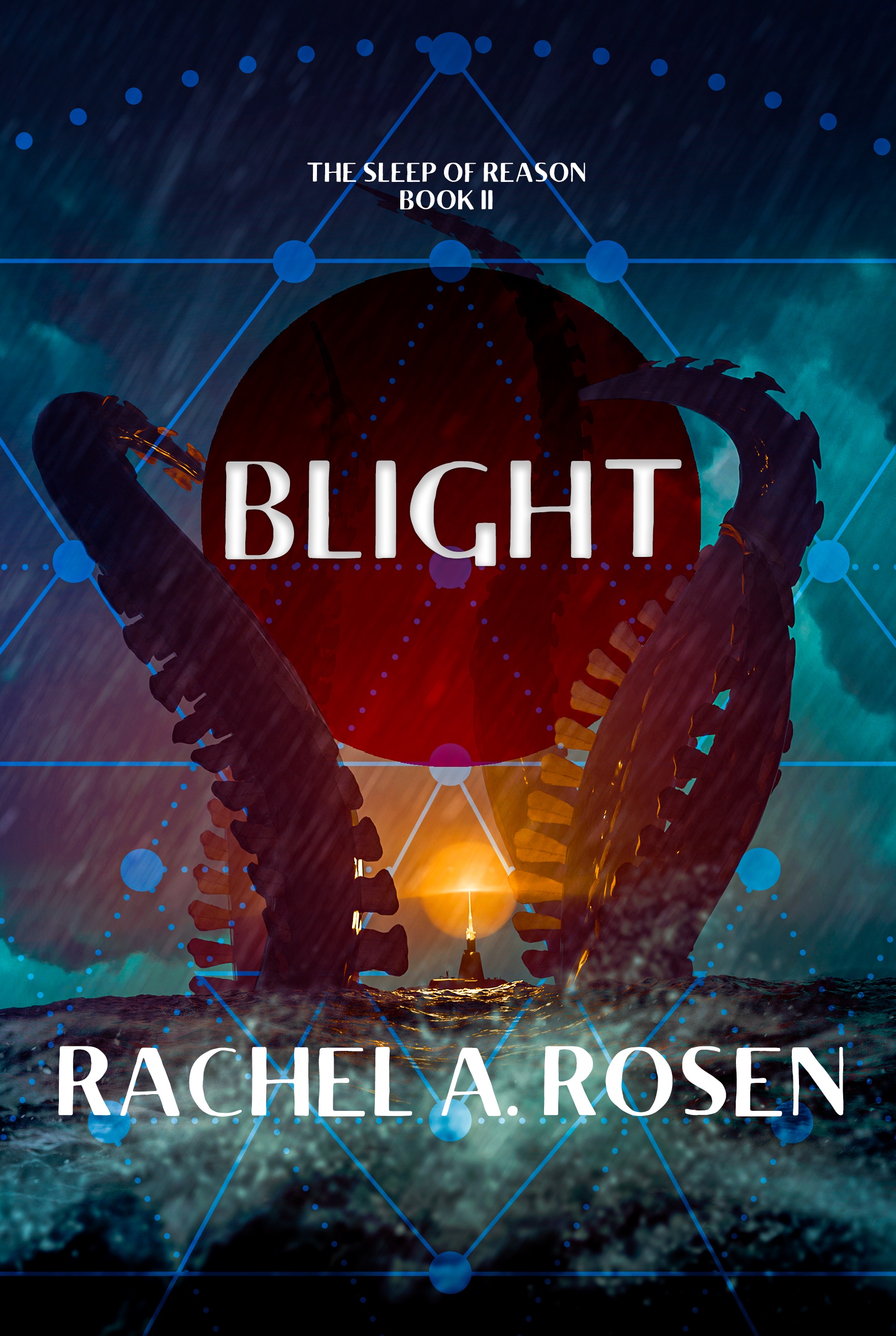
Zilla: I am so ridiculously excited for this interview—I’ve been waiting (somewhat) patiently for Rachel A. Rosen to be read to share the second book in her Sleep of Reason series with the world. And it’s finally here! Rachel, please introduce us to Blight.
Rachel: Reader, meet Blight. Blight, meet Reader. Blight is the sequel to Cascade, my first novel. Kind of a grim fella but I promise you there’s a sense of humour under there, not too far beneath the spiky surface. Cascade follows the attempts of the various characters, inside and outside systems of governmental power, to stop a climate-induced magical disaster from overrunning Canada and the world. Since there are three books in a trilogy, it’s not too big a spoiler to say that they fail at that, and Blight, which takes place three years later, is about picking up and living in the ruins.
Zilla: Among the many, many things that fascinated me about this book was how much magic derived from the power of true names, whether they protect us from demons or deliver us to sorcerers. What drove you to write your fantasy this way?
Rachel: I was Ursula K. LeGuin-pilled early in life, but of course she wasn’t the first person to write a form of magic in which one’s true name should be carefully guarded, lest the speaker end up with power over you. In Cascade, it’s established that several of the main characters have buried their true names, a type of curse that makes everyone incapable of even thinking of it; in Blight, we are about to find out why that’s important. My version of demons, people and animals who have been corrupted by magic to become monstrous, lure their victims to their deaths by whispering their true names. But humans are always worse than that, and we see what the power of a true name can be in the hands of a magician with malicious intent.
Identity is a form of armour. It’s not a coincidence that the far right weaponizes words—woke, antifa, fake news—twisting their original meanings to corrupt them. If we are going to survive the next few years, battles will not only have to be fought in the streets, but on the terrain of speech. I’ve just made it somewhat more literal for my characters, who risk being turned inside out should the wrong word get said.
Zilla: I love the subtle world building you used to show how life changes under fascism. Could you tell us about some of the inspirations there—for example, for the two types of money your characters use, Canadian dollars & DEC?
Rachel: We often get caught up on definitions, but fascism has never been a coherent ideology. When fascism comes to Canada, to paraphrase George Carlin, it will be polite and couch its atrocities in language about national pride, tradition, and orderliness.
You can convince people to accept massive socio-political and economic changes through framing particular issues as not political. You can still vote, but why would you? The issues most critical to your wellbeing—say, do we light the planet on fire in pursuit of shareholder value—have been decided amongst the ruling class by consensus, and you won’t be consulted on them. This is managed democracy, and it’s on its way here too. It’s no wonder that North Americans are exhausted by traditional electoral politics.
The levers of power are financial, so I wanted to look at how the currency would work in a post-apocalyptic authoritarian regime. One model was China, which adopted a dual currency in its transition to capitalism. In Blight, most characters use a devalued Canadian currency, but Dominion Exchange Credits—DEC—are available for luxury goods. These, being digital, are easier for the state to control, and the list of what constitutes luxury is always growing. You end up with people selling their souls for health care, something that of course would never happen here.
Zilla: Speaking of fascism (and who isn’t, these days), I noticed that at the beginning of the novel, characters had a range of methods of resistance, from large to small. By the end, all our heroes had chosen to opt out and actively resist. Is this a choice for narrative arcs, or does it speak to broader realities activists need to confront?
Rachel: Activists want to be inclusive, and the struggle has many levels. Protesting in the streets is activism. Is feeding people activism? It’s one of the most fundamental forms of activism. Creating art? Maybe, if it inspires action rather than just making people feel better about their political opinions. Is teaching the next generation critical thinking activism? As a teacher, I believe that’s just kicking the can down the road a bit. Ultimately, you have to stand in front of the bulldozer to prevent the machine from doing its job. The arc of one character goes from singing the wrong note, in the first book, to machine-gunning brownshirts by the end of the second, and to a degree that’s all of our arcs, if we’re going to be honest.
Zilla: On a more personal note, I’d like to ask, HOW DARE YOU KILL [REDACTED], HOW DARE YOU MAKE ME FEEL FEELINGS?
Rachel: Because I am a monster. Every time someone complains about the character deaths in Cascade, I am gleeful, because that means I made a little person who a reader likes enough that they are sad to see them die. To be real with you, I like that character too and gave myself a big sad whilst writing that scene.
Zilla: Is there a happy ending to the trilogy? WILL ANYONE EVER BE HAPPY AGAIN???
Rachel: I won’t reveal much about the ending beyond that there is one. I’m not going to pull a George R.R. Martin—I’ve plotted out The Sleep of Reason to the third and final book. But in terms of whether anyone will ever be happy, the disaster gays at least get to swap spit and witticisms in this one, which should make at least some people happy.
Zilla: Thanks for sharing your story and your process. We’re looking forward to reading! Where can the Night Beats community find you and your book?
Rachel: I am firehosing social media in an attempt to make these books discoverable. A good place to follow me is right here on Night Beats, since any updates will go directly to your inbox. You can sign up for the Night Beats Newsletter here.
You can also find me on:
My website is rachelrosen.ca and my podcast is at wizardsandspaceships.ca, or wherever you get your podcasts.
You can buy the book at this universal link, The BumblePuppy Press, or order it at your local bookstore or library!
 Night Beats Extended Universe