A snippet from Rohan’s psychological science fiction short story, Ex-Mech. Read it for free here.

A snippet from Rohan’s psychological science fiction short story, Ex-Mech. Read it for free here.
Every Tuesday, get to know a bit about the stories behind the books you love, and discover your next favourite novel.

Sabitha: This Tuesday we’re talking fantasy—we’re talking to Barry Ryerson about The Magic Circle. Barry, tell us a bit about your book!
Barry: The Magic Circle is set over a hundred years in our future and forty years after the world fired most of its nuclear arsenal at each other. In this time, countries that survived have been rebuilding and, in an attempt to prevent such a war ever happening again, major superpowers signed the World Peace Accords. This prevents the superpowers from having contact with each other, on the premise that if they never even speak, they’ll never need to fight.
In this backdrop we meet three strangers. Bethany Roberts is an 18 year old art student in Paris. She’s fun, quirky, and utterly hopeless with guys. Wikus de Klerk is a South African programmer who is old enough to remember the bombs falling. And Yevgeny Arafyev works for the Russian Church as a spy, secretly crossing borders in order to recruit or kill those like him.
Because, since those bombs went off, magic has returned to Earth.
Not everyone has magic. In fact, it’s very rare and most people don’t know it exists. Bethany discovers it when she tries to flirt. Yevgeny had it as a child and uses it on his missions. Wikus is aware of it, and is desperate to have that power himself.
Yet powers outside their understanding threaten all life on Earth. How will they use this power?
Sabitha: What inspired you to write this book?
Barry: I’ve long loved fantasy and sci-fi, but very rarely do you get anything that truly blends the two. I’ve been wanting to read a book like this for years and so, now, I’ve made one. True magic and guns.
Sabitha: I love that—when you can’t find what you want to read, you write it yourself! What was your favourite thing to write in the book?
Barry: Midway through there is a battle scene where we see the fight unfold from each of the main character’s perspectives. I really enjoyed that, as it builds and shows the limits of what the characters know in a tense environment.
Sabitha: Your cast sounds really fun. Which character do you relate to the most and why?
Barry: I’d say Bethany. She’s creative, very self-conscious, and is trying to find her way in the world. Being half-Jamaican, she’s often seen as half-Jamaican by Europeans, but half-Scottish by Jamaicans. I’m half-Irish myself and feel that, too. She also has an innocence that gradually gets rubbed away throughout the book.
Sabitha: How did you choose the title?
Barry: I love double entendres and The Magic Circle means so many things. A group of stage magicians. The core group that Bethany joins. The linking of magic-users. The meaning develops and changes as the book progresses.
Sabitha: If you could pick any author to read your book, who would you want to read it? Why them?
Barry: Brent Weeks! His Lightbringer series was hugely inspirational for me on this book.
Sabitha: We love when genres collide, and we’re looking forward to reading. Where can the Night Beats community find you and your book?
Barry: You can buy the book on Amazon or get signed copies from my website (shipped from UK but worldwide shipping available). You can follow me on Twitter and Instagram.
Fiction To Sink Your Teeth Into, a feature from author and professional chef Rohan O’Duill!
The sky above the port was the colour of television, tuned to a dead channel.
I really love the atmosphere created by Gibson in this book. The smell and sizzle from the yakitori stalls are a small detail that adds to the masterpiece that is a cyberpunk Chiba.
Snack sized

Every Tuesday, get to know a bit about the stories behind the books you love, and discover your next favourite novel.

Sabitha: We’re delighted to have Jinny Alexander here to talk to us about her book, Dear Isobel. Jinny, can you introduce us to your book?
Jinny: Dear Isobel recounts the aftermath of an affair, told by the ‘other woman’, who remains unnamed throughout the book. She’s biased, grieving, sad, and angry, and, as one reviewer put it: “utterly, continuously self-absorbed”. She is also real, honest, and raw. I deliberately left her unnamed, because so many people experience infidelity, and Dear Isobel is almost certainly telling the story of someone you know!
Sabitha: What inspired you to write this book?
Jinny: I began writing Dear Isobel about ten years ago when Ireland was in the depths of recession. I had just lost my own job and was grieving the loss of the work I loved, as were people all over the country. A friend had recently emigrated to Australia and I’d bought her pottery equipment from her when she left. I threw myself into learning to make ceramics to distract myself from having no job – that part of Dear Isobel is shamelessly stolen from my own story. Meanwhile, I began to write again too – something I always wanted to do but hadn’t had time for. Ireland was bored with the gloom of the recession so I found myself thinking of other reasons a business would end abruptly. Meanwhile, a friend was having a fling with a work colleague, so I put the two together – the loss of a job and infidelity, and there was Dear Isobel.
Sabitha: I love that you pulled aspects of your own life into the story—it makes characters so much more real, and in my opinion, relatable. So which character do you relate to the most and why?
Jinny: I know people who have been in the same situation as all four of my main characters, and I have some insight into all their circumstances. I found I had a lot of sympathy for the narrator, despite her afore-mentioned, self-centred brow-beating. I’ve learned just how common infidelity is, and how easy it is to be in the position Charles and the narrator get into. Weirdly, I don’t feel as sorry for Isobel as I probably should, but when I do a sequel from her POV, this may change! Then there’s James… In real life, I know a couple of men who are like James, and they are kind, gentle, loving people who have acted very much as he does in the book. I really admire the James’s of the world.
Sabitha: What was your favourite thing to write in the book?
Jinny: There is a line that still reverberates around my head – I think it’s because I accidentally wrote it in perfect Iambic rhythm – but it also sums up the entire story and the narrator’s obsession with Charles: [Do] thoughts of me still linger in the ashes of his dreams?
Sabitha: Thanks for such a personal story. We’re looking forward to reading! Where can the Night Beats community find you and your book?
Jinny: Dear Isobel is available here, as are some of the short story anthologies I am featured in. You can find me on Twitter, Instagram, Facebook, or via my website.
Rachel A Rosen’s debut novel, Cascade (The Sleep of Reason Book 1) is coming out in June. And here’s a trailer to wet your appetite—an amuse bouche of horror.
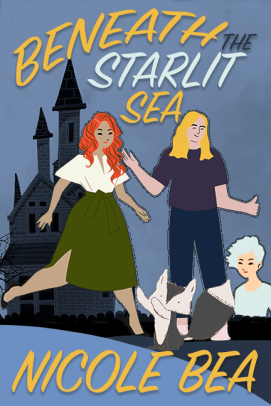
This suggestion came to us from a Night Beats writer, Nicole Northwood, who challenged Rachel to design her upcoming novel, Beneath the Starlit Sea, as a picture book. Rachel can’t resist a challenge! Tweet us and if Rachel likes your suggestion, she’ll make on in a future issue of the newsletter.
A snippet from Rachel A Rosen’s climate fantasy novel, Cascade (The Sleep of Reason Book 1).

Every Tuesday, get to know a bit about the stories behind the books you love, and discover your next favourite novel.

Sabitha: Today we’ll talk to Henry Mitchell about his newest novel, The Winged Child. Henry, can you introduce us to your book?
Henry: Thanks, Night Beats, for letting me talk about my book. Talking about writing isn’t as much fun as writing, but it comes close.
The Winged Child, is a novel about Millicent McTeer, who might know how to fly, Joshua, her father, who might be a machine, her mentor, Simon Ryder, a neurobotanist who might be a dragon, a host of other characters human and other-than-human, and their adventures in a world that might be falling apart, or maybe is being born.
Sabitha: What was your favourite thing to write in the book?
Henry: I first met Millicent McTeer in my short story, Precocious, about a little girl who was convinced she could fly, in a collection, Early Dark, published by Alfie Dog Fiction. It was love at first sight, and I knew I would eventually have to give Millicent a novel of her own.
My favorite thing to write in the book was Millicent’s interactions with the other-than-human characters in the tale, ghosts, púca, dragons, and trees.
Sabitha: We have a lot of writers in our community. What’s your writing process?
Henry: I’ve never planned a book or written from an outline. I agree with Stephen King that “plot is the last resort of a bad writer.” I usually start with a place, a scene, a bit of landscape, a street corner, a room. If I am patiently observant, a character will come along and inhabit the scene. The character eventually must do something, go somewhere, and I follow along. I may not know how the story ends until I’m writing the last page. I figure if the tale surprises me, it will surprise the reader.
Sabitha: It sounds like your story-telling process is very organic. Is there anything in particular that changed from when you started writing to the published version?
Henry: Although The Winged Child is Millicent McTeer’s story, Wendl VonTrier is perhaps the character who resonated most strongly with me. Wendl is a púca, a benevolent prankster, ever an oddity in human company, and delights in being so. His part in the tale expanded as I wrote. I haven’t had my fill of Wendl yet. My current novel-in-progress, Among the Fallen, gives him more room to play in.
As a child, Millicent was convinced she could fly. Her father, Joshua, referred to her as his Winged Child, and that became the title of the novel. Originally, I planned for the Winged Child to be a story about a childhood, but Millicent led me on until she grew into an old woman.
Sabitha: What advice would you give someone who’s querying?
Henry: I sent out two hundred queries before my first novel was accepted. Regard a rejection as a reprieve, one more chance to make it better.
Sabitha: What do you most want your readers to take away from reading your book?
Henry: I hope the tale will convince readers to live their own life, and not the one expected of them.
Sabitha: Thanks for sharing your story and your process. We’re looking forward to reading The Winged Child – and Among the Fallen when it’s written! Where can the Night Beats community find you and your book?
Henry: The Winged Child is available via Amazon, Barnes and Noble, Kobo, through your local independent bookseller or the links on my website. I post daily on my blog, on Twitter, and Facebook.
by Sabitha F.
In a first for Night Beats News, let’s have a look at a work that tells a story in pictures rather than words.
Social Distortion, a limited edition photography ‘zine by Stephanie Saroiberry, is an evocative, melancholic work about life under lockdown. Through a series of Polaroids—a medium that I absolutely adore and which is criminally underused in the age of Instagram—Stephanie explores Ohio at the beginning of the pandemic during April and May 2020. Her dreamlike shots of worn billboards and empty playgrounds paint a picture of a world emptied and abandoned, their faded pastels in stark contrast with the bleak landscape.
This ‘zine brims with nostalgia. I’m reminded of my childhood in empty, inhuman spaces designed for cars with people as an afterthought, and this wistfulness is enhanced by the use of Polaroids. The high production values emphasise the subtle details in these faded, distressed photos. Even the title harkens to the music of the 80s and 90s. When you’re isolated and lonely, the past is what you have left, and this ‘zine does an incredible job of summoning that sense of loss and memory.
There are only 50 copies in existence, so get yours while they last.
Our newest Night Beats feature is author interviews on our blog. Every Tuesday, get to know a bit about the stories behind the books you love, and discover your next favourite novel.
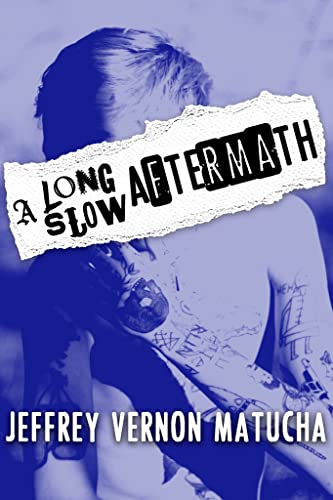
Sabitha: Our first author interview comes to us from Jeffrey Matucha, the author of A Long Slow Aftermath. Jeffrey, can you tell us a little about your book?
Jeffrey: A Long Slow Aftermath is the story of Preston who has just come out of drug rehab, a man trying to get his life together after a long bout of meth and alcohol addiction.
Living in the quickly gentrifying city of Oakland, California, Preston finds himself caught between his tech professional friend, his curious and adventurous new friend Toshi, as well as Miranda, the six-foot-tall queen of the punk scene, also newly clean and sober, as he tries to navigate through new and old worlds and the quickly changing urban landscape without the gauze of drugs and alcohol.
Sabitha: What inspired you to write this book?
Jeffrey: Preston has been a character in my writing for years. He originally appeared as one of an ensemble cast in my first book Gutter Folklore. He was the main character in my book The Falling Circle, a book about being poor in the big city. He was also a major supporting character in my book about addiction, Crash Shadow, where he was a big-time meth dealer.
I’ve written about working poor struggles and also about addiction. I decided I needed to write a book about the process of getting clean, of getting out of the endless cycle of addiction. Preston was the perfect character for this story.
Preston continues to evolve, and he continues to be a major player in my upcoming books.
Sabitha: What was your favourite thing to write in the book?
Jeffrey: I would say working on my new character Toshi. Toshi is what you might call an inclusive hat trick: she’s Asian, she’s gay, and she’s blind. Usually when someone has a character like that in their story the point of their presence has something to do with them personally, that they aren’t white, or they’re gay, or their disability, but that’s not why Toshi is in this story.
Toshi comes from a comfortable background. She was born into privilege and she knows it. But as a product of the progressive Bay Area she also keeps an open mind. She befriends Preston as Preston takes her to meet her working class neighbors, and introduces her to the exotic Miranda who has been through trials and tribulations Toshi has never known and can barely imagine. Their friendship culminates when Preston takes Toshi to her first ever punk show. Their friendship is one of a have and a have-not, but in the spirit of cooperation, exploration, and adventure, rather than a culture clash.
Miranda is also another character I loved working with in this story. A six-foot tall scene queen absolutely covered with tattoos and scars, her character has come alive to the point where she’s going to get her own book. She’s a woman of the world plus, someone who has lived far more life than most people ever will, even among the hardcore rocker community. There’s too much of her to just leave her as a supporting character.
Sabitha: If you could pick any author to read your book, who would you want to read it? Why them?
Jeffrey: I sometimes say I write punk literature, and that field is kind of a wasteland. For a tribe that is so invested in music, art, and activism, the realm of punk literature is sadly lacking. Where are our scribes? One of the bright spots of that sub-genre is Dani Dassler, who wrote an excellent novel called PR.
She’s not only read this book, she’s read many other of my novels. She’s beta read and vetted many of my scenes, including scenes of my upcoming work, The Rise and Fall of Skye Wright. So yeah, she’s not only a writer I would want to read my books, she already has!
Sabitha: What do you most want your readers to take away from reading your book?
Jeffrey: To get an insight into what someone struggling with addiction is going through. Many of my friends do not need any insight into such a thing, but I want those who haven’t experienced it to get an idea of what it’s like.
Preston is in the early stages of his recovery, when he’s still quite close to his using addiction. That’s when the struggle is all too real.
Sabitha: Thanks so much for doing this interview with us, Jeffrey. We’re looking forward to reading! Where can the Night Beats community find you and your book?
Jeffrey: You can find A Long Slow Aftermath here. You can find me on Twitter and on Facebook.
 Night Beats Extended Universe