
It’s the time of year for some spicy summer reads. Can’t pick a book? We gotcha. Check out this list of beach reads. Still can’t decide? Rachel Corsini narrows the list to the 5 most swoon-worthy romances here.
Every Tuesday, get to know a bit about the stories behind the books you love, and discover your next favourite novel.

Sabitha: We have Terry Bartley with us, to talk about his queer fantasy adventures, Tyranny of the Fey. Terry, tell us about your stories of elves, goblins, and orcs!
Terry: A famed Elven researcher is worried about her home. When she discovers a new realm with massive magic potential, she believes she has found the answer. Will the Seasonal Fey Courts allow her to continue her research without interference, or do they have more nefarious plans?
An Elven princess runs away from her arranged marriage to a parallel world. Will she be able to find the adventure she seeks? While she is in search of battles with dragons and quests to obtain sacred artifacts, she finds that what she was looking for may have been a true connection with someone that understands her.
Two childhood friends, an orc and a goblin, have long dreamed of adventure. When a magic school dropout stumbles into their lives, they jump at the chance to realize their ambitions. This found family realizes the world of Galevyn is a much bigger place than the jungle they grew up in.
Sabitha: What inspired you to write this book?
Terry: I started writing seriously about four years ago. I started writing once a week, every week. This is what turned into my novel. I started trying to edit the novel in 2020, but I didn’t know where to start, and, if I’m being honest, I was so stressed out about everything else going on that I didn’t feel up to it. The following year, I set a goal to write 100 short stories in a year. I wrote short stories featuring characters other than my novel’s MCs. This was a really fun process, and I enjoyed building out my fantasy world through the characters that lived in it.
Sabitha: When you picture your ideal reader, what are they like?
Terry: Whenever I write, I very much try to write the book that I would want to read. What that means to me is a fantasy book with a good amount of action and cute queer love stories. So my ideal reader is probably someone that likes Marvel movies, is a member of the LGBTQ+ community, and has always felt like they didn’t quite fit in where they grew up.
Sabitha: Does the location the story takes place mean something to you or to the work?
Terry: My setting is written as a magical allegory for the world we live in. I like to think the primary setting of Anglachel is what America would be if it was colonized by elves rather than various European nations. It means something to me because I feel like there are people that just can’t see the harm things like colonialism and institutional racism have caused. I’m hoping that if I’m more overt about it in my fantasy, that maybe some of these people can see it more clearly.
Sabitha: Thanks for sharing your story and your process. We’re looking forward to reading! Where can the Night Beats community find you and your book?
Terry: You can find me on my website, and you can buy Tyranny of the Fey here.
by JoeAnn Hart

JoeAnn Hart at EcoLit Books reviews Query.
Query, a Novel, is snack-sized, but it took me a while to read because I kept laughing coffee out of my nose and onto the page, the best recommendation I can give for a book.
Read the full review here!
| Wuthering Heights as a Western romance was suggested by Stevie. Email us at nightbeatseu@gmail.com, and if Rachel likes your suggestion, she’ll make it in a future issue. |

Every Tuesday, get to know a bit about the stories behind the books you love, and discover your next favourite novel.

Sabitha: For fans of the question “What if?” we have Erin Lale here, contributing editor of a series of time-traveling anthologies. Erin, tell us more!
Erin: Cassandra’s Time Yarns is the first anthology in a series of three multi-author anthologies in the Time Yarns Universe shared world. As contributing editor, I not only selected the stories but also have at least one of my own stories in each book. The next two anthologies are Anarchy Zone Time Yarns, with a theme of anarchist and libertarian societies, and Cat’s Cradle Time Yarns, with a theme of cats. There is also a single author Time Yarns anthology of my stories, Universal Genius. Time Yarns is a universe in which time travel exists, and some of the stories are about time travel, some are about unsuccessful attempts to invent time travel with dire consequences, and some are about non time travelers who have to live in the world the time travelers messed up. Watch the Time Yarns trailer to get a flavor of it.
Sabitha: We love anarchists and cats in this house, so we’re very much on board with these anthologies! What inspired you to create the Time Yarns universe and fill it with stories?
Erin: I love time-travel stories. I’m also fascinated by the idea of non-time-traveling people who have to live in the world that time travelers generated, and I wanted more stories like that. There were also two novels in the Time Yarns Universe, Punch and Planet of the Magi. The anthologies were published under my own label, Time Yarns. The novels were both snapped up by publishers that then went out of business, so both are out of print. I’m hoping to find a new publisher for them.
Sabitha: We have a lot of writers in our community. What’s your writing process?
Erin: The idea comes first. When I’m writing hard science fiction it’s always an idea that takes the standard hard science fiction form, “If x existed, how would it change society?” In the Time Yarns Universe, x is time travel technology, although there is often also an y and a z that also change things. I’m often inspired with dialogue when I first start writing a story. My published stories were a series of inspired scenes and dialogue which I then strung together in a logical order. After the experience of being Acquisitions Editor at Eternal Press and Damnation Books, I tried to change my process to start with a coherent outline and plot everything out in advance; I wrote a very long novel based on Norse mythology, which turned out to be an unpublishable mess, so I went back to seat-of-the-pants-style writing.
Sabitha: How did you choose the title?
Erin: Cassandra’s Time Yarns introduced the character Cassandra, also known as Aunt Cassie, who is one of the few characters who appears in multiple stories. In her introductory story she appears in her own time helping to solve a mystery, but in the other stories she is a mentor character to other time travelers. She pops into the story to tell a new time traveler how to do time traveling and to warn them about the antagonists. She is named after the prophetess Cassandra because characters often don’t believe her– until later, after they have had some adventures.
Sabitha: Thanks for sharing your story and your process. We’re looking forward to reading! Where can the Night Beats community find you and your book?
Erin: You can find me at my website. The Time Yarns universe has a website too, and if you want to start reading from the beginning, Cassandra’s Time Yarns is here.
by Lindsay Hobbs, Editor Extraordinaire

I don’t feel like it’s going out on a limb to say that you won’t have read a cookbook like this one before. It’s an instruction manual for feeding yourself when you are not up to much. I know that I’ve had plenty of these days in the past year (or ten). For anyone else who sometimes feels that the energy it takes to meal prep, grocery shop, and make a meal is just too much, The Sad Bastard Cookbook is here for you. Not only is it there for you in a practical sense, with meals and snacks that are manageable even when nothing else is, but it is there for you emotionally too, by reminding you that you are not alone, and that even in your darkest days, you deserve to eat.
Read Lindsay’s full review here.
Every Tuesday, get to know a bit about the stories behind the books you love, and discover your next favourite novel.

We have A.J. Calvin with us, to talk about her fantasy adventures. A.J., take us away!
A.J.: The Relics of War is an epic fantasy trilogy, Hunted is a standalone urban fantasy, and my upcoming fantasy series is called The Caein Legacy. My books are meant for an adult audience.
The Relics of War is a multi-POV series, whereas the others feature single POVs. They all feature magic or paranormal in some form, as well as fantastic/supernatural beings. And a lot of my books feature dragons. I have a thing for dragons.
Sabitha: Relatable. Dragons are extremely great. We have a lot of writers in our community. What’s your writing process?
A.J.: I’m a plotter. I’ll come up with an idea, think about it for a while (sometimes years), make notes, define the cast, and then finally make an outline. It’s not the fastest process, but my worldbuilding takes time. Once the outline is complete, I’m ready to start the drafting process.
It used to take me a long time to write a book. Hunted took me the better part of 4 years. But as I’ve continued to write and create worlds, the writing itself has become easier. I’ve been averaging about 10 weeks from start to finish on my later books (not including revisions/editing, I’m just talking about the draft phase.) I usually let a draft sit for a while before I come back to it for revisions. Sometimes it’s a few months, sometimes longer, depending on what else I have going on. While it rests, I write new things, send earlier pieces off for editing/proofreading, and/or plan publication for finished works.
It leaves me with a fairly substantial backlog when it comes to publishing. I’m about to publish book #5 overall, but I’m currently writing #14, so I’ll have plenty more to come in the future.
Sabitha: That’s amazingly fast! Do you still have time to read? And what book do you tell all your friends to read? Besides yours of course!
A.J.: I read a lot, and I’m not terribly picky about content, but I do love science fiction and fantasy the most. That being said, I read some books I wouldn’t necessarily recommend to some of my friends, because I know they wouldn’t enjoy them.
A few I’ve recommended frequently include Hyperion and The Fall of Hyperion by Dan Simmons, Aestus by SZ Attwell, The Deverry Cycle by Katherine Kerr, and Dyrwolf by Kat Kinney.
Sabitha: Which character do you relate to the most and why?
A.J.: From my own books, it’s Andrew from The Caein Legacy. He’s the eldest sibling in his family (so am I), and is very protective of one of his younger brothers. When I started writing Exile, the first book in the series, I was 36, which is the same age he is at the start of the series. It was a fun experiment to write a character of the same age. According to a couple of my beta readers, Andrew also shares a couple of my personality quirks too. He was one of my favorite characters to write so far.
Sabitha: Thanks for sharing your story and your process. We’re looking forward to reading! Where can the Night Beats community find you and your book?
A.J.: You can find me on Twitter or on Facebook. You can find my books on my website, my Amazon author page, or on Goodreads (though I’m not active on Goodreads)
by Zilla N.

There is a tendency for lonely, disconnected teenagers to fall too deeply into introspection. To observe their own life as they live it, playing both Nick Caraway and Jay Gatsby, hurdling towards their destruction, their eyes open. I know this because I was this kind of teenager. The narrator of It Helps with the Blues knows this too.
I’m not old enough to know if manic-pixie-dream-girls existed before Eternal Sunshine of the Spotless Mind gave them a name. But I know that all too often, lonely, disconnected teenagers are looking for an external saviour. This thing we feel when we find the person we think will save us, will give us meaning, will make us finally not alone–it’s not love. But it’s not exactly not love either. Only it’s too much to ask someone else to save you. Especially someone who needs saving just as much as we do. It’s not just unfair. It’s impossible. It ends in heartache. It ends in tragedy.
When I was in high school, I felt like my life was recursive, like I would be given the same choice over and over in different contexts until maybe–I hoped, if I made the right decision–I could escape the loop. Jules. Gabriel. Estelle. Joshua. The narrator is trapped in a Midwestern prison of suburbia and recriminations, doomed like Sisyphus to endlessly repeat and reexamine his mistakes.
It Helps with the Blues pours one out for the lonely kids. That was me. Maybe that was you, too.
It Helps with the Blues is available at all the usual online places, but for a limited time tRaum is selling book boxes where you can get a limited-edition locally printed palm-sized paperback plus press goodies! Or treat yourself and get all the tRaum books plus swag for days!
Fiction To Sink Your Teeth Into, a feature from author and professional chef Rohan O’Duill!
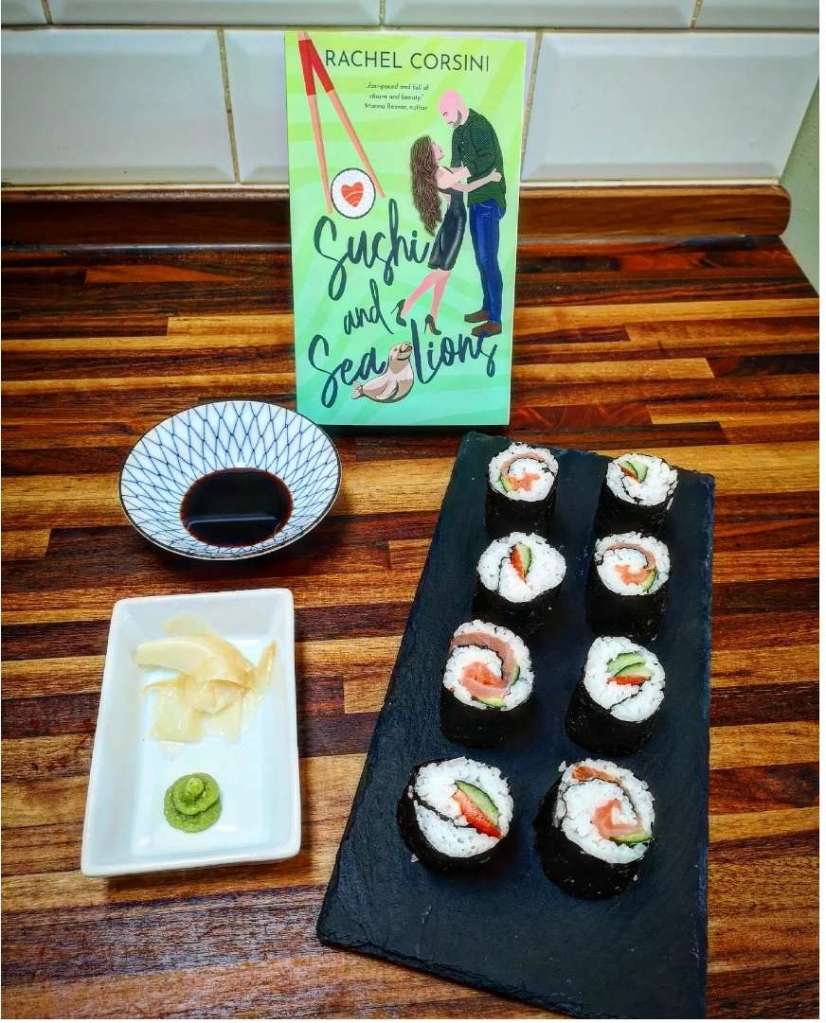
Dany and Vin Vin share several meals in Sushi and Sea Lions, from accidentally undercooked chicken parmigiana to diner chicken wings to the titular sushi. While under pressure to do a chicken parmigiana, I left that surprise for the book. This is the perfect snack to keep in the fridge and pull out and enjoy with this great read. Enjoy.

Zilla Novikov published a blog post about activism, querying, and and her novella Query on the Dragonfly site. Dragonfly.eco is a platform which explores all kinds of eco-fiction. Mary Woodbury introduces Zilla’s article by saying:
“[Zilla’s] novel Query is a unique, witty perspective on an author’s activist-through-art frustrations in getting her book noticed and published. While recognizing these frustrations, I, as a reader, also innately understood the satire, and laughed often while reading, even though I recognized the madness one feels in the constant repetition of our activists’ voices. When chatting with Zilla recently, I was reminded of a quote from a novel I read during college: “We all feel that our generation didn’t get a chance to make any positive political contributions because we were totally occupied with just trying to stop the madness.” The book was Hot Flashes, by Barbara Raskin, published in 1987. Generations later, we are still trying to stop the madness (continued climate, political, economic, and social imbalances), and sometimes we get stuck in this rut of protest when we just want to move forward, past the same-old, same-old. Balancing ecological concern, style, humor, publishing woes, and still telling a solid story, Query is a must-read for this age.”
Read the article on Dragonfly!
 Night Beats Extended Universe