Book Report Corner

by Zilla N.

It helps with the blues cover

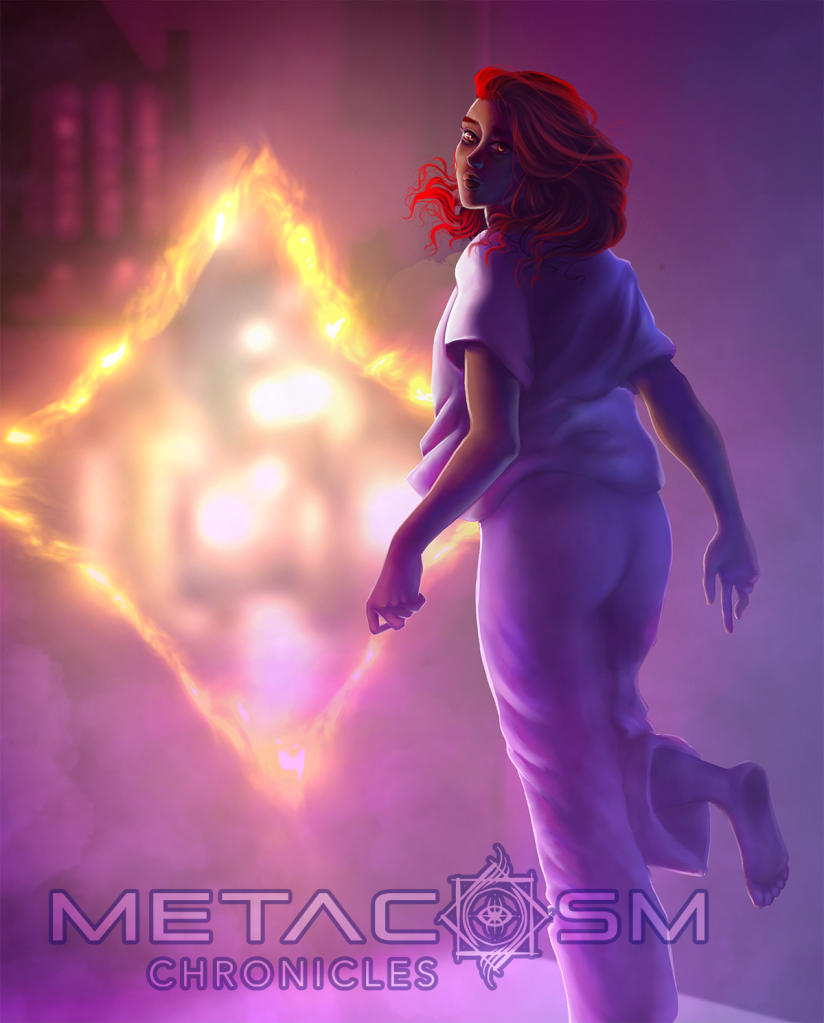
There is a tendency for lonely, disconnected teenagers to fall too deeply into introspection. To observe their own life as they live it, playing both Nick Caraway and Jay Gatsby, hurdling towards their destruction, their eyes open. I know this because I was this kind of teenager. The narrator of It Helps with the Blues knows this too.

I’m not old enough to know if manic-pixie-dream-girls existed before Eternal Sunshine of the Spotless Mind gave them a name. But I know that all too often, lonely, disconnected teenagers are looking for an external saviour. This thing we feel when we find the person we think will save us, will give us meaning, will make us finally not alone–it’s not love. But it’s not exactly not love either. Only it’s too much to ask someone else to save you. Especially someone who needs saving just as much as we do. It’s not just unfair. It’s impossible. It ends in heartache. It ends in tragedy.

When I was in high school, I felt like my life was recursive, like I would be given the same choice over and over in different contexts until maybe–I hoped, if I made the right decision–I could escape the loop. Jules. Gabriel. Estelle. Joshua. The narrator is trapped in a Midwestern prison of suburbia and recriminations, doomed like Sisyphus to endlessly repeat and reexamine his mistakes.

It Helps with the Blues pours one out for the lonely kids. That was me. Maybe that was you, too.

It Helps with the Blues is available at all the usual online places, but for a limited time tRaum is selling book boxes where you can get a limited-edition locally printed palm-sized paperback plus press goodies! Or treat yourself and get all the tRaum books plus swag for days!

Sushi and Sea Lions with homemade sushi

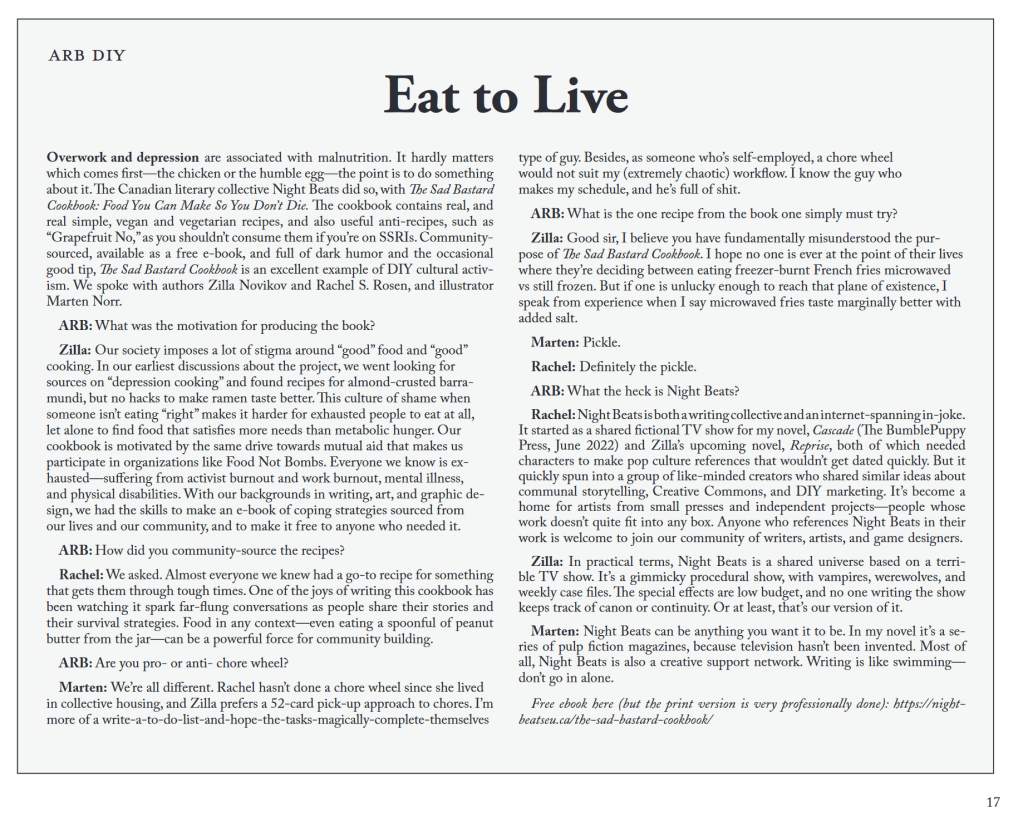
Fiction To Sink Your Teeth Into, a feature from author and professional chef Rohan O’Duill!

Dany and Vin Vin share several meals in Sushi and Sea Lions, from accidentally undercooked chicken parmigiana to diner chicken wings to the titular sushi. While under pressure to do a chicken parmigiana, I left that surprise for the book. This is the perfect snack to keep in the fridge and pull out and enjoy with this great read. Enjoy.

Sushi and Sea Lions with Sushi
Continue reading

Zilla’s Dragonfly Article

A illustration of a person reading in nature.

Zilla Novikov published a blog post about activism, querying, and and her novella Query on the Dragonfly site. Dragonfly.eco is a platform which explores all kinds of eco-fiction. Mary Woodbury introduces Zilla’s article by saying:

“[Zilla’s] novel Query is a unique, witty perspective on an author’s activist-through-art frustrations in getting her book noticed and published. While recognizing these frustrations, I, as a reader, also innately understood the satire, and laughed often while reading, even though I recognized the madness one feels in the constant repetition of our activists’ voices. When chatting with Zilla recently, I was reminded of a quote from a novel I read during college: “We all feel that our generation didn’t get a chance to make any positive political contributions because we were totally occupied with just trying to stop the madness.” The book was Hot Flashes, by Barbara Raskin, published in 1987. Generations later, we are still trying to stop the madness (continued climate, political, economic, and social imbalances), and sometimes we get stuck in this rut of protest when we just want to move forward, past the same-old, same-old. Balancing ecological concern, style, humor, publishing woes, and still telling a solid story, Query is a must-read for this age.”

Read the article on Dragonfly!

Make worse choices with Zilla Novikov

Strap up friends and strangers. It’s time to make bad choices … together

I wrote a novella called Query where I mash up publishing under late-stage capitalism with climate change activism and trauma-dumping on strangers. It’s also a queer love story and it’s been called “pants-wettingly funny.” Rysz published the regular version with a SFW cover but he also sold a book box with a special edition cover which I literally have to censor if people are at work, link here if you’re not at work or you work in a very chill workplace.

The query cover with a censored bar over the page the typewriter has written

We sold out of the first run of Query book boxes, which a) was fully incredible and b) what the heck guys, do you want to make a grown woman cry from happiness? Because I’ll do it.

So Rysz and I bought another round of mostly different, equally deranged swag to put in print run two for another round of Query book boxes.

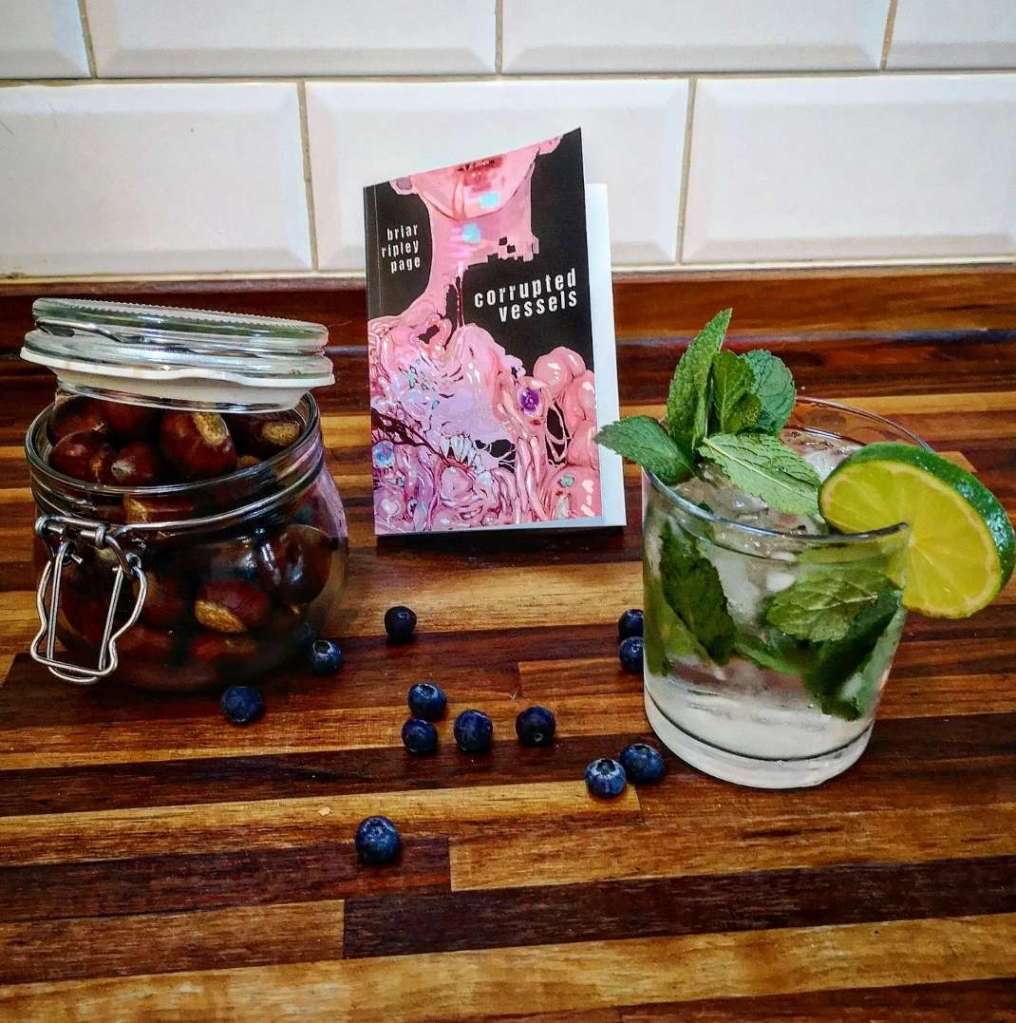
Rysz was like, “wow people like book boxes huh” so he’s put on a sale so you can get any or all of the books from his press in the SAME BOX. I have read every book he’s published and I love all of them, but hot DAMN Corrupted Vessels has a good cover so I plan on getting that one myself.

The Corrupted Vessels cover in all its body horror glory

You also have the option of getting ALL THE BOOKS Rysz publishes AT THE SAME TIME. Open your heart and your bookshelves. Let something in. I can’t promise this is a good choice, but it’s a choice. Ask yourself, what could go wrong? Then do it anyway.

Behind the Screens: Tuesday Author Interview

Every Tuesday, get to know a bit about the stories behind the books you love, and discover your next favourite novel.
Mind over antimatter cover

Sabitha: Today’s story is a bit off-the-wall—maybe literally! Rose Green is going to tell us about the wacky science fiction novel, Mind Over Antimatter

Rose: I’m Rose Green, author and illustrator, and my latest work is Mind Over Antimatter, a middle grade science fiction novel.

Thirteen-year-old Cole Uribe can’t believe his luck when an invention contest wins him top security clearance. His mission: pose as the grandson of inventor Nicolás Araya and find Araya’s plans for the micro-black-hole-powered storage device—before Alzheimer’s erases Araya’s mind for good. Except…Cole’s not the only kid claiming to be Marcelo Araya. And one of them is telling the truth.

Can a real grandson, a fake grandson, a nosy neighbor girl, and the greatest mind ever to lose brain cells be a match for a top-secret, most ruthless organization?

Sabitha: What inspired you to write this book?

Rose: Mix a little Nicola Tesla, a little Terry Pratchett, and an unusual landscape in Idaho and you end up with this book.

Sabitha: Sounds wild! We have a lot of writers in our community. What’s your writing process?

Rose: I like to be hands-on when I write. I want to really know what the characters are experiencing. While I could not play with black holes, I did crawl through some lava caves. Location is always important to me in writing, so a lot of my process is me going out and experiencing something there, and then coming home to write about it.

Sabitha: What book do you tell all your friends to read? Besides yours of course!

Rose: Some favorite middle grade books include Brandon Sanderson’s Alcatraz series, Frank Cottrell Boyce’s book Cosmic, and books by Kenneth Oppel.

Sabitha: When you picture your ideal reader, what are they like?

Rose: That smart kid in your life who reads a lot, thinks a lot of complex thoughts, and maybe hasn’t quite figured out how to fit into the world yet. Underneath, though, they are really cool (and hopefully will someday recognize that).

Sabitha: Does the location the story takes place mean something to you or to the work?

Rose: Definitely! Idaho is such a little known state—people think potatoes, and that’s it. But it’s got this interesting farmer-scholar combo going; people value education greatly but also love the wild. A lot of people speak more than one language there. And you can go to Yellowstone in the morning and catch a nice string quartet visiting your local university from New York in the evening. The first town in the US to run on nuclear power is in southern Idaho. Television as we know it was developed by someone from Idaho. I wanted to capture all of that.

Sabitha: Thanks for sharing your story and your process. We’re looking forward to reading! Where can the Night Beats community find you and your book?

Rose: You can catch up on my writing and illustrating on my website. Meanwhile, Mind Over Antimatter is available in print and ebook form from a variety of sources; see this link for more information.

Happy Birthday Cascade!

Rachel A Rosen wearing an awesome plaid dress talking at the Merrill Library

June marks the one-year anniversary of Cascade’s publication. It’s a novel about magic, climate catastrophe, and Canadian politics, about the compromises we make with power, and about how to keep fighting when the struggle is lost. You should definitely read it, if you haven’t already. It’s a lot funnier than that description makes it sound. In that year, I’ve used the patented FAFO Method to learn all about what it takes for an unknown author to launch a weird book into the world (and maybe make some money along the way).

Cascade with hot chocolate and scrabble letters spelling out fuck

A rather unscientific survey by the Bookseller indicated that more than half of debut authors found that being published negatively affected their mental health. While I am relieved to say that on most days, I don’t share their sense of crushing disappointment, it hasn’t always been an easy path. Here’s what I learned in a year of being An Official Published Author, Like For Real, It’s Sitting On My Bookshelf With My Name On the Cover(TM).

  1. You are going to do more marketing than you think.

Unless you are one of the tiny minority of authors who get the full and enthusiastic backing of a major publishing company, you are going to end up doing the bulk of your own marketing. Yes, even in trad pub. You will make appearances in any place that will have you. You will bombard your social media feed with Bookbrush graphics. You will struggle to condense your great work of art to a listicle of tropes. You will start conversations with friends, family, neighbours, and strangers about your book. Very few of them will find it as exciting as you do.

This is patently unfair to the less comely among us who would prefer not to be perceived, and to those of us who can’t summarize our cross-genre weird fiction in a snappy sentence. I long for a world in which the author’s personality and brand didn’t influence my reading choices, but unless you’re getting reviewed by major publications, it’s the only way your book will get out there. So while you’re working on your masterpiece, I highly recommend working on your charm offensive and screen presence. Also, the person who invents a way to crosspost book announcements to Instagram, Facebook, what’s left of Twitter, TikTok, Tumblr, Goodreads, Amazon reviews, and a blog or two can take all of my money as far as I’m concerned.

  1. Don’t go into the woods alone.

I can’t overstate the importance of a community. Without the Night Beats crew, I’d be lost in the woods. I’m terribly antisocial and I hate putting myself out there, and it’s having a team of other creatives around me that make the whole process manageable. The main people who buy books are other authors looking for comps, so it’s time to put on your best extrovert hat and make some new writer friends. Shared pain is lessened, shared joy is increased, and the company of other eccentrics is a gift in itself.

  1. Scams and scammers abound.

This one I could have guessed at, in retrospect. The publishing industry is not a particularly lucrative one, and the most profitable corner of it is separating naïve authors from their hard earned cash. Post about writing, and you’ll have vanity presses beating down your door to “sign” you. Post your book, and you’ll be flooded with strange people claiming they’ll promote you. Get to know Writer Beware and similar resources and approach every offer with caution and cynicism.

  1. Shoot your shot.

Be ambitious. With your writing, because the world has more than enough mediocre books, but also with your promotional strategies. You’d be surprised at who will take you seriously. The tiny blog with 100 readers might want money to review your work (do not give it to them), while the author you’ve admired for years will blurb you and champion your work to their followers. You never know. The worst anyone can do is say no and laugh at you, and you’ve already done the silliest thing imaginable by trying to make money in book publishing. You no longer possess shame, so ask away.

  1. Advice given to new authors is heavily padded to make it to five points.

Much advice given to new writers boils down to “research social media and build your following,” but let’s face it. If you were any good at all with social media, you wouldn’t have had the time to write a whole novel. You probably hate social media almost as much as you hate Daddy Bezos. It’s responsible for decreasing attention spans, the occasional war crime, and burying your book so deep in the algorithmic morass that readers will never find it. You have to do it anyway. No amount of raging against the fates that have caused you to be born in this century and not one in which you could unleash your bon mots in a broadside will save you from having to engage with whatever corporate-owned monstrosity is demanding your content.

Other good advice includes “don’t make your first book a sprawling cross-genre trilogy with messy, difficult characters, a dark cliffhanger ending and literary pretensions.” But, of course, that’s what I did. And there’s no money in writing, so you might as well write the book of your heart. I did, and I love it, and I’m excited to bring you the sequel soon. You can find it at The BumblePuppy Press, your favourite online book shop, or maybe even at your local indie bookseller or public library!

Book Report Corner

by Zilla N.

Beyond Human Cover

Lower Decks Press has done it again, producing another anthology of undeniably modern short stories that reads like Golden Age science fiction. I grew up reading ‘Analog Science Fiction and Fact Magazine’, and these stories feel as familiar as rereading those yellowing pages. But between the alien battles and unintended consequences of cybernetic technology, the themes of this anthology belong firmly in 2023.

We live in a world where late-stage capitalism is turning every aspect of our lives into a commodity to be optimised, not for ourselves, but for our employers. Workplaces put on wellness seminars because mentally and physically healthy employees work harder. In Beyond Human, undertested technology is used to maximise workers’ productivity, from those in office jobs to working personal protection. Consent becomes an illusion, if the truth of what you are consenting to is withheld, or if the consequences for failing to abandon your bodily autonomy are more severe than the risk.

I also see a trans reading in many of the stories. Society dictates what transformations must be imposed on us, but also which we are denied. Parents, religious leaders, and governments refuse to allow some people to replace broken body parts with cybernetics, or to upload their minds to the cloud. In a world where trans people are all-too-often denied the agency to modify their bodies, science fiction is the perfect vehicle to show the injustice in these stories.

In some ways, the most hopeful stories in this anthology are those with the reverse message. Instead of humans becoming alien to themselves, we learn to see the humanity in that which is unlike us. Whether it is the space dinosaur trying to save our doomed planet or the aliens who cannot survive without merging with us, Beyond Human asks us to see the other in a new, kinder light.

As always, the proceeds from the sale of the Lower Decks Press anthology go to charity, so get your sci-fi fix and support a great cause at the same time. Get it here.

Behind the Screens: Tuesday Author Interview

Every Tuesday, get to know a bit about the stories behind the books you love, and discover your next favourite novel.

The Blood Hotel cover

Sabitha: It’s a thrilling day today! We’ve got Cheryl Peña here to tell us about her three novels, The House of Wynne Lift, Descent of the Vile, and The Blood Hotel. Cheryl, can you tell us a bit about your creative works?

Cheryl: Most of my work is science fiction that deals with common themes of perception versus reality and issues related to starting over later in life.  As a writer who debuted at 50 years old, I feel like older protagonists are often left out of genre fiction.  They’re often side characters, but rarely the main character.  Therefore, most (but not all) of my protagonists are older, at least thirties, but often more.  I feel that people are never too old to contribute to society or make a difference.

Sabitha: I completely agree with that! Can you tell us what inspired you to write your most recent book?

Cheryl: The latest novel is The Blood Hotel, which is a sequel to my first novel, Descent of the Vile.  I got the idea for it when my friend, author Hermione Lee, suggested there could be more to the story, as I’d originally thought it would be a standalone novel.  But there was a lot of room to add to the narrative, and it came together very quickly.  I already had a title that sounded right, so I created the plot around the title.

Sabitha: Was there any music that inspired you while you were writing?

Cheryl: Definitely.  I usually write to classical music, so I played Ludovico Einaudi and Stephan Moccio a lot.  I also listened to Bryan Ferry and Franz Ferdinand when the mood was a little more up-tempo. 

Sabitha: Do you have a “fan-cast” – do you have actors you’d cast as your main characters?

Cheryl: Descent of the Vile was inspired after watching all three films in the Three Flavours Cornetto Trilogy back-to-back and having a nightmare that night.  The dream became the opening sequence for the book, which featured Simon Pegg (naturally) as Jackson Riley, having a really bad day.  So, he’s the person I pictured as I wrote the books.

Sabitha:  Which character do you relate to the most and why?

Cheryl: I had to figure out how to relate to Jackson as the books were told from his point of view.  Although my first book, a suspense thriller novella called The House of Wynne Lift, featured an all-male cast, I wanted to portray Jackson as realistically as possible.  I did a lot of research writing the novella, but I did even more for the novels to understand the male psyche and how it differs from others.  I also took acting classes, which helped me learn to internalize the role I was writing so that I could imagine myself in that character’s place.

Sabitha: Thanks for sharing your story and your process. We’re looking forward to reading! Where can the Night Beats community find you and your book?

Cheryl: You can find me at my website, Facebook, Instagram, and Twitter. My books are on Amazon—you can find The House of Wynne Lift, Descent of the Vile, and The Blood Hotel.