Behind the Screens: Tuesday Author Interview

Every Tuesday, get to know a bit about the stories behind the books you love, and discover your next favourite read. Today I’m talking to Kelly Rose Pflug-Back, editor of Up:Rising.

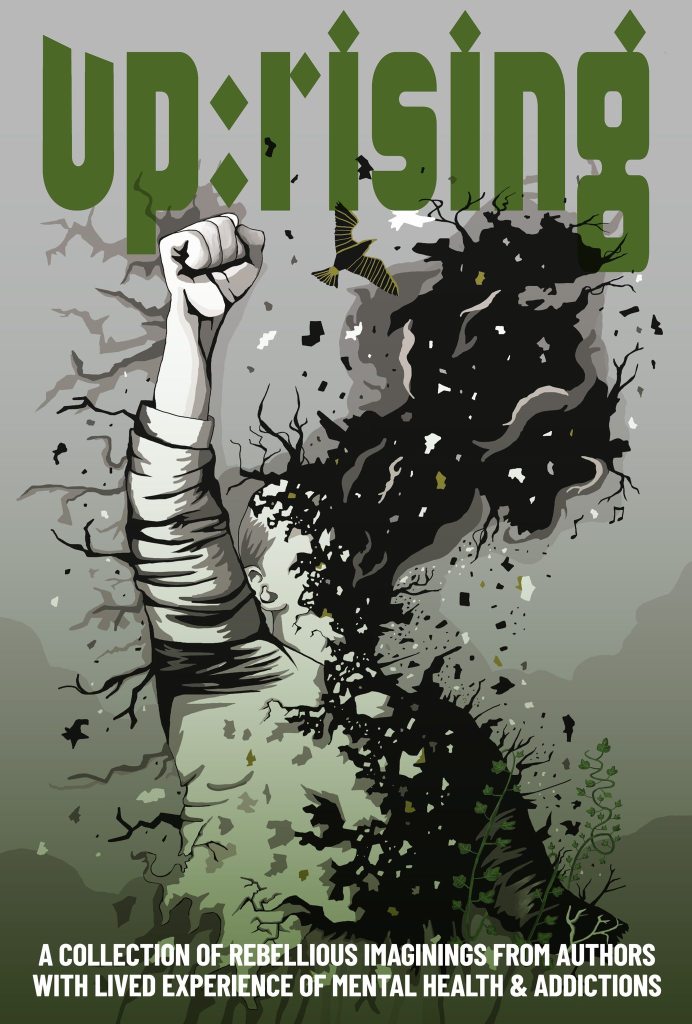
Up:rising: A collection of rebellious imaginings from authors with lived experience of mental health &  addictions. Cover is in green tones featuring a person with their face dissolving into night and trees sprouting from their body with one upraised fist.

Rachel: Tell our readers a little bit about the book!

Kelly: It’s got some tender parts, and some  brutal ones. I wasn’t sure what we would pull in when we cast our editorial net, but we received some very beautiful and unflinching work. The theme of the anthology is Rebellion, and people interpreted that in so many different ways. It’s really a full spectrum of human emotion. 

Rachel: Rebellion is inherently collective, and this book came about as a partnership between two incredible artist-run organizations. Can you tell us a bit about the process and what working with them was like?

Kelly: I’ve worked with Workman Arts in the past, facilitating workshops on grant writing. Part of their mandate is professional development for artists with experience of mental health and addictions. Because I have that lived experience, I’ve seen a lot of social programming that’s very patronizing, very infantalizing. So it was important to myself and the other two editors that this book exist outside of that framework. We really wanted it to show the excellence of the contributors, especially those who don’t have previous publishing experience. We also really wanted to keep the work free from censorship. Some of the pieces are pretty raw, and we didn’t want to deal with external pressure to make the book more “respectable.” I reached out to Strangers because they value radical ideas and I had a feeling they would see eye-to-eye with us. They’re on the US side of the border so it also turned out to be an opportunity for them to expand their distribution into Canada. That’s exciting to me!

Rachel: It is exciting! As are many of the authors in the anthology! Can you entice our readers with some of the standout poems and stories?

Kelly: We have really stunning short stories by Andrea Wilmot (author of Withered) and Cid V. Brunet (author of This is My Real Name). Also some really provocative and lovely poems by Daniel Oudshoorn, Shan Powell, and many others. And of course our opening story, by K. Zimmer, is a favourite of mine. I think when we talk about mental health, there’s this idea that everyone experiences some kind of mental health struggles…but one thing I love about this book is that we have pieces by people who live with some of the more stigmatized mental health labels, people who experience schizophrenic symptoms and have been institutionalized or left to live on the street. It means a lot to me to be able to publish those pieces. 

Rachel: Speaking of stigmatized mental health labels, can you tell our readers a little bit about Mad Liberation?

Kelly: Mad Liberation is about creating mental health frameworks outside of stigma, punishment, and institutionalization. The efforts for justice and self determination coming from the Psychiatric Survivors movement has its roots in the Civil Rights era, and there’s really so many facets and manifestations of people fighting for self determination and fighting to reclaim the word and concept of “madness.”

Rachel: It’s a civil rights movement that we don’t hear much about. What’s the relationship between madness/Mad Pride and radical politics?

Kelly: The dominant idea of mental illness, the structures we have for diagnosing and labelling people as mentally ill, it all has roots in colonialism and patriarchy. So I think we cannot have any kind of liberation movement without Mad Pride being part of it. 

Rachel: Having been lucky enough to read an ARC of the book, I can’t wait for our readers to get ahold of their copy. Where can people find you and the book?

Kelly: You can find my writing updates at textandtextiles.ca, and on Instagram at @kellyrosecreates. In the interest of keeping my jock/nerd ratio at an even 50:50 I recently became a weight lifting instructor, so you can also find me at lesspainmoregains.com or on Instagram at @lesspain_moregains. I embarked on that path in the interest of helping other people with trauma and addictions history through weight lifting. It has amazing potential for neuroplasticity. 

If everything runs according to schedule, the book will be released in November and will be available for order from Strangers, at Strangers in a Tangled Wilderness. Our Canadian distributor is this awesome distro called Ratti Incantatti, who you can find at https://rattiincantati.com. I will be posting the launch information on my website and social media, so stay tuned if you happen to be local!

Behind the Screens: Tuesday Author Interview

Every Tuesday, get to know a bit about the stories behind the books you love, and discover your next favourite novel.

How to Write a Fantasy Battle: Basic Medieval and Modern Military Tactics for Authors by Suzannah Rowntree. It's got a dragon head and inside is some kind of epic battle scence.

Rachel: I found this guide so incredibly helpful, and I’m sure our readers will too! Can you tell us a little about the book? What made you decide to write it (and was it the Rings of Power battle scenes)?

Suzannah: I’m absolutely thrilled to hear that so many people are finding the book to be helpful!

The book had its genesis in my writer’s group near the end of 2023, when a friend was tearing out her hair about the climactic battle scene in her WIP. I suggested scheduling a video call wherein I would give her a crash course on how to write a battle. I started making notes for what I wanted to cover, and the more I wrote down, the more I thought of. It was all gushing out of me at once. I remember being at the casual day job the day before the call, intensely making voice-to-text notes on my phone, and one of my co-workers asked if I was OK. What do you tell someone when that happens? “Yeah I’m good, I’m just advising my friend on how to go to war.”

My friend really appreciated the call and left me in no doubt that something like this, expanded into a book, could be super helpful to a lot of people. I took the notes I’d made for the call and expanded them into the first draft of How to Write a Fantasy Battle. Afterwards, I got hit by imposter syndrome. Was the tone too snarky? Did I really know what I was talking about? I’d been reading academic-level crusader history books for ten years and following the current Russo-Ukrainian war since its beginning, but I didn’t have any formal training in either history or strategy – all I’ve got is a law degree. Plus, if I published a book on military tactics as a woman, would anyone take me seriously? It wasn’t until early this year, when the whole author group demanded to see the draft and then unanimously agreed that it needed to be published, that I felt I should move ahead.

How to Write a Fantasy Battle contains exactly what the subtitle suggests: Medieval and Modern Military Tactics for Authors. I mainly discuss the basics of how battles were fought in the high middle ages, which is my area of expertise, but I also include stuff that I’ve learned about war from other periods, especially the present day in Ukraine. There are certain commonalities across history, whatever kind of technology we’re talking about, and it’s these commonalities that I think fantasy authors will find most useful to know about. The fantastical and magical elements in your work might not exist in real life, but chances are that they’ll fulfil a similar role in your fantasy battle as some modern technological innovation does today.

Rachel: What’s an example of a battle scene you think is done well? How about one that isn’t? And why?

Suzannah: I spend a lot of time in the book discussing the battle scenes in Tolkien’s The Lord of the Rings, which are impeccable. Tolkien had a strong grasp of medieval history, plus he had witnessed two world wars and fought in one of them. This doesn’t just affect his grasp of military tactics; he also uses military logistics to complicate the narrative, and of course the whole book is a profound examination of trauma.

Apart from The Lord of the Rings, there’s also the John Woo movie Red Cliff, which is one of my favourites. It isn’t perfectly realistic as it uses certain heroic tropes suitable to an adaptation of the Chinese classic The Romance of the Three Kingdoms. (If you do watch Red Cliff, be sure to find the original, two-part cut for Chinese markets, which combined is nearly 5 hours long, and every minute counts). Still, despite its romanticism, Red Cliff is a deliciously well-informed depiction of an ancient war that also depicts a lot of the topics I cover in the book.

Probably the worst battle scene I have ever witnessed is the one in Disney’s live-action Mulan. The army leaves its nice, safe, cosy fortifications to go face the nomad army in the field, which they do on very thin justification, but okay. Once they are within range of the enemy, though, they don’t hide behind some of the available hills in order to execute an ambush—they just hang out in the open, half-heartedly concealed behind a smokescreen. They don’t even send their cavalry off to hide out as surprise reserves. Then, as the crowning idiocy, the nomad army of light cavalry wheels out siege engines. Where did the siege engines come from? How did they get transported to the battle scene by the light cavalry? How did the nomadic light cavalry-based army, who do not seem familiar with siege warfare, develop the specialised expertise in ballistics necessary to design, build, and operate these siege engines? How do they bulls-eye the good guys first time, with no bracketing shots? For that matter, how come the good guys are stupid enough to form tortoise formations against the magical siege engines? Do they want to maximise their own casualties?

I’ve seen a lot of crazy things but this one takes the cake. There’s a reason we call them siege engines, and it’s not because they were super useful in a field battle against moving targets.

Rachel: Flaming arrows: Yes or no?

Suzannah: You know, flaming arrows are a lot less common in history than fantasy books and movies will lead you to believe. Incendiary weapons go back a long way – notably the Byzantine Empire’s closely-guarded Greek fire, which ignited on contact with the air – as well as its imitators. But I don’t believe I’ve ever heard of these incendiaries being delivered via arrow. Hollywood will show a star dragging an arrow through a torch’s flame before shooting it, but in reality if you want an arrow to catch and stay alight, you probably want to add some oil-soaked fuel to it, and that’s going to affect both your aim and your range. Nope – most of the time incendiaries seem to have been delivered in a small sealed jar via siege engine, and would smash and catch light only on impact. The exception is the use of fireships, for instance in the Spanish Armada campaign. And, of course, the Byzantines actually did develop other ways to deliver Greek fire: including a sort of flame-thrower.

Rachel: You’re anticipating defending a fixed location against a superior force. What do you prepare in advance of their arrival?

Suzannah: First: Supplies, supplies, supplies. Food, water, medicine, vehicles, and weapons. Stockpile everything you can get your hands on, and make sure you’ve got more than you need, because you’ll probably have a massive influx of non-combatants who need to take shelter with you. Even better, secure a resupply route if possible, through which you can bring in more supplies, evacuate your wounded and bring in fresh fighters.

Second: Communications. Send for help to anyone who might come to relieve you. Again, if you can secure an open line of communication with your allies, it’s even better, but at least send some messengers to find reinforcements.

Third: Fortifications. This might mean positioning yourselves with a cliff, river, or bog at your back, and a makeshift barricade of carts at your front. Or, it might mean tucking yourself safely inside a nice stone castle and refusing to come out until your reinforcements arrive.

Fourth: Outposts. At the least, you need scouts watching the enemy as they approach, counting their numbers and ascertaining their approach route. Better still, manned outposts – small fortified points – can delay and complicate the enemy’s approach, buying you that all-important time as you prepare your main position for defence.

One last note: make sure you bear in mind the tactical purpose of defence, which is to hold out until reinforcements arrive. If you have friends who will come to help you out, it makes sense to fight defensively in a siege. Even today, the rule of thumb is one fighter on the defensive is worth three on the offensive – so you can hold a fortified position quite capably if you have just one-third of the fighters your attackers have. That’s a powerful advantage to the defenders. But it comes with a corresponding disadvantage: fighting defensively will cede the initiative to the enemy. It’s the enemy who has a chance to grab a victory while you are slowly bleeding out on the defensive. Now, if you know your friends will come for you before it’s too late, this is a no-brainer. Go on the defensive. However, on rare occasions there is no hope of outside help, and in this case you need to fight differently: ideally, you should set up an ambush long before your enemy even reaches your fortifications. 

Rachel: Any advice for street-to-street fighting? Either when the citizenry is with you or against you?

This is called urban warfare, and it isn’t something I deal with in the book at much length because it is such a specialised field. But let’s put it like this: in medieval warfare, if you are attempting urban warfare when the citizenry is against you, you are dead, and if you are attempting urban warfare when the citizenry is with you, then your enemy has just made a very helpful error and you’ll be able to collect a shiny new medal and be home in time for tea. Urban warfare in a hostile environment is a suicide mission, unless you have overwhelming numbers pouring into the city at once, eg at the climax of a siege when half the population has fled and the other half is demoralised and starving. The only reason urban warfare isn’t a suicide mission these days is because fighters are specially trained to survive it.

Why so? One of the most important factors in war of any kind is the terrain, and in a city the terrain consists of walled buildings – that is, places that are easy to hide in and fortify. Lure an enemy into even a modern city, with its broad streets, and they will be easy to isolate, trap, and destroy. Medieval cities were even more defensible because of the narrow streets that could funnel enemies into a trap – during the Seventh Crusade in Egypt, a force of three hundred elite knights were trapped and annihilated in the narrow streets of Mansourah when the citizens threw beams of wood into the street to form barricades. In the mid-nineteenth century, whole neighbourhoods of the city of Paris were levelled to create the famous boulevards, specifically to prevent the populace being able to barricade the streets when they wanted to protest the way the government was treating them. The boulevards also allowed government forces to move around the city more easily in order to crush popular uprisings.

Rachel: Thanks for sharing this amazing resource with us. Where can the Night Beats community find you and your book?

Suzannah: Thanks for helping me spread the word! I really think this book is going to be super helpful to a lot of authors. I can be found around social media, but at present I’m most active on Bluesky (https://bsky.app/profile/suzannahrowntree.bsky.social) and Instagram (@suzannahsnaps). At present How To Write a Fantasy Battle is available for pre-order as an ebook on Amazon (https://books2read.com/u/bO7Q5J ) for a mere USD4.99, but I’ll be uploading it to other ebook retailers as soon as I get the chance.

You can also visit my website and sign up for my author newsletter at https;//suzannahrowntree.site if you want to hear about my historical fantasy set during the medieval crusades and the late 19th century.

Behind the Screens: Tuesday Author Interview

Every Tuesday, get to know a bit about the stories behind the books you love, and discover your next favourite novel.

Arcing by Adria Bailton, featuring a heart with floral elements coming out of it.

Zilla: Maybe your next great read is actually an audiobook! Adria Bailton’s Arcing brings us a speculative story in audio form. Adria, can you tell us a bit about it?

Adria: Arcing: A Novelette is a speculative women’s fiction, coming-of-age story that may resonate most with Gen Z but, of course, with anybody who struggled with major life decisions at a young age.

 When a tragic event splits Rosa’s family apart, she finds herself on her own embracing freedoms she’s never had. She meets Dan on one such night of freedom.

Dan has dreamed of otherworldy Rosas since he was young, but never thought he’d meet her in his life. When he finally does, he can’t get her out of his mind.

Just as everything is looking up for Rosa – she’s found a man she loves and her life is stablizing – she’s forced to confront her own complicitness in her family’s destruction. Will Rosa choose love or family?

Zilla: What inspired you to write this book?

Adria:When I was working on finishing a novel to send to an author open call from a publisher in 2021, I was also thinking about the main character of this novel, Rosa. Why did she behave the way she does in the novel I was working on at the time? Additionally, I wondered about the character in a song that had been stuck in my head. As someone who is neurodivergent, I find comfort in listening to a single song over and over and this song was on my rotation. Finally, I had a dream, which may be embedded in the text somewhere. Of course, I had to work on this story of Rosa’s because I was on a deadline for the novel.

Zilla: So would you say Arcing is a character-driven novel?

Adria: Arcing is definitely character driven. As I said, I was thinking about characters primarily, ruminating on why Rosa seems so detached from her sisters. Why would she be like that in this moment of such turmoil for her whole family? I also was trying to get to the motivations of the character in a song, which produced Dan.

Zilla: From your characters to someone else’s—who are your favourite characters that you didn’t write?

Adria: That’s a tough one, but I’m partial to a couple of bodyguards, Joscelin Verrueil and Gideon the Ninth. Of course, I read Joscelin in Kushiel’s Dart over 20 years ago when I was still in formative years for reading. I enjoyed Cassiel’s Servant, which is a recent release of the same story told through his eyes recently. Sometimes a story is just such a good read. I tend to think the current Romantasy trend could use a trek through those books. Jacqueline Carey, in my opinion, is the assignment.

Gideon didn’t really grab me until the sunglasses in Gideon the Ninth and then I was all in. Apparently I love a sword-wielding bodyguard, whether they follow orders and a strict observance of their religious order or not.

Zilla: What’s your next writing project?

Adria: I’m always working on short stories, drafting or revising. Recently, I drafted a novel about a lesbian couple trying to find a home in the dinosaur apocalypse. It’s with some readers for feedback right now and I hope to get back to it for revision in mid-April. I also have the story of Nina, Rosa’s younger sister during this time, in a novel called Worlds Divide coming out from Balance of Seven in 2026 With those two novels and their revisions on the horizon, that’s enough in the long form for now. The short stories revolve around a personification of death and another is a list story about killing oppressors.

Zilla: Thanks for sharing your story and your process. We’re looking forward to reading! Where can the Night Beats community find you and your book?

Adria:  You can find me primarily at my website. My socials are BlueSky, TikTok, MastodonYouTube, and Instagram. Arcing: A Novelette can be found on Goodreads and many places where audiobooks are sold. A sample and links to audiobook retailers are available at my website. Readers should also be able to find the book through their library app.

Behind the Screens: Tuesday Author Interview

Every Tuesday, get to know a bit about the stories behind the books you love, and discover your next favourite novel.

Bounty by Jason Pchajek, featuring what looks like a ship and a tiny robot running.

Zilla: Cyberpunk and ecofiction might be genres made for each other. Jason Pchajek wrote a Canadian (!!!) book that combines both, so we had to have him here to tell us about it. Jason, take it away!

Jason: Bounty is my debut novel, a climate fiction and cyberpunk thriller set in 2120s Winnipeg where a bounty hunter works to save his city from ecological collapse. The best way to explain it is through the blurb: 

Nikos Wulf is at the top of his game. Within the sublevels of 2120 Winnipeg, he is the undisputed king of bounty hunters, working for the elite Bounty Commission Eco-Terror Taskforce. The job: maintain the delicate ecological balance in a city holding back climate collapse. But when a series of bounties go wrong, Nikos finds himself on the trail of a troubling new player among the city’s anti-establishment. Bound to a sense of duty to the city that made him, Nikos finds himself in a deadly game of catch-up with an insidious enemy bent on bringing down everything he’s fought so hard to protect.

Zilla: What inspired you to write this book?

Jason: The main inspiration for writing this book was to represent my city and country in the cyberpunk genre. Quite often stories in this genre, and science fiction in general, even when written by Canadians, never seems to take place in Canada. So, I approached it with the goal of representing what I think my hometown of Winnipeg would look like 100 years in the future.

To accomplish this, I tried to imagine everything. How the city, country, and world would evolve technologically, economically, politically, and socially. A reviewer lauded my “innate understanding of how to build believable and credible worlds geographically, materially, and sociologically” and she called it an “immersive experience”, so I think I did a good job haha.

Zilla: How much research did you need to do for your book?

Jason: Since the science of climate change and other major technological advancements play a central role to the story, I had to do a lot of research. I had to understand how different areas of the globe would be impacted by climate disaster over time, how resource shortages and land loss would lead to conflict and displacement, how societies will respond differently to climate disaster, and so much more.

It was a lot of work to try and get it all as accurate as possible to create a feasible world.

One of the biggest questions was in climate recapture technology and how it could be used to create new building material. In Bounty the central megacorp, Argo, creates a new super-strong material called “argite” through captured carbon from the air and oceans. I reached out to a few geologists to ask if inserting carbon into the porous rock prevalent under Winnipeg could create denser and more durable material, and I was told that yes, it’s theoretically possible!

Zilla: Thanks for sharing your story and your process. We’re looking forward to reading! Where can the Night Beats community find you and your book?
Jason: The Night Beats community can find me on most social media sites under the @jasonpchajek handle (Twitter, Instagram, and Tik Tok), but I am most active on Bluesky (@jasonpchajek.bsky.social). If you want to check out Bounty, it is available through most major booksellers, but you can find easy links on my website.

Behind the Screens: Tuesday Author Interview

Every Tuesday, get to know a bit about the stories behind the books you love, and discover your next favourite novel.

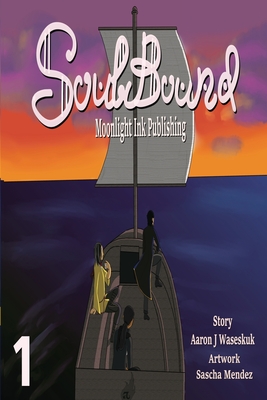
Soulbound by Aaron Wasekuk, featuring three figures on a ship.

Zilla: Fantasy is for young and old, so today we’ve got a coming-of-age series from Aaron Waseskuk. Aaron, can you tell us a bit about your books?

Aaron: SoulBound is a series following the adventures of Jaelyn as she unlocks the hidden magic powers dormant within her soul. Through the teachings of Master Oum & his protege, Ethan, they impart wisdom and skills, granting her strength to fight her own inner demon—as well as pirates, Monsters, and a cult of arsonists. But will her newfound abilities help her reunite with her family?

Zilla: What inspired you to write this book?

Aaron: Originally it started as Naruto fanfiction ages ago, but I liked the original protagonist enough to want to make something out of it. Ironically enough, he’s not even my current protagonist.

Zilla: Which of your characters do you most wish you could meet?

Aaron: I’d want to meet Oum, the mentor figure in Volume 1 and Volume 2. I love talking to old wise mentors. Sharing a cup of tea with him sounds delightful.

Zilla: Which of your characters would want to talk to you? What would they say?

Aaron: I think Sebastian (the protagonist of Volume 3) would demand to know where his mother is and why I’m so mean to him. I don’t think he’d appreciate either answer. What’s twisted is that he is my favorite character… eventually. He needs time to mature first.

Zilla: What makes Sebastian your favourite?

Aaron: His ability to see the future (among other things) has so much potential for weird and trippy story telling. Plus I have a lot of big ideas planned for him down the road. Jaelyn is #2, because she is our first protagonist and succeeding in making her a good character felt like a huge win to me.

Zilla: How much research did you need to do for your book?

Aaron: For a work of fiction, a surprisingly large amount. From technology of the time period to physics to color and dream theory. Even the names are researched and carefully chosen for each relevant character.

Zilla: Is your work more plot-driven or character-driven?

Aaron: I like to think the characters make their own decisions and I just relay what they do. I have an idea of where I want things to go. But, quite recently, we revamped an entire plot in which our hero escapes a dungeon. Instead of finding help like originally planned, he runs into another character who ruins the entire escape. But a new plot emerges from the choices of these two and I’m excited to see what they do next.

Zilla: Who did you imagine reading your book as you wrote it?

Aaron: I imagined myself as a teenager when I first got into anime and fantasy. People who grew up loving stories like Naruto, Avatar, and the like. We modeled a lot of SoulBound off Japanese anime and manga from its release to the world. If you like those types of world and stories, you’ll enjoy this.

Zilla: What’s your next writing project?

Aaron: We are looking into sci-fi for our next genre. It’s actually something we’ve been outlining for a while. Ghost Hunting, but in space. I’m excited to get to work on it once time allows.

Zilla: Thanks for sharing your story and your process. We’re looking forward to reading! Where can the Night Beats community find you and your book?
Aaron: This link has all the stores where you can buy our physical book and ebook, as well as our social media platforms. Audio and as early releases of chapters are available only on our Patreon. We are most active on Bluesky, Instagram, and Facebook.

Behind the Screens: Tuesday Author Interview

Every Tuesday, get to know a bit about the stories behind the books you love, and discover your next favourite novel.

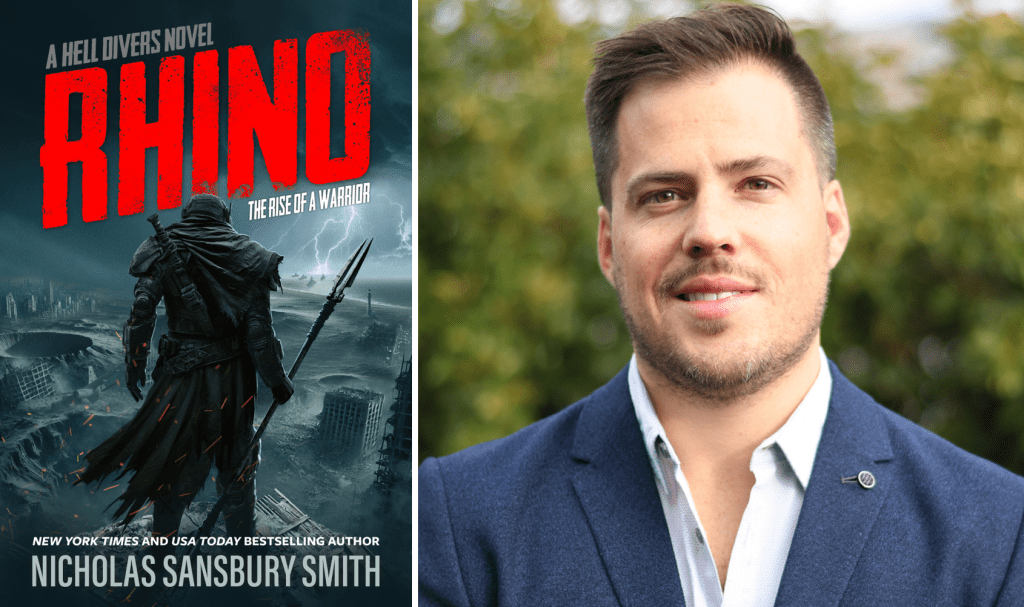
Cover for Rhino: The Rise of a Warrior: A Hell Divers novel by Nicholas Sansbury Smith, along with a photo of the author, a young white man.

Zilla: Write what you know, they said, and what Nicholas Sansbury Smith knows is disaster management—so he wrote a post-apocalyptic adventure novel Rhino. Nick, can you tell us the blurb?

Nick: Centuries after the Third World War reduced civilization to ashes in a global nuclear inferno, humanity clings to life in giant airships sustained by Hell Divers—brave souls who risk their lives plunging to the surface to salvage essential supplies to maintain mankind. But this is not their story. This is the saga of the survivors before them, the survivors on the ground.

 Embark on this riveting post-apocalyptic adventure centered on Nick Baker, a frail orphan born in the perpetual darkness of an ITC bunker. As raiders from the great Cazador empire descend—massacring and enslaving Nick’s people—witness his epic rise from boy slave to fearsome warrior bent on freeing his people from bondage. And discover the legend of a man whose enemies will come to fear as Rhino

Zilla: I love a good fight scene, and it sounds like Rhino: The Rise of a Warrior delivers with plenty of them. As a writer, how do you keep action sequences engaging while also realistic? Within ‘realistic’ for science of course—I’ll accept a mech suit but I won’t accept someone twisting out of a well-executed arm lock.

Nick: My action sequences are often based on the characters and their personal limitations and skills. Rhino might be the best story I’ve written to explain just how this works. For example, in the beginning of the story, when Nick Baker is just a boy, he is frail and has no fighting experience. He has the fire inside of him, but fire doesn’t translate into knowing Kung-Fu. This isn’t the Matrix. Instead, Nick gains weight, trains, and eventually is taught the art of warfare. It takes years before he can actually fight. He learns different weapons and how to use them. Accurately describing weapons is another important part of realistic fight scenes, as is depicting how the action works.

One thing a lot of writers don’t understand, and a lot of people in general, is that fighting requires extreme endurance. Just look at how tired boxers get over the duration of a long fight that goes to the bell. With action sequences it’s most authentic to show your characters getting winded and fatigued from combat, and for injuries to not just slow them down but disable them if severe enough.

In Rhino, I used all of the above to illustrate one boy’s transformation into man, and ultimately—warrior.

Zilla: On the news, we see the horror stories of national emergencies, but we also see community resilience as people come together. What did your time in Iowa Homeland Security and Emergency Management teach you about people’s ability to look after each other, and how did that play out in the book?

Nick: My time at HSEMD taught me humans are inherently good and help each other in the face of natural disasters. I also saw political views being pushed aside and people coming together. Neighbors help each other and communities organize. Of course, there will be some anomalies where this isn’t true (thieves, opportunists—often from outside of the disaster area), but for the most part when disasters strike, human instinct is to help. That is, when there are resources. That often changes when food, water, and supplies run out. Then you’re talking more of an apocalyptic novel, and I’ve written about that a lot on how people react. There are still communities coming together, and neighbors helping each other, but when shit really hits the fan, you start seeing more desperation, which drives people to panic, and sometimes—violence.

Zilla: I am a massive Mad Max fan, plus I love all the various sequels and spin-offs. Are there specific motifs from that series that inspired you as you wrote?

Nick: Definitely the world building and the plot around controlling the petrol. If an apocalyptic world like that were to exist, just like in Rhino with the Cazador Empire he becomes part of, survival would be driven around resources, specifically fuel. This is a theme in this story and the entire series for that matter. Other inspirations would be from the modified vehicles. I’ve done that to the boats/ships in the Hell Divers series. You’ll see some of that in Rhino as well. I absolutely love writing in this type of destroyed environment. It’s haunting and brutal, in a beautiful way.

Zilla: What’s your next writing project?

Nick: I am working on multiple projects: a military sci-fi saga with a co-author, and then a LitRPG apocalypse trilogy, plus more Hell Divers books. I enjoy writing multiple storylines at once, as it keeps them from going stale for me. Readers are smart, they know when writers are bored with their work. I don’t get bored usually because I take time off from writing stories that might otherwise feel more like a chore if I had to write the same thing every day. I got asked the other day if I ever run out of ideas—nope, I wish I had more time to turn more of those ideas into stories!

Zilla: Thanks for sharing your story and your process. We’re looking forward to reading! Where can the Night Beats community find you and your book?
Nick: I’m on Instagram, X/Twitter, and Facebook. You order Rhino on Amazon, Apple BooksB&N, or| Bookshop.org.

Behind the Screens: Tuesday Author Interview

Every Tuesday, get to know a bit about the stories behind the books you love, and discover your next favourite novel.

MEDIANICAL AGE: Drifting through the tides of time by M.A. Alvarez, showing a group of characters in a space setting.

Zilla: M.A. Álvarez brings us a time travelling blend of science fiction and fantasy, Medianical Age. M.A., can you tell us a bit about your novel?

M.A.: Medianical Age: Drifting through the tides of time is my first work to be translated into English. The book was launched on February 28, 2025, the same day as the great planetary alignment of seven planets!

The book includes illustrations by me, such as the one featured on the cover, depicting the characters in the novel. Medianical Age is a play on words composed of medieval, age and mechanical. This is because the story takes place in medieval times and in a distant mechanized future as follows:

One promising day, sometime in the Middle Ages, a deceitful and charlatan surgeon goes to a castle and assures the lord that he can cure his son’s madness by removing a stone from his head. Since childhood, he has claimed to see strange beings, which only he can perceive, and this has led to his confinement by his ashamed family.

In the distant future, a renowned visionary known as K-79 receives an important award for his work in the world of science: the construction of cyborgs from people who were about to die in the past, for different purposes.

Everything seems to be going according to his plans; however, K-79 detects an anomaly in the Middle Ages and discovers that its existence is in danger …

Zilla: What inspired you to write this book?

M.A.: I enjoy writing historical fiction, and for this novel, I was inspired by the contrast between a bygone era, like the Middle Ages, and a distant, technological future. I wanted to explore the conflict between superstition and science. It also gave me the opportunity to combine different literary genres.

Zilla: Getting historical fiction right isn’t easy! How much research did you need to do for your book?

M.A.:This book required a lot of research, especially for the Medieval period. Fortunately, I am passionate about history, and I love researching information for my books. Additionally, I often attend historical tours, and I have visited many medieval castles!

Zilla: How is the plot structured?

M.A.: The structure of the plot is like a puzzle, where the pieces fall into place in the end, affecting all the characters. This is due to the time travel elements—particularly one that is quite unexpected…

Zilla: Thanks for sharing your story and your process. We’re looking forward to reading! Where can the Night Beats community find you and your book?
M.A.: The book is available on Amazon and you can find more information about it, as well as my social media links, on my website.

Behind the Screens: Tuesday Author Interview

Every Tuesday, get to know a bit about the stories behind the books you love, and discover your next favourite novel.

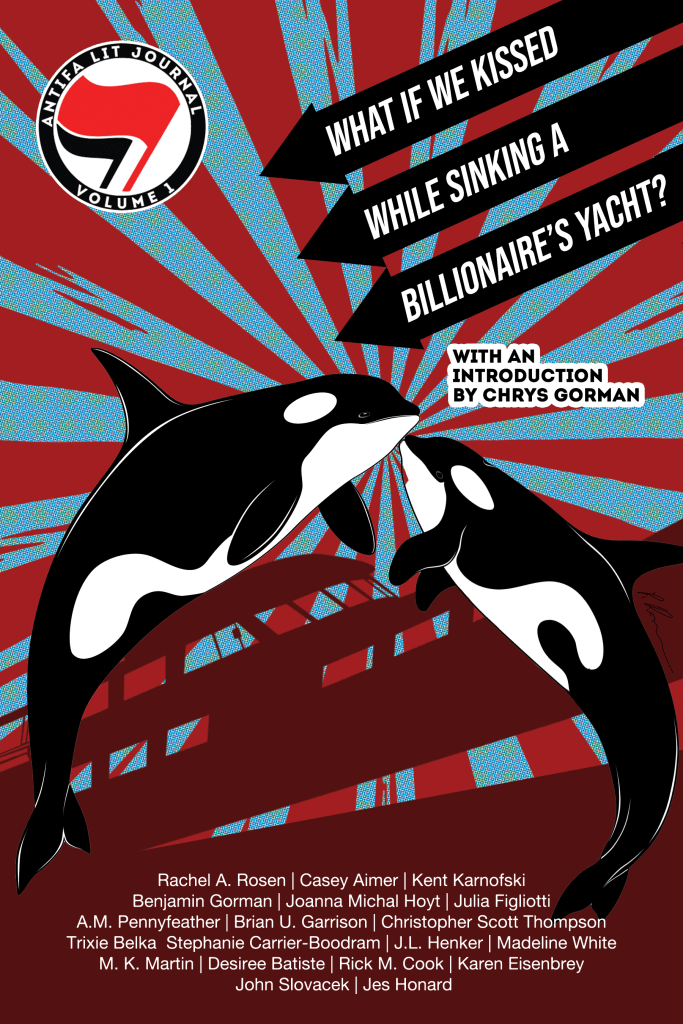
Antifa Lit Volume 1: What If We Kissed While Sinking a Billionaire's Yacht? with an introduction by Chris Gorman. The logo has the red and black antifa flags with the text around a circle. There's a starburst in red and blue. A silhouette of a yacht is going down in the background, with two orcas leaping up in the foreground. There's a long list of authors.

Rachel: With us today is Benjamin Gorman, editor and contributor to the Antifa Lit Journal, which, if I do say so myself, is a rad book. Tell us a little about the anthology, Ben! What is it, and how did it come together?

Ben: We had decided as a family that we would need to leave the US if Trump won the election, so between Election Day and Inauguration Day, we liquidated our possessions and Chrys (who wrote the introduction to Volume 1), our kid Franke, our three dogs, and our two cats relocated to Spain. In the midst of all the insanity of the move, I processed it by writing an explanation that started as a draft of a Facebook post, then a longer blog post, and became a whole book, Dear America: A Breakup Letter. It was published by Not a Pipe Publishing just as we were safely across the border, and it did surprisingly well. A lot of people were in the same headspace, though I understand not everyone can leave the country. Watching all that interest in the book while we were absorbing the daily nightmare of American news, Chrys suggested publishing an anthology of anti-fascist poetry and short fiction. Not a Pipe has published themed anthologies before, like Written with Pride, the all-LGBTQIA+ anthology, and Strongly Worded Women, by exclusively women authors. The response from authors and poets was overwhelming. So many talented writers were desperate to have a venue to speak out against fascism, to process their fear, and to provide readers with an alternate vision of the future. As we poured over all the submissions, we realized we could easily populate a regular journal with high quality short fiction and poetry. So the anthology became Volume 1. And our intention is to keep it going as long as there’s an appetite for it. I don’t foresee this regime going away nearly as quickly as some people expect, and I think we’ll see increases in fascism, especially in terms of would-be-autocrats leveraging anti-immigrant sentiment, all over the wealthy world as the people from countries we’ve made uninhabitable through our climate colonialism decide to move to the places where they can still live above water and below 130° F/ 55° C. There will be very real consequences in terms of housing, supply chains, etc., and I fear that instead of trying to be welcoming, a lot of countries will turn to demagogues. We’ll need people of conscience to speak out, and writers often fill that role. 

Continue reading

Behind the Screens: Tuesday Author Interview

Every Tuesday, get to know a bit about the stories behind the books you love, and discover your next favourite novel.

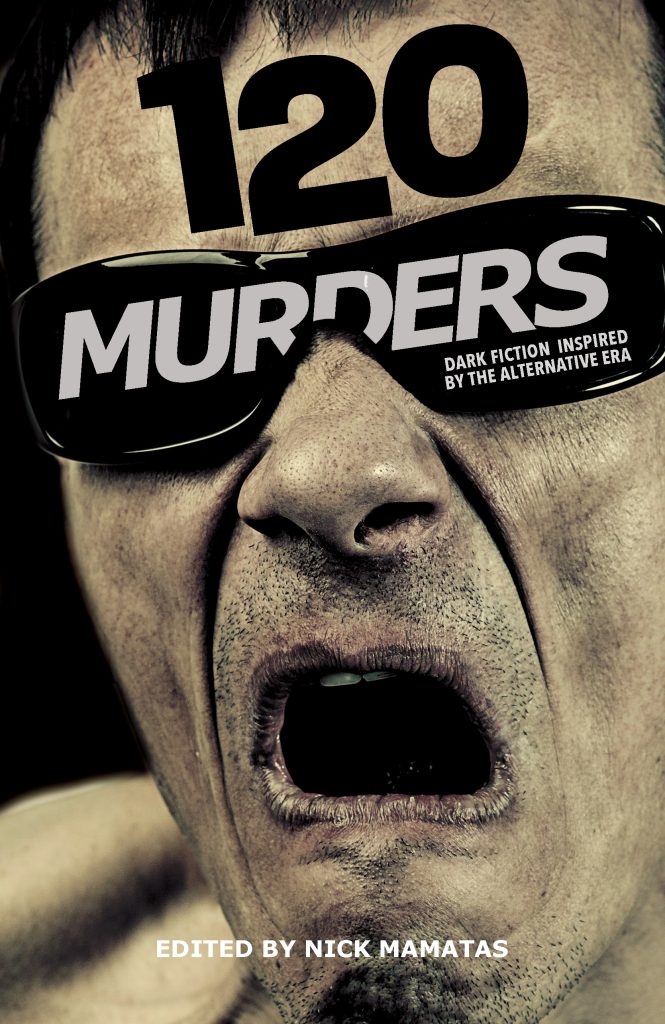
120 Murders: Dark Fiction Inspired By the Alternative Era, edited by Nick Mamatas. Closeup of a screaming white man wearing sunglasses.

Rachel: Nick Mamatas is a fantastic author and a longtime friend, and every time he puts out a new book, I know I’m going to love it. This one is no exception, and I’m thrilled that he’s here to tell you about it. Nick, please tell us about yourself and 120 Murders.

Nick: I’m Nick Mamatas, an author and editor. My most recent editorial work is the editing of the anthology 120 Murders: Dark Fiction Inspired by the Alternative Era. I asked top writers of noir, gothic, and horror fiction to write a story inspired somehow by the songs played on college radio and “alternative” music video programming blocks, and, boy howdy, did they!

It’ll be published by a new independent press, Ruadán (pronounced ROO-ah-dawn) Books, which focuses on all manner of dark speculative fiction.

120 Murders includes brand new stories by William Boyle, Selena Chambers, Jeff Chon, Libby Cudmore, Jeffrey Ford, Meg Gardiner, Todd Grimson, Cara Hoffman, Maxim Jakubowski, Alex Jennings,  Cyan Katz, Josh Malerman, Michael Marano, Silvia Moreno-Garcia, Zandra Renwick, Jason Ridler, Veronica Schoanes, Elena Mauli Shapiro, Brian Francis Slattery, Molly Tanzer, Chris L. Terry, and Paul Tremblay, as well as little notes about their musical tastes.

Rachel: One of the hazards of growing older is that delusion that the pop music you listened to when you were 17 was truly the best pop music ever produced by humanity. For GenX, of course, that is objectively true. In Ghosts Of My Life, Mark Fisher talks about the material conditions that led to post-punk, and how they no longer exist to produce music with the same originality and emotional resonance. Is there something about the alternative era that lends itself particularly well to horror, dark fantasy, and noir?

Nick: There might be some biases built into that conception. I remember when Don’t Tell a Soul came out; most Replacements fans I knew thought something along the lines of “What the hell is this?!” and now that album is a classic, I guess. Do people still listen to Helium? I suspect not. I just tried and almost made it through “Superball.” Yow! 

But I do agree; the 80s and 90s were the last time when rents and rehearsal space were cheap enough, but recording equipment expensive enough, that bands would write and play out and perfect their sounds, and then be discovered and signed. The incubation period for songwriting has been drastically shortened thanks to self-releasing, and labels for lack of something to spend their capital on so focus on brand development over band development, and high-priced producers and songwriters/punch-up artists that flatten sounds and eliminate lyricism. You can’t mass produce “It’s so easy to laugh, it’s so easy to hate/ It takes strength to be gentle and kind.” It doesn’t rhyme!

Deeper lyrics tend to be darker. Analog production tends to sound dirtier. Reagan, Thatcher, and Kohl, those great annihilators of society, gave everyone plenty to write about. Now everyone’s a Reaganite—1980s Reagan in economics and queerphobia, 1960s Reagan in racism. One can hardly even object to it anymore; what’s a ruin when it’s your cradle?

Rachel: Horrifying, though I am relieved it’s not just because I’m old. What was your process for assembling the collection? Did any authors have to fight it out for a particular song?

Nick: I asked the writers whose short stories I like, and begged some famous friends whose short stories I like, to lend me their names and then went hunting for money. For the most part, everyone wanted something different to riff off of, though for a moment there 120 Murders looked like it might have ended up 120 Murmurs–an R.E.M. tribute. 

I was also quietly open to query letters, which, back in the old days, every anthologist was. The SATization of submissions by editors, who claim to be interested in new voices, mean that many anthologists don’t entertain query letters, which I think is a huge mistake. Slush piles are an extremely inefficient way to find new voices, but they do serve to make editors objects of respect and fear among hundreds of hopeful submitters, which is often rather the point of launching some anthology or magazine project. You get prominent writers to love you by giving them money, and would-be writers to fear you by holding forth on social media about how writers aren’t following submission guidelines or are otherwise being bad boys (almost always boys, of course).

One might say that querying serves as an in politic, as someone needs to know how to write an effective business letter, but that’s a skill one can master in an afternoon. Others suggest that it serves as a barrier against writers who are shy or lack confidence. I’ll say that several people tweeted/commented to me, publicly, to ask when/if/why wouldn’t I open to slush submissions. Anyone nervy enough to ask an anthologist to quintuple his workload, and to attempt a bit of public shaming while they’re at it, is certainly brave enough to just write and privately send a normal query letter.

Three of the stories in the final book were query acceptances, and a fourth was the author’s fiction debut. Cyan Katz was a student in an online workshop I ran and I was impressed enough with their work, which was wild and raw and had a very “punk” feel, that I solicited them for a story and worked to get it into great shape. Other authors generally needed light edits, or some rewrites, or were given a second chance after the first story wasn’t great.

Rachel: With BookTok and niche online communities, the many genre markets are increasingly segmented, and trend-chasing publishers seem to be leaning towards cozy, hopeful stories. What were some of your motivations and challenges when pushing back against these trends?

Nick: I’m very skeptical of the cozy trend, though every subgenre and movement has its virtuosos and its hacks. The top three percent of anything is going to be great. I do think there are two trends—plenty of cozy and hopeful, but also a lot of dark stuff. Barnes & Noble here in the US has a horror section again, major publishers have relaunched horror lines for the first time in thirty years, and neo-noir is pretty huge. There may even be a cozy story in 120 Murders, though the author and I disagree about how cozy it is. I think any story with a closetful of desiccated corpses is pretty dark.

In crime fiction, there’s been a microtrend toward anthologies in tribute to this or that musical artist. I even have a story in one, Lawyers, Guns, and Money, which is obviously a Warren Zevon tribute. Some of the book themes are a little shakier, honestly. I thought a broad musical range—all of college radio and alternative—and a thematic range of noir, science fiction, crime, and gothic—would make more sense, or would at the very least put a bullet in the head of the trend.

Rachel: I would never ask you to pick favourites, but are there any particular images or moments from any of the stories that live rent-free in your head? What are they?

Nick: Bunches! I’ll list a few. One of the stories begins with its author contemplating being solicited for the story she is writing and the reader is reading. My name is in it, so of course I love it. We have queer cyborgs who actually do queer things on the page, alleyways full of broken glass sparkling under the streetlamps, a big pile of sloppy joe mix plopped atop a cardboard chore wheel (ew!), poor Jeffrey Ford writing about a very Jeffrey Ford-type guy being shot in the head for being annoying (Jeff, no!) a horrific historical scene of butchery and cannibalism, and much much more.

Rachel: Cara Hoffman’s author’s note references “collective loneliness,” and “art from garbage and lack,” concepts that as a cynical Gen Xer immediately resonated with me. What does this era of music—and the stories inspired by it—tell us about our struggles today?

Nick: There’s a weird social media trend in which Gen X people describe themselves as feral and tough because they were latchkey kids and roamed the streets freely and had to get up and walk across the room to change the TV channel. It’s extremely tedious, if you ask me, and obviously just whistling past a graveyard.

But art from garbage and lack is totally it. The internet is dead; this interview may well be the only non-AI tainted thing a reader may come across today, and even then they’ll likely just find it via links you and I post to our social media accounts. Does anyone just stop by any website anymore to see what’s up? Amazon Prime Day, maybe! Ugh. So we are back to where we were in 1992—photocopy machines (many books are print-on-demand, that’s just big photocopying!) and homebrew movies (albeit with phones and not VHS camcorders) and singing over beats. If the Sisters of Mercy had Doktor Avalanche (the first Dr was a Boss DR55 drum machine that could produce all of four sounds) and toastmasters and MCs had the first twenty seconds of a vinyl track to work with in the 1980s and 1990s, well, so do we. The struggle is going to be to find our humanity between gaps in the algorithm, and as the last people to hit adolescence in an analog world, Gen X and Xennials have something to say and something to share.

Rachel: I’ve already read it, but where do normal readers get a copy? And how do they find you?

Nick: Find me on Bluesky at nmamatas!

On Instagram I mostly post license plates and pizza slices, but there I am concentrateandtryagain. You can get 120 Murders at a nice discount, with a bonus story by me bundled in with your receipt, at the publisher website. I would also highly recommend special ordering a copy from your local independent bookstore, though the book will also be available via the megachains—emphasis on the word chains, if you catch my drift. You don’t want to be chained, do you?

Revealing Blight (The Sleep Of Reason #2)


“They would have you believe all hope is lost. So let them see what it looks like when we fight without hope.”.

I’m so excited to share the cover for Blight (The Sleep Of Reason #2). It’s the sequel to Cascade, and follows the surviving characters as they struggle to navigate a new, post-disaster world shaped by feral magic, demons, and tyranny.

The cover illustration is by the fabulous Marten Norr. You can find more of his work at Flower Prince Draws.

As for the book itself—it will be released in Spring 2025 through The BumblePuppy Press. Can’t wait that long to read it? You can reach me through my contact page for an Advance Review Copy, or just wait for the ARC signup sheet that I’ll be posting soon.

If you haven’t read Cascade yet, what are you waiting for? I’m so excited for you to read Blight, but it’ll make much more sense if you read Cascade first. You can buy it anywhere online or through the publisher.

Praise for Cascade:

“A near-perfect blend of implacable horror, gallows humor, and ecological apocalypse.” — Peter Watts, author of Blindsight

“Finally, an urban fantasy that kills the cop — and the rest of the government — in your head. Relentlessly radical and often hilarious, Cascade will change the way you look at magic, and the state, forever.” — Nick Mamatas, author of The Second Shooter

Advance praise for Blight:

“Suffused with masterful horror and black humour and compassion for its beleaguered and all-too-human characters, this spellbinding chronicle of leviathanic magic, political intrigue, and righteous insurrection hurls a molotov cocktail at the evil lurking in humanity’s banal appetites for control.” — Dale Stromberg, author of Maej

 “Rosen is a daring voice in Canadian SFF, and she’ll break your heart while making you laugh.” — Michelle Browne, author of Meaning Wars

“Rosen’s ability to create such a beautifully vivid picture of a vicious world as it slowly chokes to death is simply breathtaking.” — Rohan O’Duill, author of Cold Blooded

“A worthy sequel to an epic ecofantasy. The world’s on fire, it’s time to lick our wounds and start putting it back together.” — Zilla Novikov, author of Query