Behind the Screens: Tuesday Author Interview

Every Tuesday, get to know a bit about the stories behind the books you love, and discover your next favourite novel.

Cover of Deads Rise! by Shawn Whitney. It's yellow and pink with a woman with her fist upraised and a skeleton overlaid on her. Other text is "No signs of life book one" and "Dying is just the beginning...".

Rachel: We love to get politics all over our pulp fiction, so here’s screenwriter and novelist Shawn Whitney to tell us about his latest book, Deads Rise! Shawn, tell us about the book!

Shawn: It’s the first in a series called No Signs of Life. When half the world’s population suddenly drops dead, humanity braces for the zombie apocalypse. But as the “Deads” reawaken hours later, it becomes clear this is something far more complex.

Tanitia Mortero never asked to die, let alone rise again. Now, she finds herself caught in a war between the living and the Deads – a war fueled by fear, misunderstanding, and a refusal to accept that death was just the beginning of a startling evolutionary leap.

Rachel: That sounds rad, and hints at something more complicated than your typical action-horror.

Shawn: My own work focuses on typically unrepresented folks. However, when I’m writing to pay the bills, I have to write what my publisher tells me. That means male-led and even restricts the kinds of men that can appear because apparently the audience for male-led sci-fi is so fragile that they can’t even handle a flawed hero or they will explode into a thousand tiny pieces of testosterone. Nonetheless, I try to squeeze in some thoughtful elements that relate to social change, changing consciousness and personal transformation.  

Rachel: Testosterone explosions sound like the least fun type of apocalypse. What inspired Deads Rise?

Shawn: It might have been seeing the film adaptation of The Girl With All The Gifts, to be honest. I saw it and thought “what if the zombies were the heroes in the zombie apocalypse story?” Originally it was conceived as a kind of YA TV series but getting anything past first base is easier at a Mormon summer camp than in the film/tv industry. So, it sat for a couple of years till I decided to make it a novel.

Rachel: Do you have a playlist for your book? Can you tell us why you picked a couple of the songs?

Shawn: Lots of Rage Against the Machine. Always. Maybe some Wet Leg and Gil Scott Heron —both the Revolution Will Not Be Televised and Whiteys On The Moon. Largely for the particular energy of the music for different plot points. Heron for a pivotal scene near the end of the book.

Rachel: Speaking of good taste, what book do you tell all your friends to read? Besides yours, of course!

Shawn: At the moment it’s Children of Time. I was blown away by how the writer handled an alien species’ consciousness, culture and history. And how they created a continuous character through multiple generations.

Rachel: And it’s another great example of making the “monster” the hero of the story. Do you have any suggestions to help people in our community become better writers? 

Shawn: The most important thing to do is to write a lot and write to the end. Practice makes perfect. The more you work a muscle, the stronger it gets. 

Then start writing another novel because you don’t want to be one of those writers who never finishes their books. Once you get past your first, it’s important to learn not to be precious about it. I’m not saying you need to crank out ten a year—and maybe your pace of writing and the spaces in your life only allow one every couple years. But don’t let perfection be the enemy of the good.

There’s no right way. I started reading John Truby’s Into the Story and I got so annoyed with him constantly emphasizing how brilliant he was and how all other methods were wrong that I stopped reading it. There are some rules to writing—rising action, conflict, etc. But there’s many ways to skin a novel.

I remember people used to say “writers are readers. You should read obsessively.” Yeah, well, I don’t. I have a job, two kids, a house to maintain. And I also want to read about what’s going on in the world and understand the source of conflicts or scientific advances or whatever. Sometimes I want to watch TV. There’s only so many hours in a day. Don’t beat yourself up if you don’t read a book a week.

Rachel: What’s your next writing project?

Shawn: For my publisher, I’m ghostwriting a trashy, male harem fantasy story set in Hell. Gotta pay the bills! For myself, I’m torn to be honest. I just finished the second book in the No Signs of Life series. I’d like to take a break from that world and I’m tossing around a few different possibilities, all sci-fi. You know how it is; ideas are never wasted; they just come back as new story ideas down the road.

Rachel: We’re so looking forward to reading Deads Rise! Where can our community find you and your work?

Shawn: You can find me at my website, shawnwriteshere.com, or my Amazon author page. I can also be reached via email at shawn@shawnwriteshere.com. on Twitter I’m @shawnwriteshere. On FB I have a page called Shawn Whitney – author guy that absolutely nobody goes to.
Maej by Dale Stromberg with Vegetable Stew

Fiction To Sink Your Teeth Into, a feature normally written by professional chef Rohan O’Duill, has been taken over this month by Rachel A. Rosen, who co-wrote a book about being bad at cooking.

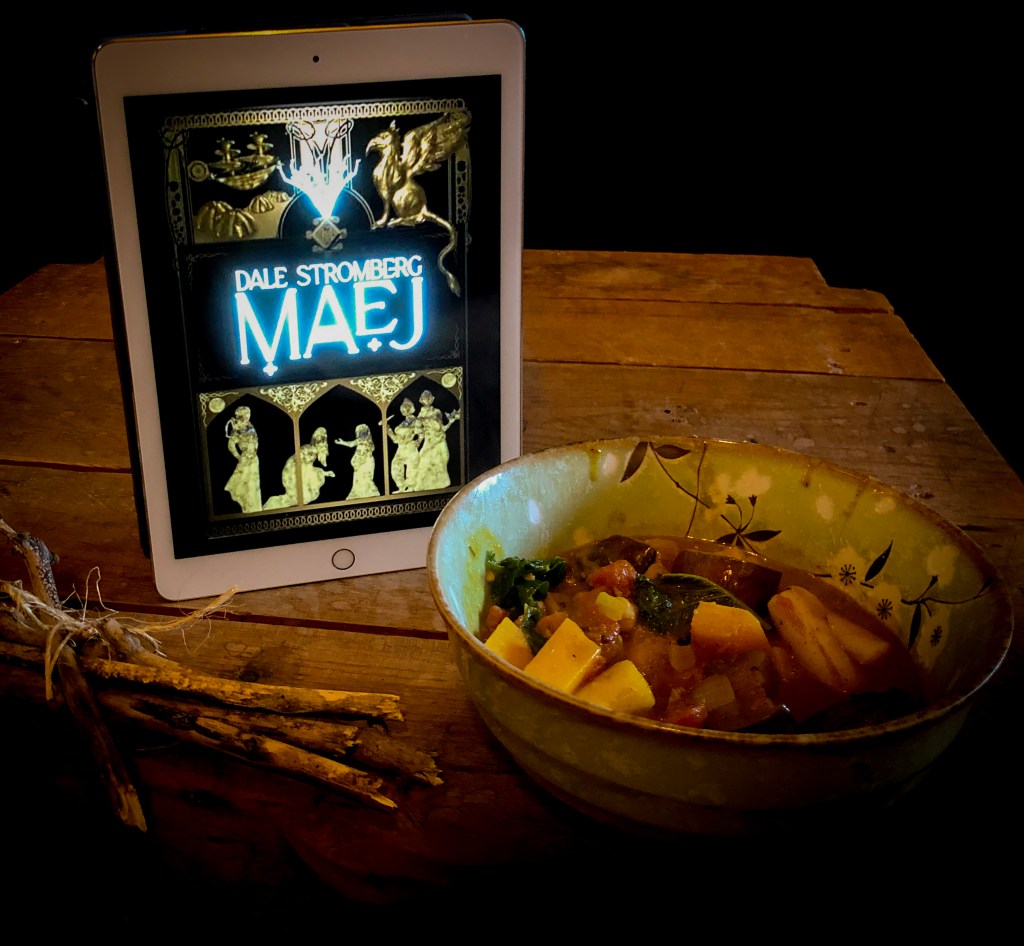
In Dale Stromberg’s Maej, Madenhere and Taræntlere eat meersaw-gossamy, described as a flavourful stew of “squash, aubergine, egg, and garlic.” I asked him for details about what it tastes like, and he told me they were never afraid to throw in chilies, and that “any dairy was rhinocerote milk and eggs are likely peahen eggs.” Lacking access to rhinocerotes and being vegan myself, I created a slightly less ambitious version.

An ebook copy of Maej by Dale Stromberg on an iPad. It's sitting on a rustic wood coffee table. There's a bowl of vegetable stew and some sticks bundled together.
Continue reading

a + e by Ryszard Merey with Orange Tic Tacs

a + e (Seasons Book 1: Spring) by Ryszard Merey is a haunting and luminous tale of doomed queer love and friendship. If you’ve ever had a teenage crush on your best friend, snuck into a club wearing fishnet, or otherwise got your mess splattered over everyone else in your life, this book is for you. In it, Ash seems to subsist entirely off orange Tic Tacs, while Eu eats everything he won’t touch.

The cover of A+E, which doesn't even have the author's name or title on it, on an iPad. It depicts two gothy, gender-ambiguous teenagers in an embrace. In front of it, sitting on a picnic table, is a package of orange tic tacs, some of them on the table itself. I had to chase a cat off the picnic table to get this shot, and he used this opportunity to sneak into my house and start eating my cat's food, so I hope you appreciate my sacrifice here.
Continue reading

Behind the Screens: Tuesday Author Interview

Every Tuesday, get to know a bit about the stories behind the books you love, and discover your next favourite novel.

An issue of Clarkesworld with an astronaut in a desert looking planet. Another astronaut in the background is tying strings to a spaceship. The issue features a bunch of authors, including today's protagonist.

Rachel: I’m obsessed with Zohar Jacobs’ short stories, and every time she publishes one, I have to send the link around to everyone I know and yell at them until they read it. Today, she’s joined us to tell our readers about her work!

Zohar: I write science fiction and slipstream, and so far have had stories published in the Sunday Morning Transport, Small Wonders, Analog and Clarkesworld. I also have a story forthcoming in Asimov’s.

Rachel: I’m always impressed by the religious and cultural questions you address in your writing, whether it’s about the role of religion on a Soviet lunar base or the question of whether a paired intelligence counts as one person or two in a minyan. Religion is such an under-explored concept in sci-fi—what draws you to exploring it?

Zohar: Mostly I’m getting back at Gene Roddenberry for how badly he dealt with religion in Star Trek. Although I’m an agnostic, religion has always been part of my life, and it’s one of the most complex social and intellectual systems that humanity has created. Why assume that we’d leave all that behind? You could actually argue that the feeling of being unmoored by distance from Earth and the scale of the universe might make people turn to religion more.

Rachel: Another theme I see in your writing is the engagement with real-world issues such as the climate crisis or the war in Ukraine? What are the challenges of writing about a future that is so grounded in our present?

Zohar: Oddly I’ve never thought of it as a challenge. I sometimes think that I’m not a very creative person: reality is always where I get my inspiration, because it comes up with much more complex and bizarre scenarios than I ever could. By hewing close to reality, I can expect my readers to bring their own set of rich, independent associations to my work. I guess the challenge is that I can’t predict how people will take my writing – but I’m not sure I could do that anyway.

Rachel: How important is literary voice in science fiction?

Zohar: Many SF readers prefer transparent, pacy prose that doesn’t get in the way of the story: think Andy Weir’s The Martian. So maybe it’s not that important. On the other hand, some of SF’s best writers have been great prose stylists – Ursula le Guin, Samuel R. Delany, M. John Harrison – so it’s clearly no obstacle to success either. Literary voice is important to me, but then I sometimes joke that I’m actually a literary author who just likes spaceships too much.

Rachel: What’s your next writing project?

Zohar: Funnily enough, a literary novel. It feels odd to temporarily step back from the SFF community, but this is a story that I’ve been wanting to tell for nearly 20 years. (It has spaceships too.)

Rachel: Tell us where the Night Beats community can find you and find your work!

Zohar: Apart from the magazines where I’ve been published, you can find me on Twitter @zoharjacobs and BlueSky @zoharjacobs.bsky.social. One of these days I will set up a website but this is not that day yet.

Behind the Screens: Tuesday Author Interview

Every Tuesday, get to know a bit about the stories behind the books you love, and discover your next favourite novel.

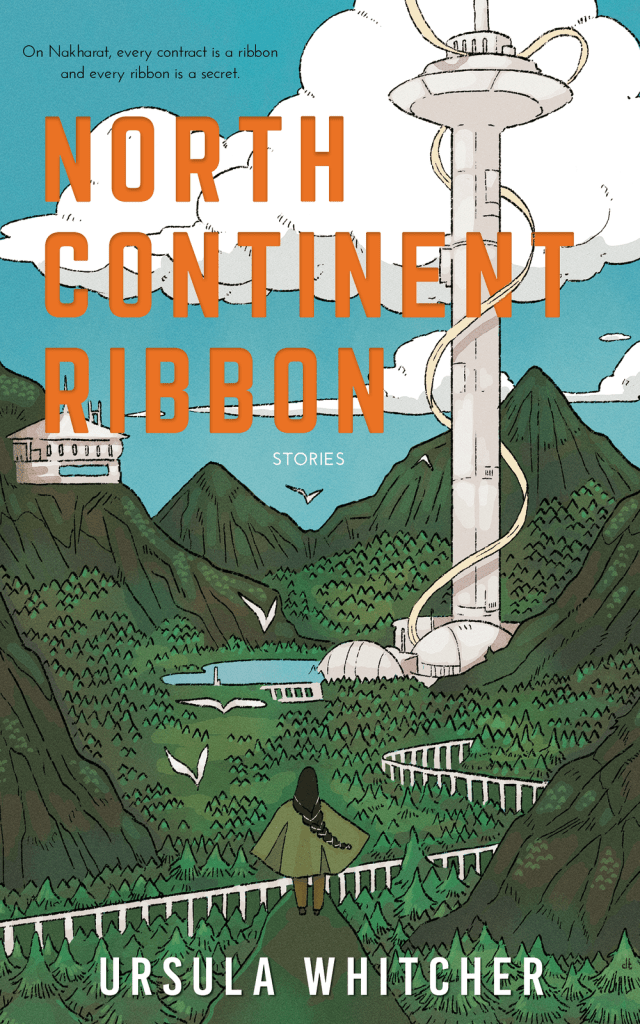
North Continent Ribbon: Stories by Ursula Whitcher. The tagline reads: "On Nakharat, every contract is a ribbon and every ribbon a secret." The cover depicts a person in a cape watching birds fly over a wooded valley. There's a small settlement and what looks like the CN Tower with a ribbon winding up it.

Rachel: I’m a sucker for intelligent, literary sci-fi, so when I finished reading North Continent Ribbon, I immediately asked Ursula if they’d be interested in telling our readers about it so that I’m not screaming about how good it is all by myself.

Ursula: North Continent Ribbon is a collection of connected, queer short stories that’s coming out in August.

Here’s the blurb:

“On Nakharat, every contract is a ribbon and every ribbon is a secret, braided tight and tucked behind a veil. Artificial intelligence threatens the tightly-woven network. Stability depends on giving each machine a human conscience—but the humans are not volunteers.”

Rachel: I was struck by the theme of connection and relationship, both visible and hidden, in North Continent Ribbon. Did this theme emerge organically or did you intentionally build the stories around it?

Ursula: It’s organic! The intentional organizing theme is different parts of Nakharat society—I wanted it to be clear why one person would hate the judges or the army or the Companies but another person might try to join up. But I wrote queer romances while thinking through facets of my own identity, and I was curious about the role bigger social groups like student clubs and groups of drinking buddies play in social change, so I’m not surprised you see a more intricate web.

Rachel: The collection covers multiple eras of Nakharat history, which feels very rich and lived-in. How much worldbuilding exists off the page?

Ursula: In some places there’s a ton, while other parts of the world are more of a mystery. I have lots of thoughts about the culture of the titular North Continent, plus miscellaneous facts (ask me about ocean ecology or grammatical genders!) Other locations are wide open.

Rachel: My absolute favourite element of your world was the grim wire technology in the trains and spaceships, and what it says about labour, class, and automation. Where did that idea originate?

Ursula: The very first writing I did about Nakharat involved an even more furious adult version of the “Last Tutor” protagonist, Isekendriya. I knew that Isekendriya grew up on a mountain estate overlooking wide, empty plains, that the thought of their parents filled them with rage and guilt, and that nevertheless they wore a ribbon in the family colors hidden in their hair. I asked myself what kind of wealth leads to an estate in the middle of nowhere, and the answer was transportation—specifically, trains. 

The combination of ribbon imagery, train tracks, my character’s fury at their complicitness, and my own feelings about the US justice system led to the creepy technology you see in the book. I’m glad you found it compelling! I definitely did—compelling enough that I kept writing stories set on Nakharat, and eventually wrote my way back around to Ise.

Rachel: One of the challenges of short stories is creating characters that the reader can bond with, and who experience growth and change, within a very limited number of words. How do you balance economy of storytelling with creating complex and compelling characters?

Ursula: I cheat and write novelettes! As a poet, I expected that my natural fiction range would be very short. But I love the freedom that a novelette (about twice the length of a traditional short story) allows me to explore the psyches of characters who are uncertain or conflicted about what they want.

Rachel: Will you be revisiting Nakharat? What are you working on now?

Ursula: Right now I’m working on a couple of different historical fantasy projects (Napoleonic wars? Byzantium?) But I haven’t ruled out a return to Nakharat! One of the stories is about an artificially intelligent book, and I’m curious about whom else the book might meet.

Rachel: Tell us where the Night Beats community can find you and find your work!

Ursula: You can pre-order a hardcopy of North Continent Ribbon from Neon Hemlock Press.

If you want an alert the moment the ebook pre-order goes live, or you’re curious about what else I’m working on, you can subscribe to my newsletter:

And I’ve been spending lots of time hanging out on Bluesky ( @yarntheory.bsky.social ).

High tea paired with Lewis Carroll’s Alice’s Adventures in Wonderland

Fiction To Sink Your Teeth Into is usually a feature from author and chef Rohan O’Duill, but this month, Rachel A. Rosen is hijacking it.

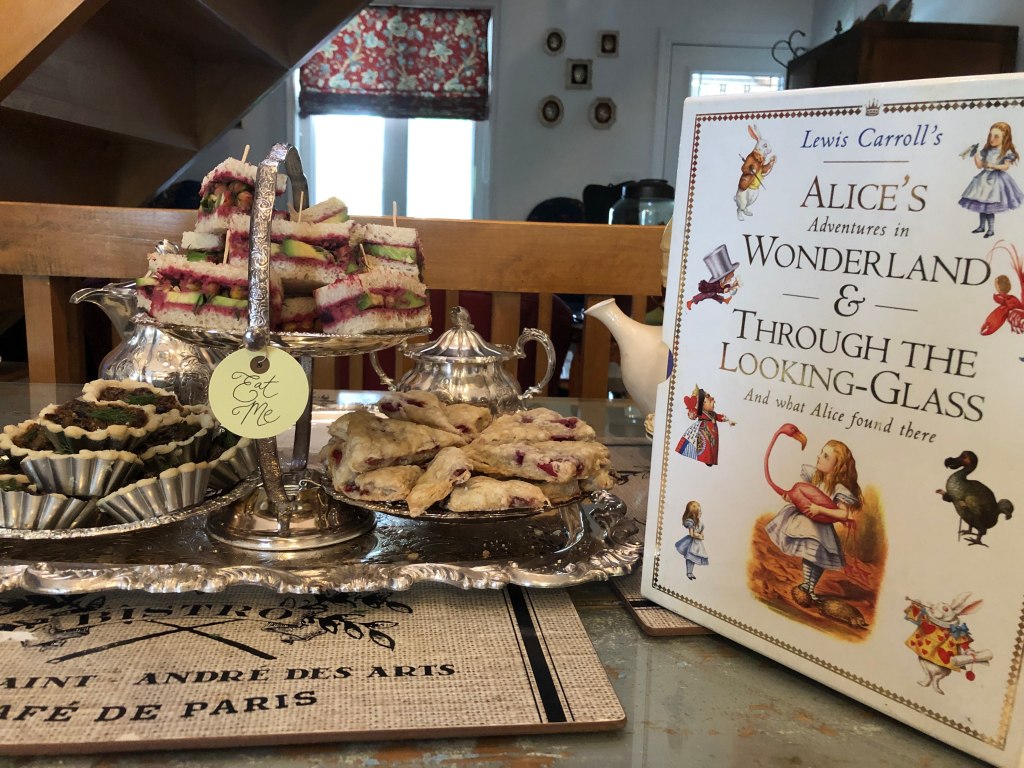
I was obsessed with Alice’s Adventures in Wonderland and Through the Looking-Glass before I could even read, and paired with my love of baking shows, I have been dying to do a Mad Hatter Tea Party for ages. It’s complicated by the lack of cooperation from the small woodland creatures in my vicinity, plus the fact that I’m vegan. I made several recipes for this, with varying degrees, and I’ll share the most successful ones here.

Lewis Carroll's Alice's Adventures in Wonderland & Through the Looking Glass and What Alice Found There, next to a display of tiny sandwiches, mini tarts, and scones. There's a silver sugar bowl and the edge of a teapot in the background. A little label that says "eat me" is on the display.
Continue reading

Baozhi dumplings with The City We Became by NK Jemisin

Fiction To Sink Your Teeth Into, a feature from author and professional chef Rohan O’Duill!

As the characters take on their roles as city boroughs and scramble to find each, other they get offered a plate of Mrs. Yu’s Baozhi dumplings. It is hungry work becoming a city after all. These dumplings do require a bit of skill but they will be well worth it as you bite into one and enjoy Jemisin’s beautifully written book.

A ridiculously beautiful steamer full of dumplings in front of N.K. Jemisin's "The City We Became."
Continue reading

Announcing: Guaranteed Bestseller (That No One Will Read)

Guaranteed Bestseller offers nine sardonic tales holding a carnival mirror to writers and stories. From a deal with the Devil to the ultimate AI vs human showdown, witness the terrifying spectacle of artists who’ll do anything to clamber out of the creative trenches alive.

Sign up for an exclusive cover reveal, be part of our ARC team, and read the book before everyone else!

https://forms.gle/Rvh48t7EoLaK4wNS9

the bottom of a tablet showing paper ripped away. Underneath you can see a face on the butt of a demon. Below it, the text reads "Coming Soon"