Behind the Screens: Tuesday Author Interview

Every Tuesday, get to know a bit about the stories behind the books you love, and discover your next favourite novel.

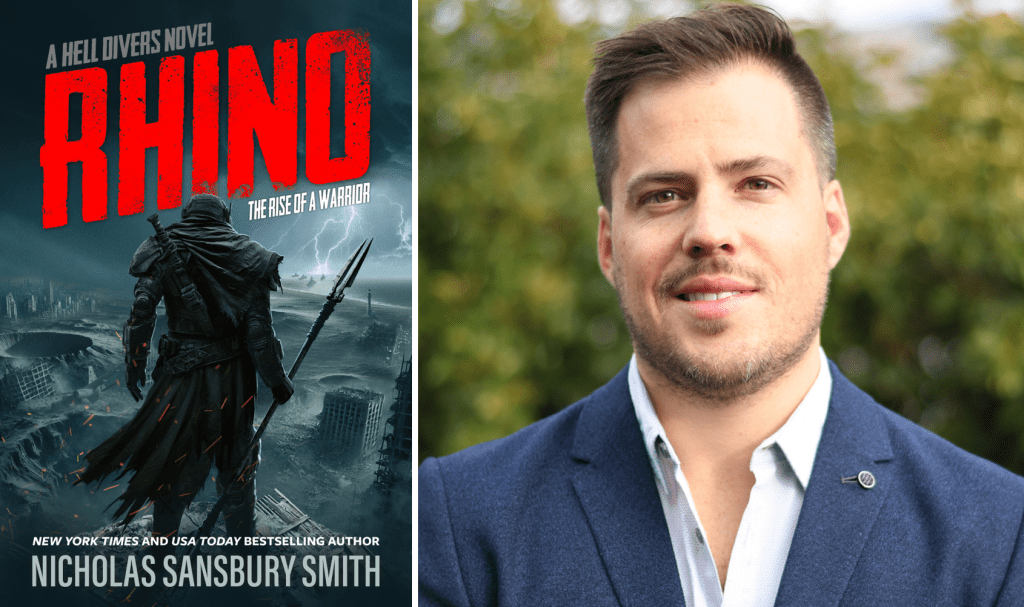
Cover for Rhino: The Rise of a Warrior: A Hell Divers novel by Nicholas Sansbury Smith, along with a photo of the author, a young white man.

Zilla: Write what you know, they said, and what Nicholas Sansbury Smith knows is disaster management—so he wrote a post-apocalyptic adventure novel Rhino. Nick, can you tell us the blurb?

Nick: Centuries after the Third World War reduced civilization to ashes in a global nuclear inferno, humanity clings to life in giant airships sustained by Hell Divers—brave souls who risk their lives plunging to the surface to salvage essential supplies to maintain mankind. But this is not their story. This is the saga of the survivors before them, the survivors on the ground.

 Embark on this riveting post-apocalyptic adventure centered on Nick Baker, a frail orphan born in the perpetual darkness of an ITC bunker. As raiders from the great Cazador empire descend—massacring and enslaving Nick’s people—witness his epic rise from boy slave to fearsome warrior bent on freeing his people from bondage. And discover the legend of a man whose enemies will come to fear as Rhino

Zilla: I love a good fight scene, and it sounds like Rhino: The Rise of a Warrior delivers with plenty of them. As a writer, how do you keep action sequences engaging while also realistic? Within ‘realistic’ for science of course—I’ll accept a mech suit but I won’t accept someone twisting out of a well-executed arm lock.

Nick: My action sequences are often based on the characters and their personal limitations and skills. Rhino might be the best story I’ve written to explain just how this works. For example, in the beginning of the story, when Nick Baker is just a boy, he is frail and has no fighting experience. He has the fire inside of him, but fire doesn’t translate into knowing Kung-Fu. This isn’t the Matrix. Instead, Nick gains weight, trains, and eventually is taught the art of warfare. It takes years before he can actually fight. He learns different weapons and how to use them. Accurately describing weapons is another important part of realistic fight scenes, as is depicting how the action works.

One thing a lot of writers don’t understand, and a lot of people in general, is that fighting requires extreme endurance. Just look at how tired boxers get over the duration of a long fight that goes to the bell. With action sequences it’s most authentic to show your characters getting winded and fatigued from combat, and for injuries to not just slow them down but disable them if severe enough.

In Rhino, I used all of the above to illustrate one boy’s transformation into man, and ultimately—warrior.

Zilla: On the news, we see the horror stories of national emergencies, but we also see community resilience as people come together. What did your time in Iowa Homeland Security and Emergency Management teach you about people’s ability to look after each other, and how did that play out in the book?

Nick: My time at HSEMD taught me humans are inherently good and help each other in the face of natural disasters. I also saw political views being pushed aside and people coming together. Neighbors help each other and communities organize. Of course, there will be some anomalies where this isn’t true (thieves, opportunists—often from outside of the disaster area), but for the most part when disasters strike, human instinct is to help. That is, when there are resources. That often changes when food, water, and supplies run out. Then you’re talking more of an apocalyptic novel, and I’ve written about that a lot on how people react. There are still communities coming together, and neighbors helping each other, but when shit really hits the fan, you start seeing more desperation, which drives people to panic, and sometimes—violence.

Zilla: I am a massive Mad Max fan, plus I love all the various sequels and spin-offs. Are there specific motifs from that series that inspired you as you wrote?

Nick: Definitely the world building and the plot around controlling the petrol. If an apocalyptic world like that were to exist, just like in Rhino with the Cazador Empire he becomes part of, survival would be driven around resources, specifically fuel. This is a theme in this story and the entire series for that matter. Other inspirations would be from the modified vehicles. I’ve done that to the boats/ships in the Hell Divers series. You’ll see some of that in Rhino as well. I absolutely love writing in this type of destroyed environment. It’s haunting and brutal, in a beautiful way.

Zilla: What’s your next writing project?

Nick: I am working on multiple projects: a military sci-fi saga with a co-author, and then a LitRPG apocalypse trilogy, plus more Hell Divers books. I enjoy writing multiple storylines at once, as it keeps them from going stale for me. Readers are smart, they know when writers are bored with their work. I don’t get bored usually because I take time off from writing stories that might otherwise feel more like a chore if I had to write the same thing every day. I got asked the other day if I ever run out of ideas—nope, I wish I had more time to turn more of those ideas into stories!

Zilla: Thanks for sharing your story and your process. We’re looking forward to reading! Where can the Night Beats community find you and your book?
Nick: I’m on Instagram, X/Twitter, and Facebook. You order Rhino on Amazon, Apple BooksB&N, or| Bookshop.org.

Behind the Screens: Tuesday Author Interview

Every Tuesday, get to know a bit about the stories behind the books you love, and discover your next favourite novel.

MEDIANICAL AGE: Drifting through the tides of time by M.A. Alvarez, showing a group of characters in a space setting.

Zilla: M.A. Álvarez brings us a time travelling blend of science fiction and fantasy, Medianical Age. M.A., can you tell us a bit about your novel?

M.A.: Medianical Age: Drifting through the tides of time is my first work to be translated into English. The book was launched on February 28, 2025, the same day as the great planetary alignment of seven planets!

The book includes illustrations by me, such as the one featured on the cover, depicting the characters in the novel. Medianical Age is a play on words composed of medieval, age and mechanical. This is because the story takes place in medieval times and in a distant mechanized future as follows:

One promising day, sometime in the Middle Ages, a deceitful and charlatan surgeon goes to a castle and assures the lord that he can cure his son’s madness by removing a stone from his head. Since childhood, he has claimed to see strange beings, which only he can perceive, and this has led to his confinement by his ashamed family.

In the distant future, a renowned visionary known as K-79 receives an important award for his work in the world of science: the construction of cyborgs from people who were about to die in the past, for different purposes.

Everything seems to be going according to his plans; however, K-79 detects an anomaly in the Middle Ages and discovers that its existence is in danger …

Zilla: What inspired you to write this book?

M.A.: I enjoy writing historical fiction, and for this novel, I was inspired by the contrast between a bygone era, like the Middle Ages, and a distant, technological future. I wanted to explore the conflict between superstition and science. It also gave me the opportunity to combine different literary genres.

Zilla: Getting historical fiction right isn’t easy! How much research did you need to do for your book?

M.A.:This book required a lot of research, especially for the Medieval period. Fortunately, I am passionate about history, and I love researching information for my books. Additionally, I often attend historical tours, and I have visited many medieval castles!

Zilla: How is the plot structured?

M.A.: The structure of the plot is like a puzzle, where the pieces fall into place in the end, affecting all the characters. This is due to the time travel elements—particularly one that is quite unexpected…

Zilla: Thanks for sharing your story and your process. We’re looking forward to reading! Where can the Night Beats community find you and your book?
M.A.: The book is available on Amazon and you can find more information about it, as well as my social media links, on my website.

Behind the Screens: Tuesday Author Interview

Every Tuesday, get to know a bit about the stories behind the books you love, and discover your next favourite novel.

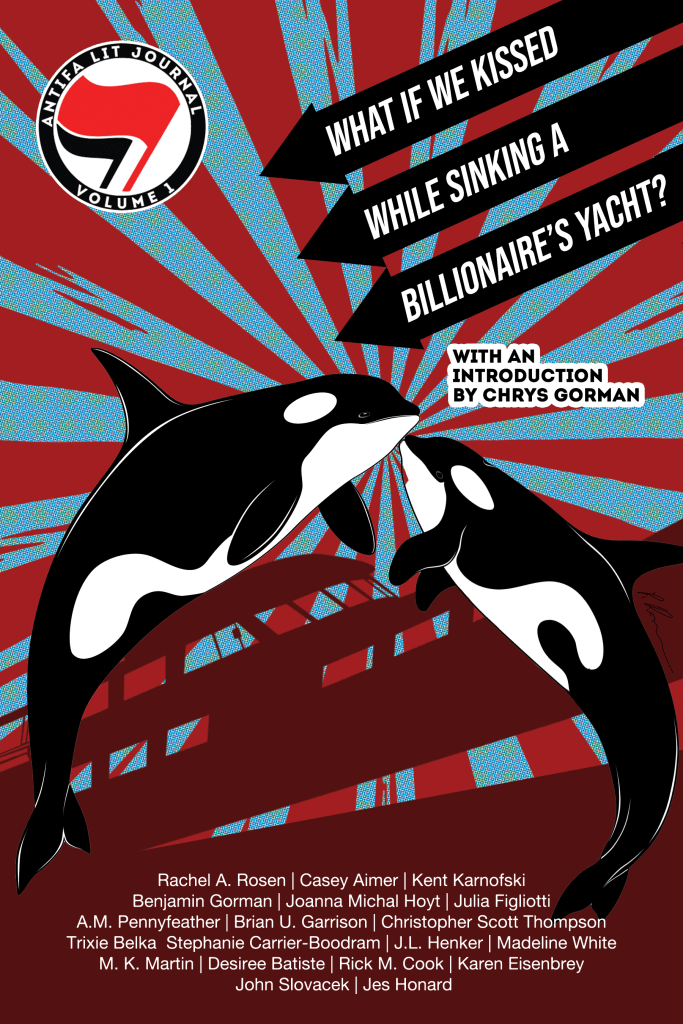
Antifa Lit Volume 1: What If We Kissed While Sinking a Billionaire's Yacht? with an introduction by Chris Gorman. The logo has the red and black antifa flags with the text around a circle. There's a starburst in red and blue. A silhouette of a yacht is going down in the background, with two orcas leaping up in the foreground. There's a long list of authors.

Rachel: With us today is Benjamin Gorman, editor and contributor to the Antifa Lit Journal, which, if I do say so myself, is a rad book. Tell us a little about the anthology, Ben! What is it, and how did it come together?

Ben: We had decided as a family that we would need to leave the US if Trump won the election, so between Election Day and Inauguration Day, we liquidated our possessions and Chrys (who wrote the introduction to Volume 1), our kid Franke, our three dogs, and our two cats relocated to Spain. In the midst of all the insanity of the move, I processed it by writing an explanation that started as a draft of a Facebook post, then a longer blog post, and became a whole book, Dear America: A Breakup Letter. It was published by Not a Pipe Publishing just as we were safely across the border, and it did surprisingly well. A lot of people were in the same headspace, though I understand not everyone can leave the country. Watching all that interest in the book while we were absorbing the daily nightmare of American news, Chrys suggested publishing an anthology of anti-fascist poetry and short fiction. Not a Pipe has published themed anthologies before, like Written with Pride, the all-LGBTQIA+ anthology, and Strongly Worded Women, by exclusively women authors. The response from authors and poets was overwhelming. So many talented writers were desperate to have a venue to speak out against fascism, to process their fear, and to provide readers with an alternate vision of the future. As we poured over all the submissions, we realized we could easily populate a regular journal with high quality short fiction and poetry. So the anthology became Volume 1. And our intention is to keep it going as long as there’s an appetite for it. I don’t foresee this regime going away nearly as quickly as some people expect, and I think we’ll see increases in fascism, especially in terms of would-be-autocrats leveraging anti-immigrant sentiment, all over the wealthy world as the people from countries we’ve made uninhabitable through our climate colonialism decide to move to the places where they can still live above water and below 130° F/ 55° C. There will be very real consequences in terms of housing, supply chains, etc., and I fear that instead of trying to be welcoming, a lot of countries will turn to demagogues. We’ll need people of conscience to speak out, and writers often fill that role. 

Continue reading

Behind the Screens: Tuesday Author Interview

Every Tuesday, get to know a bit about the stories behind the books you love, and discover your next favourite novel.

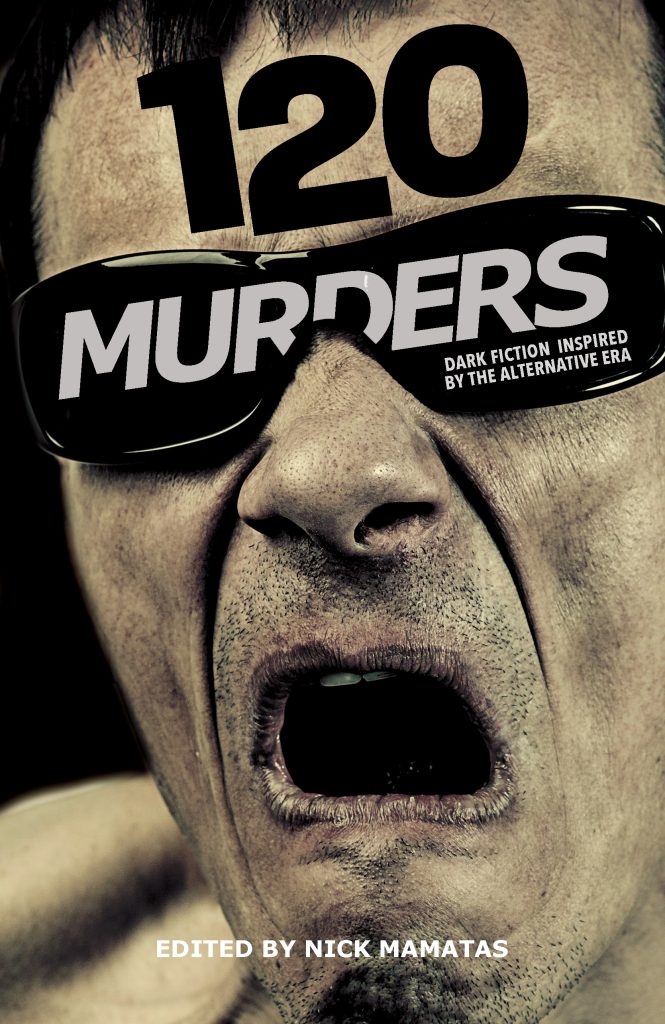
120 Murders: Dark Fiction Inspired By the Alternative Era, edited by Nick Mamatas. Closeup of a screaming white man wearing sunglasses.

Rachel: Nick Mamatas is a fantastic author and a longtime friend, and every time he puts out a new book, I know I’m going to love it. This one is no exception, and I’m thrilled that he’s here to tell you about it. Nick, please tell us about yourself and 120 Murders.

Nick: I’m Nick Mamatas, an author and editor. My most recent editorial work is the editing of the anthology 120 Murders: Dark Fiction Inspired by the Alternative Era. I asked top writers of noir, gothic, and horror fiction to write a story inspired somehow by the songs played on college radio and “alternative” music video programming blocks, and, boy howdy, did they!

It’ll be published by a new independent press, Ruadán (pronounced ROO-ah-dawn) Books, which focuses on all manner of dark speculative fiction.

120 Murders includes brand new stories by William Boyle, Selena Chambers, Jeff Chon, Libby Cudmore, Jeffrey Ford, Meg Gardiner, Todd Grimson, Cara Hoffman, Maxim Jakubowski, Alex Jennings,  Cyan Katz, Josh Malerman, Michael Marano, Silvia Moreno-Garcia, Zandra Renwick, Jason Ridler, Veronica Schoanes, Elena Mauli Shapiro, Brian Francis Slattery, Molly Tanzer, Chris L. Terry, and Paul Tremblay, as well as little notes about their musical tastes.

Rachel: One of the hazards of growing older is that delusion that the pop music you listened to when you were 17 was truly the best pop music ever produced by humanity. For GenX, of course, that is objectively true. In Ghosts Of My Life, Mark Fisher talks about the material conditions that led to post-punk, and how they no longer exist to produce music with the same originality and emotional resonance. Is there something about the alternative era that lends itself particularly well to horror, dark fantasy, and noir?

Nick: There might be some biases built into that conception. I remember when Don’t Tell a Soul came out; most Replacements fans I knew thought something along the lines of “What the hell is this?!” and now that album is a classic, I guess. Do people still listen to Helium? I suspect not. I just tried and almost made it through “Superball.” Yow! 

But I do agree; the 80s and 90s were the last time when rents and rehearsal space were cheap enough, but recording equipment expensive enough, that bands would write and play out and perfect their sounds, and then be discovered and signed. The incubation period for songwriting has been drastically shortened thanks to self-releasing, and labels for lack of something to spend their capital on so focus on brand development over band development, and high-priced producers and songwriters/punch-up artists that flatten sounds and eliminate lyricism. You can’t mass produce “It’s so easy to laugh, it’s so easy to hate/ It takes strength to be gentle and kind.” It doesn’t rhyme!

Deeper lyrics tend to be darker. Analog production tends to sound dirtier. Reagan, Thatcher, and Kohl, those great annihilators of society, gave everyone plenty to write about. Now everyone’s a Reaganite—1980s Reagan in economics and queerphobia, 1960s Reagan in racism. One can hardly even object to it anymore; what’s a ruin when it’s your cradle?

Rachel: Horrifying, though I am relieved it’s not just because I’m old. What was your process for assembling the collection? Did any authors have to fight it out for a particular song?

Nick: I asked the writers whose short stories I like, and begged some famous friends whose short stories I like, to lend me their names and then went hunting for money. For the most part, everyone wanted something different to riff off of, though for a moment there 120 Murders looked like it might have ended up 120 Murmurs–an R.E.M. tribute. 

I was also quietly open to query letters, which, back in the old days, every anthologist was. The SATization of submissions by editors, who claim to be interested in new voices, mean that many anthologists don’t entertain query letters, which I think is a huge mistake. Slush piles are an extremely inefficient way to find new voices, but they do serve to make editors objects of respect and fear among hundreds of hopeful submitters, which is often rather the point of launching some anthology or magazine project. You get prominent writers to love you by giving them money, and would-be writers to fear you by holding forth on social media about how writers aren’t following submission guidelines or are otherwise being bad boys (almost always boys, of course).

One might say that querying serves as an in politic, as someone needs to know how to write an effective business letter, but that’s a skill one can master in an afternoon. Others suggest that it serves as a barrier against writers who are shy or lack confidence. I’ll say that several people tweeted/commented to me, publicly, to ask when/if/why wouldn’t I open to slush submissions. Anyone nervy enough to ask an anthologist to quintuple his workload, and to attempt a bit of public shaming while they’re at it, is certainly brave enough to just write and privately send a normal query letter.

Three of the stories in the final book were query acceptances, and a fourth was the author’s fiction debut. Cyan Katz was a student in an online workshop I ran and I was impressed enough with their work, which was wild and raw and had a very “punk” feel, that I solicited them for a story and worked to get it into great shape. Other authors generally needed light edits, or some rewrites, or were given a second chance after the first story wasn’t great.

Rachel: With BookTok and niche online communities, the many genre markets are increasingly segmented, and trend-chasing publishers seem to be leaning towards cozy, hopeful stories. What were some of your motivations and challenges when pushing back against these trends?

Nick: I’m very skeptical of the cozy trend, though every subgenre and movement has its virtuosos and its hacks. The top three percent of anything is going to be great. I do think there are two trends—plenty of cozy and hopeful, but also a lot of dark stuff. Barnes & Noble here in the US has a horror section again, major publishers have relaunched horror lines for the first time in thirty years, and neo-noir is pretty huge. There may even be a cozy story in 120 Murders, though the author and I disagree about how cozy it is. I think any story with a closetful of desiccated corpses is pretty dark.

In crime fiction, there’s been a microtrend toward anthologies in tribute to this or that musical artist. I even have a story in one, Lawyers, Guns, and Money, which is obviously a Warren Zevon tribute. Some of the book themes are a little shakier, honestly. I thought a broad musical range—all of college radio and alternative—and a thematic range of noir, science fiction, crime, and gothic—would make more sense, or would at the very least put a bullet in the head of the trend.

Rachel: I would never ask you to pick favourites, but are there any particular images or moments from any of the stories that live rent-free in your head? What are they?

Nick: Bunches! I’ll list a few. One of the stories begins with its author contemplating being solicited for the story she is writing and the reader is reading. My name is in it, so of course I love it. We have queer cyborgs who actually do queer things on the page, alleyways full of broken glass sparkling under the streetlamps, a big pile of sloppy joe mix plopped atop a cardboard chore wheel (ew!), poor Jeffrey Ford writing about a very Jeffrey Ford-type guy being shot in the head for being annoying (Jeff, no!) a horrific historical scene of butchery and cannibalism, and much much more.

Rachel: Cara Hoffman’s author’s note references “collective loneliness,” and “art from garbage and lack,” concepts that as a cynical Gen Xer immediately resonated with me. What does this era of music—and the stories inspired by it—tell us about our struggles today?

Nick: There’s a weird social media trend in which Gen X people describe themselves as feral and tough because they were latchkey kids and roamed the streets freely and had to get up and walk across the room to change the TV channel. It’s extremely tedious, if you ask me, and obviously just whistling past a graveyard.

But art from garbage and lack is totally it. The internet is dead; this interview may well be the only non-AI tainted thing a reader may come across today, and even then they’ll likely just find it via links you and I post to our social media accounts. Does anyone just stop by any website anymore to see what’s up? Amazon Prime Day, maybe! Ugh. So we are back to where we were in 1992—photocopy machines (many books are print-on-demand, that’s just big photocopying!) and homebrew movies (albeit with phones and not VHS camcorders) and singing over beats. If the Sisters of Mercy had Doktor Avalanche (the first Dr was a Boss DR55 drum machine that could produce all of four sounds) and toastmasters and MCs had the first twenty seconds of a vinyl track to work with in the 1980s and 1990s, well, so do we. The struggle is going to be to find our humanity between gaps in the algorithm, and as the last people to hit adolescence in an analog world, Gen X and Xennials have something to say and something to share.

Rachel: I’ve already read it, but where do normal readers get a copy? And how do they find you?

Nick: Find me on Bluesky at nmamatas!

On Instagram I mostly post license plates and pizza slices, but there I am concentrateandtryagain. You can get 120 Murders at a nice discount, with a bonus story by me bundled in with your receipt, at the publisher website. I would also highly recommend special ordering a copy from your local independent bookstore, though the book will also be available via the megachains—emphasis on the word chains, if you catch my drift. You don’t want to be chained, do you?
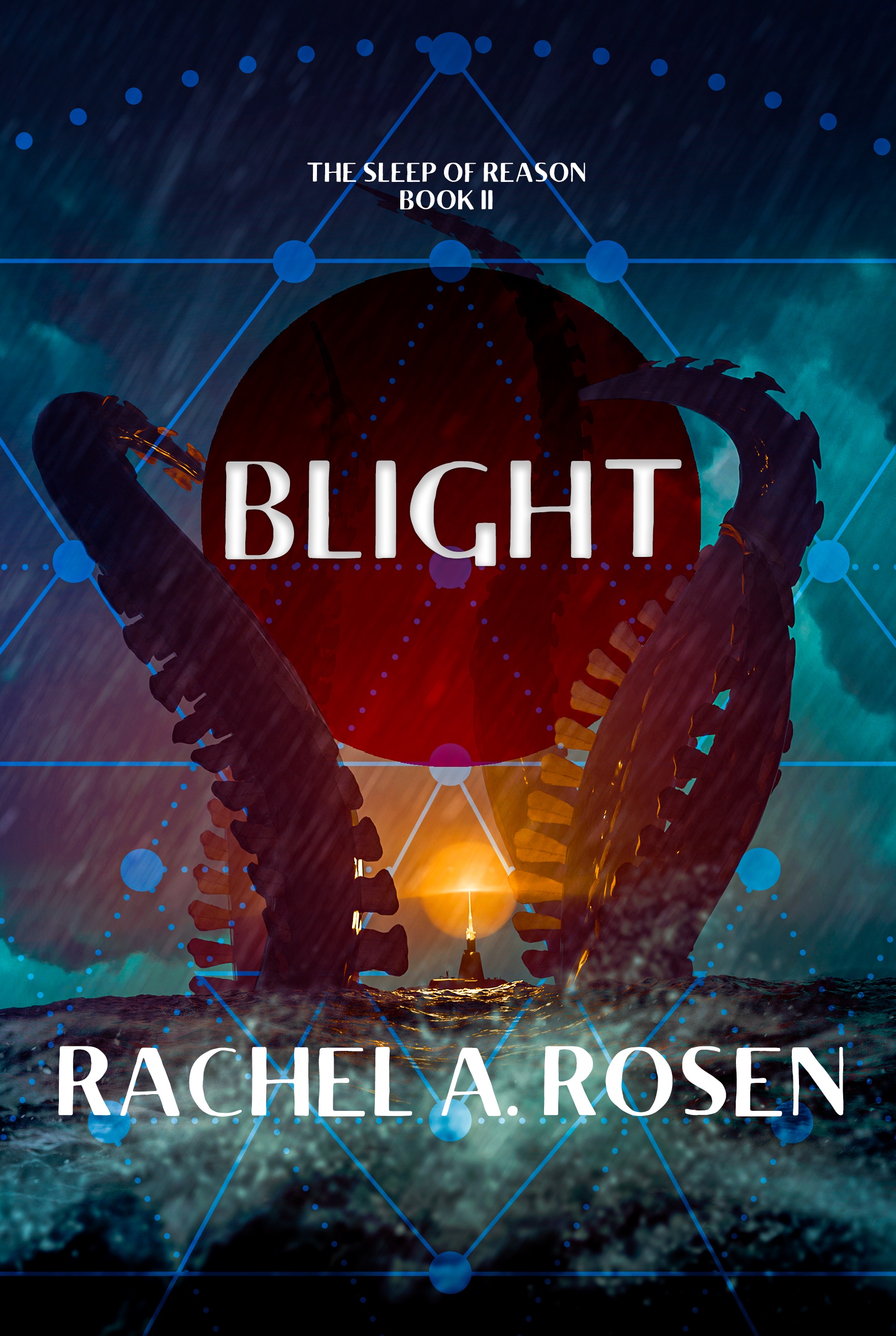
Revealing Blight (The Sleep Of Reason #2)


“They would have you believe all hope is lost. So let them see what it looks like when we fight without hope.”.

I’m so excited to share the cover for Blight (The Sleep Of Reason #2). It’s the sequel to Cascade, and follows the surviving characters as they struggle to navigate a new, post-disaster world shaped by feral magic, demons, and tyranny.

The cover illustration is by the fabulous Marten Norr. You can find more of his work at Flower Prince Draws.

As for the book itself—it will be released in Spring 2025 through The BumblePuppy Press. Can’t wait that long to read it? You can reach me through my contact page for an Advance Review Copy, or just wait for the ARC signup sheet that I’ll be posting soon.

If you haven’t read Cascade yet, what are you waiting for? I’m so excited for you to read Blight, but it’ll make much more sense if you read Cascade first. You can buy it anywhere online or through the publisher.

Praise for Cascade:

“A near-perfect blend of implacable horror, gallows humor, and ecological apocalypse.” — Peter Watts, author of Blindsight

“Finally, an urban fantasy that kills the cop — and the rest of the government — in your head. Relentlessly radical and often hilarious, Cascade will change the way you look at magic, and the state, forever.” — Nick Mamatas, author of The Second Shooter

Advance praise for Blight:

“Suffused with masterful horror and black humour and compassion for its beleaguered and all-too-human characters, this spellbinding chronicle of leviathanic magic, political intrigue, and righteous insurrection hurls a molotov cocktail at the evil lurking in humanity’s banal appetites for control.” — Dale Stromberg, author of Maej

 “Rosen is a daring voice in Canadian SFF, and she’ll break your heart while making you laugh.” — Michelle Browne, author of Meaning Wars

“Rosen’s ability to create such a beautifully vivid picture of a vicious world as it slowly chokes to death is simply breathtaking.” — Rohan O’Duill, author of Cold Blooded

“A worthy sequel to an epic ecofantasy. The world’s on fire, it’s time to lick our wounds and start putting it back together.” — Zilla Novikov, author of Query

Behind the Screens: Tuesday Author Interview

Every Tuesday, get to know a bit about the stories behind the books you love, and discover your next favourite novel.

Cover of Deads Rise! by Shawn Whitney. It's yellow and pink with a woman with her fist upraised and a skeleton overlaid on her. Other text is "No signs of life book one" and "Dying is just the beginning...".

Rachel: We love to get politics all over our pulp fiction, so here’s screenwriter and novelist Shawn Whitney to tell us about his latest book, Deads Rise! Shawn, tell us about the book!

Shawn: It’s the first in a series called No Signs of Life. When half the world’s population suddenly drops dead, humanity braces for the zombie apocalypse. But as the “Deads” reawaken hours later, it becomes clear this is something far more complex.

Tanitia Mortero never asked to die, let alone rise again. Now, she finds herself caught in a war between the living and the Deads – a war fueled by fear, misunderstanding, and a refusal to accept that death was just the beginning of a startling evolutionary leap.

Rachel: That sounds rad, and hints at something more complicated than your typical action-horror.

Shawn: My own work focuses on typically unrepresented folks. However, when I’m writing to pay the bills, I have to write what my publisher tells me. That means male-led and even restricts the kinds of men that can appear because apparently the audience for male-led sci-fi is so fragile that they can’t even handle a flawed hero or they will explode into a thousand tiny pieces of testosterone. Nonetheless, I try to squeeze in some thoughtful elements that relate to social change, changing consciousness and personal transformation.  

Rachel: Testosterone explosions sound like the least fun type of apocalypse. What inspired Deads Rise?

Shawn: It might have been seeing the film adaptation of The Girl With All The Gifts, to be honest. I saw it and thought “what if the zombies were the heroes in the zombie apocalypse story?” Originally it was conceived as a kind of YA TV series but getting anything past first base is easier at a Mormon summer camp than in the film/tv industry. So, it sat for a couple of years till I decided to make it a novel.

Rachel: Do you have a playlist for your book? Can you tell us why you picked a couple of the songs?

Shawn: Lots of Rage Against the Machine. Always. Maybe some Wet Leg and Gil Scott Heron —both the Revolution Will Not Be Televised and Whiteys On The Moon. Largely for the particular energy of the music for different plot points. Heron for a pivotal scene near the end of the book.

Rachel: Speaking of good taste, what book do you tell all your friends to read? Besides yours, of course!

Shawn: At the moment it’s Children of Time. I was blown away by how the writer handled an alien species’ consciousness, culture and history. And how they created a continuous character through multiple generations.

Rachel: And it’s another great example of making the “monster” the hero of the story. Do you have any suggestions to help people in our community become better writers? 

Shawn: The most important thing to do is to write a lot and write to the end. Practice makes perfect. The more you work a muscle, the stronger it gets. 

Then start writing another novel because you don’t want to be one of those writers who never finishes their books. Once you get past your first, it’s important to learn not to be precious about it. I’m not saying you need to crank out ten a year—and maybe your pace of writing and the spaces in your life only allow one every couple years. But don’t let perfection be the enemy of the good.

There’s no right way. I started reading John Truby’s Into the Story and I got so annoyed with him constantly emphasizing how brilliant he was and how all other methods were wrong that I stopped reading it. There are some rules to writing—rising action, conflict, etc. But there’s many ways to skin a novel.

I remember people used to say “writers are readers. You should read obsessively.” Yeah, well, I don’t. I have a job, two kids, a house to maintain. And I also want to read about what’s going on in the world and understand the source of conflicts or scientific advances or whatever. Sometimes I want to watch TV. There’s only so many hours in a day. Don’t beat yourself up if you don’t read a book a week.

Rachel: What’s your next writing project?

Shawn: For my publisher, I’m ghostwriting a trashy, male harem fantasy story set in Hell. Gotta pay the bills! For myself, I’m torn to be honest. I just finished the second book in the No Signs of Life series. I’d like to take a break from that world and I’m tossing around a few different possibilities, all sci-fi. You know how it is; ideas are never wasted; they just come back as new story ideas down the road.

Rachel: We’re so looking forward to reading Deads Rise! Where can our community find you and your work?

Shawn: You can find me at my website, shawnwriteshere.com, or my Amazon author page. I can also be reached via email at shawn@shawnwriteshere.com. on Twitter I’m @shawnwriteshere. On FB I have a page called Shawn Whitney – author guy that absolutely nobody goes to.

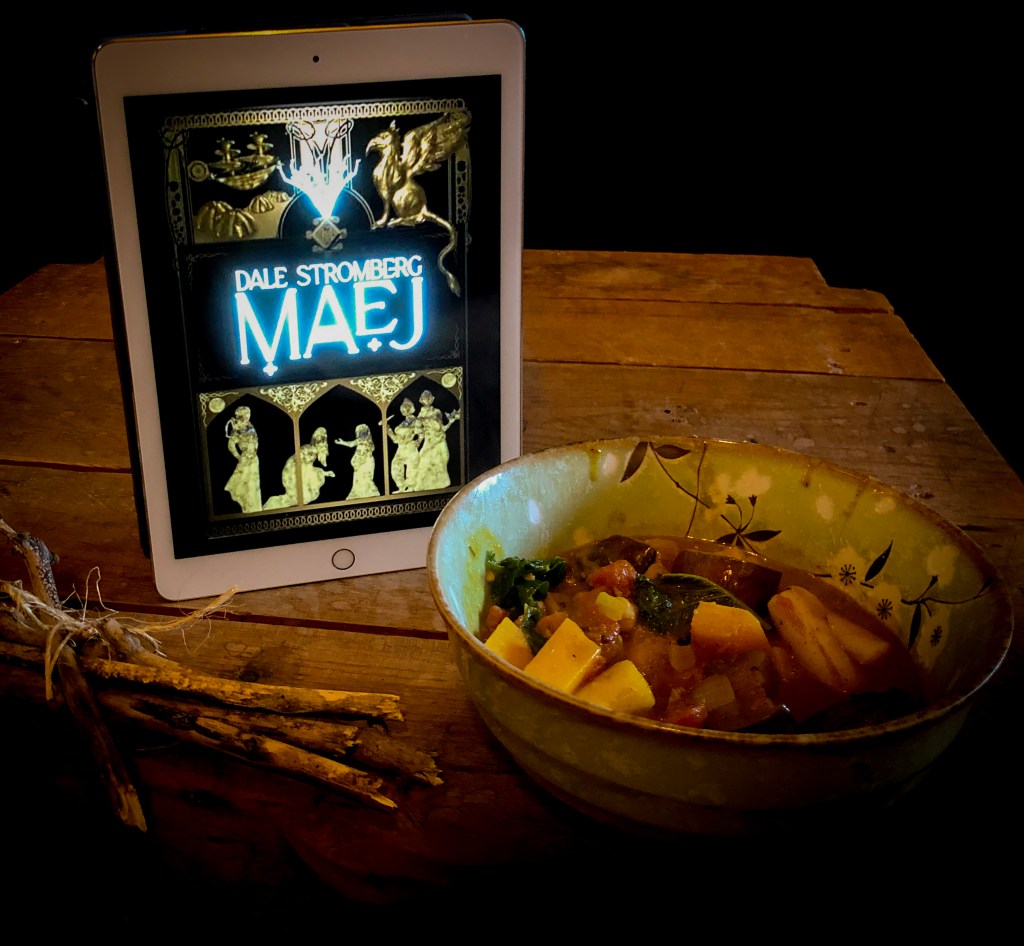
Maej by Dale Stromberg with Vegetable Stew

Fiction To Sink Your Teeth Into, a feature normally written by professional chef Rohan O’Duill, has been taken over this month by Rachel A. Rosen, who co-wrote a book about being bad at cooking.

In Dale Stromberg’s Maej, Madenhere and Taræntlere eat meersaw-gossamy, described as a flavourful stew of “squash, aubergine, egg, and garlic.” I asked him for details about what it tastes like, and he told me they were never afraid to throw in chilies, and that “any dairy was rhinocerote milk and eggs are likely peahen eggs.” Lacking access to rhinocerotes and being vegan myself, I created a slightly less ambitious version.

An ebook copy of Maej by Dale Stromberg on an iPad. It's sitting on a rustic wood coffee table. There's a bowl of vegetable stew and some sticks bundled together.
Continue reading

a + e by Ryszard Merey with Orange Tic Tacs

a + e (Seasons Book 1: Spring) by Ryszard Merey is a haunting and luminous tale of doomed queer love and friendship. If you’ve ever had a teenage crush on your best friend, snuck into a club wearing fishnet, or otherwise got your mess splattered over everyone else in your life, this book is for you. In it, Ash seems to subsist entirely off orange Tic Tacs, while Eu eats everything he won’t touch.

The cover of A+E, which doesn't even have the author's name or title on it, on an iPad. It depicts two gothy, gender-ambiguous teenagers in an embrace. In front of it, sitting on a picnic table, is a package of orange tic tacs, some of them on the table itself. I had to chase a cat off the picnic table to get this shot, and he used this opportunity to sneak into my house and start eating my cat's food, so I hope you appreciate my sacrifice here.
Continue reading

Behind the Screens: Tuesday Author Interview

Every Tuesday, get to know a bit about the stories behind the books you love, and discover your next favourite novel.

An issue of Clarkesworld with an astronaut in a desert looking planet. Another astronaut in the background is tying strings to a spaceship. The issue features a bunch of authors, including today's protagonist.

Rachel: I’m obsessed with Zohar Jacobs’ short stories, and every time she publishes one, I have to send the link around to everyone I know and yell at them until they read it. Today, she’s joined us to tell our readers about her work!

Zohar: I write science fiction and slipstream, and so far have had stories published in the Sunday Morning Transport, Small Wonders, Analog and Clarkesworld. I also have a story forthcoming in Asimov’s.

Rachel: I’m always impressed by the religious and cultural questions you address in your writing, whether it’s about the role of religion on a Soviet lunar base or the question of whether a paired intelligence counts as one person or two in a minyan. Religion is such an under-explored concept in sci-fi—what draws you to exploring it?

Zohar: Mostly I’m getting back at Gene Roddenberry for how badly he dealt with religion in Star Trek. Although I’m an agnostic, religion has always been part of my life, and it’s one of the most complex social and intellectual systems that humanity has created. Why assume that we’d leave all that behind? You could actually argue that the feeling of being unmoored by distance from Earth and the scale of the universe might make people turn to religion more.

Rachel: Another theme I see in your writing is the engagement with real-world issues such as the climate crisis or the war in Ukraine? What are the challenges of writing about a future that is so grounded in our present?

Zohar: Oddly I’ve never thought of it as a challenge. I sometimes think that I’m not a very creative person: reality is always where I get my inspiration, because it comes up with much more complex and bizarre scenarios than I ever could. By hewing close to reality, I can expect my readers to bring their own set of rich, independent associations to my work. I guess the challenge is that I can’t predict how people will take my writing – but I’m not sure I could do that anyway.

Rachel: How important is literary voice in science fiction?

Zohar: Many SF readers prefer transparent, pacy prose that doesn’t get in the way of the story: think Andy Weir’s The Martian. So maybe it’s not that important. On the other hand, some of SF’s best writers have been great prose stylists – Ursula le Guin, Samuel R. Delany, M. John Harrison – so it’s clearly no obstacle to success either. Literary voice is important to me, but then I sometimes joke that I’m actually a literary author who just likes spaceships too much.

Rachel: What’s your next writing project?

Zohar: Funnily enough, a literary novel. It feels odd to temporarily step back from the SFF community, but this is a story that I’ve been wanting to tell for nearly 20 years. (It has spaceships too.)

Rachel: Tell us where the Night Beats community can find you and find your work!

Zohar: Apart from the magazines where I’ve been published, you can find me on Twitter @zoharjacobs and BlueSky @zoharjacobs.bsky.social. One of these days I will set up a website but this is not that day yet.

Behind the Screens: Tuesday Author Interview

Every Tuesday, get to know a bit about the stories behind the books you love, and discover your next favourite novel.

North Continent Ribbon: Stories by Ursula Whitcher. The tagline reads: "On Nakharat, every contract is a ribbon and every ribbon a secret." The cover depicts a person in a cape watching birds fly over a wooded valley. There's a small settlement and what looks like the CN Tower with a ribbon winding up it.

Rachel: I’m a sucker for intelligent, literary sci-fi, so when I finished reading North Continent Ribbon, I immediately asked Ursula if they’d be interested in telling our readers about it so that I’m not screaming about how good it is all by myself.

Ursula: North Continent Ribbon is a collection of connected, queer short stories that’s coming out in August.

Here’s the blurb:

“On Nakharat, every contract is a ribbon and every ribbon is a secret, braided tight and tucked behind a veil. Artificial intelligence threatens the tightly-woven network. Stability depends on giving each machine a human conscience—but the humans are not volunteers.”

Rachel: I was struck by the theme of connection and relationship, both visible and hidden, in North Continent Ribbon. Did this theme emerge organically or did you intentionally build the stories around it?

Ursula: It’s organic! The intentional organizing theme is different parts of Nakharat society—I wanted it to be clear why one person would hate the judges or the army or the Companies but another person might try to join up. But I wrote queer romances while thinking through facets of my own identity, and I was curious about the role bigger social groups like student clubs and groups of drinking buddies play in social change, so I’m not surprised you see a more intricate web.

Rachel: The collection covers multiple eras of Nakharat history, which feels very rich and lived-in. How much worldbuilding exists off the page?

Ursula: In some places there’s a ton, while other parts of the world are more of a mystery. I have lots of thoughts about the culture of the titular North Continent, plus miscellaneous facts (ask me about ocean ecology or grammatical genders!) Other locations are wide open.

Rachel: My absolute favourite element of your world was the grim wire technology in the trains and spaceships, and what it says about labour, class, and automation. Where did that idea originate?

Ursula: The very first writing I did about Nakharat involved an even more furious adult version of the “Last Tutor” protagonist, Isekendriya. I knew that Isekendriya grew up on a mountain estate overlooking wide, empty plains, that the thought of their parents filled them with rage and guilt, and that nevertheless they wore a ribbon in the family colors hidden in their hair. I asked myself what kind of wealth leads to an estate in the middle of nowhere, and the answer was transportation—specifically, trains. 

The combination of ribbon imagery, train tracks, my character’s fury at their complicitness, and my own feelings about the US justice system led to the creepy technology you see in the book. I’m glad you found it compelling! I definitely did—compelling enough that I kept writing stories set on Nakharat, and eventually wrote my way back around to Ise.

Rachel: One of the challenges of short stories is creating characters that the reader can bond with, and who experience growth and change, within a very limited number of words. How do you balance economy of storytelling with creating complex and compelling characters?

Ursula: I cheat and write novelettes! As a poet, I expected that my natural fiction range would be very short. But I love the freedom that a novelette (about twice the length of a traditional short story) allows me to explore the psyches of characters who are uncertain or conflicted about what they want.

Rachel: Will you be revisiting Nakharat? What are you working on now?

Ursula: Right now I’m working on a couple of different historical fantasy projects (Napoleonic wars? Byzantium?) But I haven’t ruled out a return to Nakharat! One of the stories is about an artificially intelligent book, and I’m curious about whom else the book might meet.

Rachel: Tell us where the Night Beats community can find you and find your work!

Ursula: You can pre-order a hardcopy of North Continent Ribbon from Neon Hemlock Press.

If you want an alert the moment the ebook pre-order goes live, or you’re curious about what else I’m working on, you can subscribe to my newsletter:

And I’ve been spending lots of time hanging out on Bluesky ( @yarntheory.bsky.social ).