Every Tuesday, get to know a bit about the stories behind the books you love, and discover your next favourite novel.
Rachel: We’re delighted to have Nina Munteanu, author of Gaia’s Revolution, here to talk with us about eco-fiction, the climate crisis, and slime molds! Nina, please tell us us a little about your creative work. And what inspired you to write it?
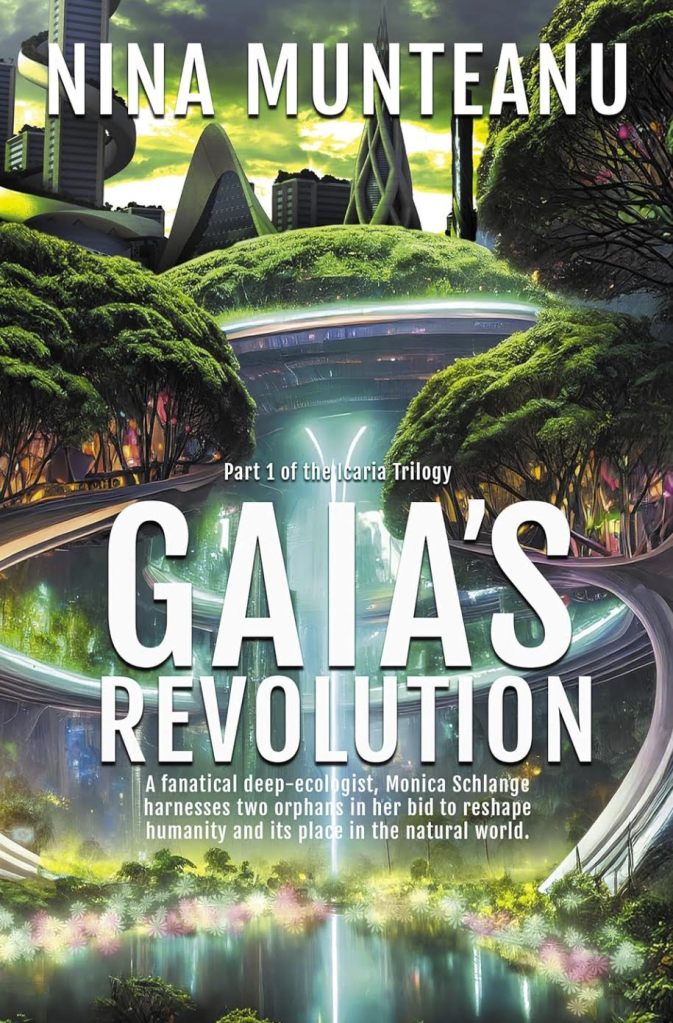
Nina: My latest novel is Gaia’s Revolution, the first of The Icaria Trilogy, clifi eco-fiction that explores a collapsing capitalist society in Canada through ravages of climate change, societal decisions, and a failing technology. Gaia’s Revolution opens in Berlin, 2022, then moves to Canada, where ambitious twin brothers Eric and Damien ignite a revolution that could save the planet—or erase humanity altogether. Fanatical deep ecologist, Monica Schlange plays the brothers like chess pieces in her gambit to ‘rule the world.’ She captures three orphans in a web of intrigue to reshape humanity and its place in the natural world. But the orphans will ultimately determine the direction of humanity and launch a new set of rules no one envisioned.
This is a story about Canada’s future, a fast-paced political thriller that touches on issues Canadians may soon or already face: environmental devastation of climate change, social unrest and polarization, eco-terrorism, DNA-targeted plagues, techno-clones, environmental technocracy and behaviour engineering.
I originally wrote what eventually became the middle book of the current trilogy back when I was a teenager in the late 60s. The story, originally called Caged in World, featured a world forced inside sealed domes to escape the harsh uninhabitable environment destroyed by climate change (Yes! I knew about climate change back then!) and effects of unruly human greed. A teenager in high school, I was acutely aware of what we were doing to the planet; it inspired me to write this story, and this dystopia became the first full length novel I would write.
Rachel: I did something similar, both in terms of conceiving of the middle book first, and in tackling the effects of the climate crisis in Canada. And, as it turns out, writing rather morally grey lead characters. Ecofiction these days often tends towards the utopian, with well-intentioned characters doing their best. Why did you decide to focus on manipulative and extremist characters instead?
Nina: The morally ambiguous character appeared much truer to what is going on with our current climate / environmental dilemma and what the trilogy is about. Our world is fast becoming more fractured, polarized and extremist in worldviews and actions; and we are growing less tolerant of any divergences. Under extraordinary circumstances, ordinary people may be driven outside their comfort level, to extremism and moral ambiguity. I wanted to explore that possibility by featuring actors deeply involved through their convictions in the big decisions that face humanity; questions that touch on ecocentrism vs. anthropocentrism; deep ecology, sustainability, and selfish vs selfless motivations. When faced with truly existential questions and extreme divergences in worldview, innocence is the first casualty.
The true—and the only innocent—protagonists in this story are the three orphans, who must navigate the harsh environment their elders have left them. In some ways they—and the casualty of their innocence—are at the heart of the story.
Rachel: Can you explain a little about limnology and how your background in ecology plays into your writing?
Nina: Limnology is the ecological study of freshwater. It is a multi-disciplinary field that incorporates chemistry, physics and biology to create big-picture analyses of systems and their surroundings. For that reason, limnologists also look at watersheds and land use, given their effect on water systems. I’ve brought much of my science background into my fiction writing—mostly for premise and background, but also as theme in many of my works (the majority of which are eco-fiction). My love for Nature and my study of the environment have informed my fiction incredibly: in the language, the direction of my works, in my choice of protagonists, even. When I was ten years old all I wanted was to be a paperback novelist. But I took some turns and pursued a science degree instead and became a science teacher and environmental consultant, only to return to writing books. The universe in its wisdom, provided me with the tools I needed to be the writer I was meant to be: a science-informed eco-fiction science-fiction writer of high-concept ideas with large scope.
Rachel: What is the role of speculative fiction in combatting the climate crisis?
Nina: The climate crisis and associated environmental issues are largely a global phenomenon—concerns like water and air quality and quantity, environmental exploitation and fossil fuel extraction, impacts to biodiversity and rampant extinction. Science fiction (and speculative fiction particularly) is the literature of consequence that explores large issues faced by humankind; This largely metaphoric writing can provide an important vehicle in raising environmental awareness. Literature in general has always served as a cultural reporter on themes important to humanity. Critic Frederic Jameson argues that the literature of “science fiction is in its very nature a symbolic meditation on history itself.” The science fiction genre—and speculative fiction particularly—explores premises based on current scientific and technological paradigms. What if we kept doing this?…What if that went on unchecked?… What if we decided to end this?… These are conveyed through the various predictive visions from cautionary tales (e.g., Atwood’s Oryx and Crake) to dystopias (e.g., Huxley’s Brave New World). The power of speculative fiction over realist fiction or non-fiction reportingh to do with environment and climate change is in “showing us” instead of simply “telling us.” Using the tools of metaphor and personal dramatization, speculative fiction provides a palatable, and more meaningful narrative that readers can truly experience and connect with, learn and act on.
Rachel: If you weren’t a writer, what do you think you’d do instead?
Nina: I’ve already done it! And I’m still doing it! I was an ecologist / limnologist, working as an environmental consultant for various clients, educating them and helping them comply with regulations and become better environmental citizens. I’d like to teach ecology in primary and secondary school, if such a program existed—which it doesn’t, unfortunately. Either way, both of these are aimed to educate toward more environmental awareness and sustainable choices. You could say, I’m doing that with my writing now, which is why I love it as a career. I currently teach writing at The University of Toronto. I also write non-fiction articles for various magazines and on my blogs, which see over 80,000 visitors a month.
The other pursuit I would have loved to follow is in the field of lichenology (the study of lichens) or mycology, (the study of fungi and slime molds). As it turns out, I’ve become a pretty good amateur mycologist and lichenologist. I walk the nearby forests daily and often come out with photos and an article in my head about some interesting specimen. Check out the blog on my site The Meaning of Water for some of them.
Rachel: I’m low-key obsessed with the strange organisms that make up our very real world. So…could you tell our readers a few interesting facts about slime molds?
Nina: I’d love to! Perhaps because—or in spite of—the bizarre designs of their fruiting bodies, their intriguing behaviour and success and ubiquity while remaining rather invisible and overlooked—slime molds have both defied taxonomic identification and been given some of the most colourful, disgusting, and wonderful common names. Some include: Moon Poo Slime, Wolf’s Milk Slime, Tree Hair Slime, Dog Vomit Slime, Bubble Gum Slime, Scrambled Egg Slime, Tapioca Slime, and Chocolate Tube Slime.
Slime molds are bizarre life forms, once classified as fungus—because they sort of looked like fungi. Unlike a fungus that is not capable of absorbing and digesting their food internally, a slime mold can. They can also move—unlike fungus; slime molds conduct phagocytosis—just like the amoeba I studied in school. They can move several millimeters in an hour and some may charge into a rapid movement of over 1 mm/second. That’s visible to the naked eye! Think Steve McQueen and The Blob. Shades of science fiction! Lastly, slime mold has been proven to have intelligence, able to navigate the most efficient route to a food source. We have much more to learn about these tiny intelligent beings who are silently taking over the world.
Rachel: While I am off forming a new punk band called Moon Poo Slime, where can our readers find you and your work?
Nina: Readers and other interested parties can find me and my work on several sites. www.NinaMunteanu.ca is dedicated to my writing; www.NinaMunteanu.me showcases weekly articles with my latest news and articles on writing; I post weekly articles on www.TheMeaningOfWater.com which explores all things environmental and about water, particularly. I’m also active on several social media platforms, including Bluesky, Twitter, and Linked-In.

