Book Report Corner

by Rachel A Rosen

Undrowned: Black Feminist Lessons from Marine Mammals  Alexis Pauline Gumbs . Teal cover, yellow text with a minimalist graphic of dolphins.

As you might guess from my latest book, I love sea creatures and hate capitalism. Which makes Undrowned: Black Feminist Lessons from Marine Mammals by Alexis Pauline Gumbs the perfect sort of book for me. (I mean, my favourite part of Moby-Dick was the whale facts, even when they were wrong. This one won’t take you nearly as long to read.)

Undrowned book is a stunning, poetic tribute to Blackness, queerness, femmeness, fatness, resistance, solidarity, and love, told through the lens of marine biology. It brings together two of my great loves: activism and whale facts. This is a book that’s all activism and whale facts, in the best possible way. What a joyful read.

Book Report Corner

by Rachel A Rosen

The Practice, the Horizon, the Chain by Sofia Samatar. The image is a set of interlocking circles against a sea of stars.

If you’re in education or academia in the age of austerity, you’ve likely had a moment or two where you’ve wondered what you’re doing there, and whether or not you’re doing more harm than good. I know that I’ve had more than a few of those moments. The Practice, the Horizon, and the Chain, Sofia Samatar’s wonderfully strange and dreamy novella about education, class divisions, and the carceral state on a mining ship, gets this contradiction.

In the Hold, generations of workers are Chained, never seeing anything other than their miserable conditions. But a boy who is good at drawing is plucked from the Hold and brought up to the ship’s university, where he joins the bluelegs, people like his professor, who get an electronic ankle bracelet instead of a chain. Some people even have no fetters, and get names instead. As the boy adjusts to his new circumstances and the professor navigates the boundaries of hers, they become embroiled in a struggle for freedom—not just for themselves, but for their entire society.

This novella manages to be at once intensely relatable and transcendent: a story of the power and the limits of academia, the compromises of political action, the relationship between labour and the state, and the promise of breaking free.

Book Report Corner

by Zilla Novikov

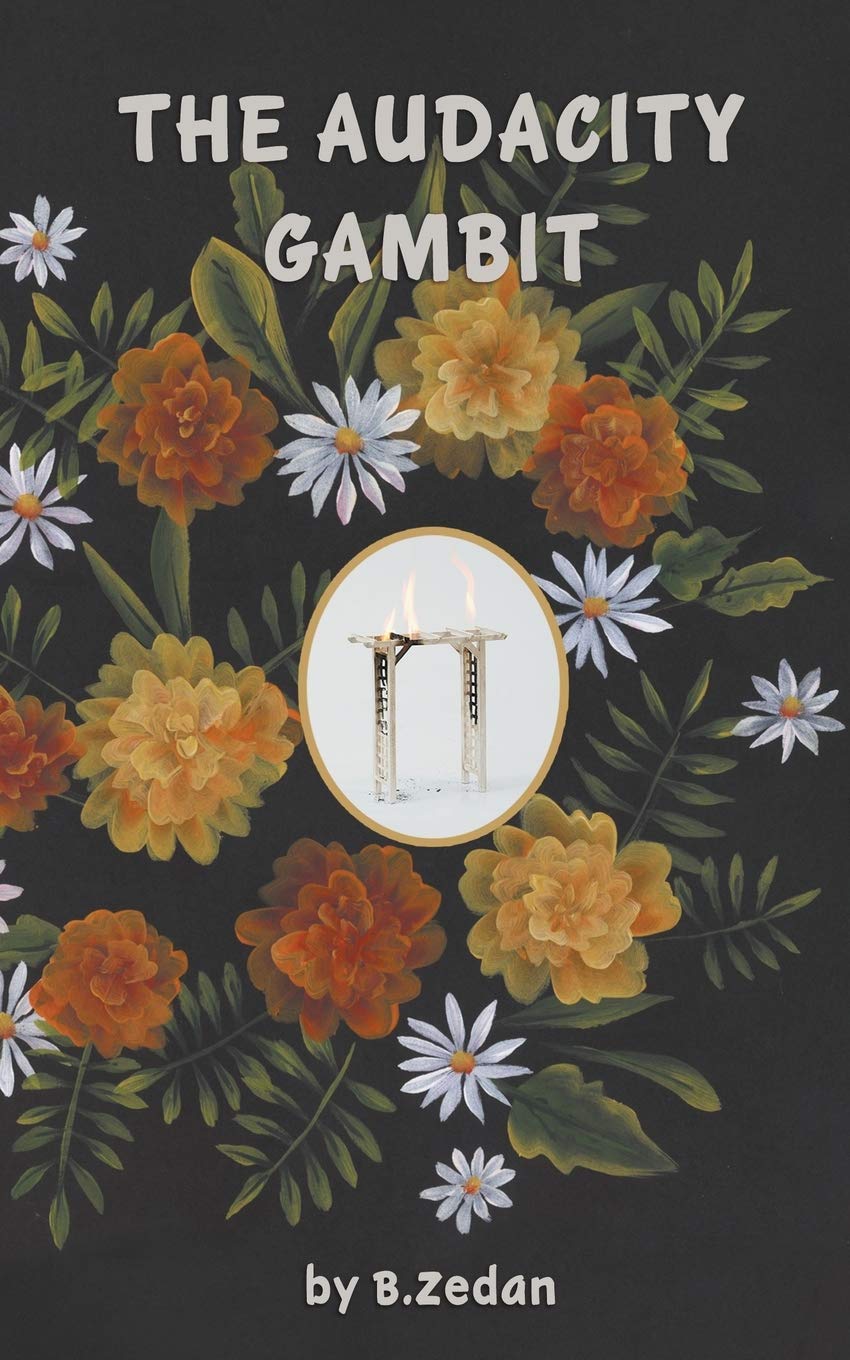
The Audacity Gambit cover with flowers and a burning gazebo

The Audacity Gambit by B. Zedan is a gentle fairy tale, though the underlying themes are as uncompromising as any Fae could demand. Emily is the Chosen One, the one who can restore her people to the Fae Kingdom–but this is no accident of fate. Her life has been manipulated since the moment of her birth to fulfil the esoteric needs of prophecy, and the trusted adults of her life have been concerned only with preparing the way. But, while the world can put a person in a box long enough that she assumes its shape, she can still choose who she becomes when she steps outside.

The fantastical world is a character in its own right, full of whimsy in the style of Frank L Baum or Cat Valente, where Polaroid cameras reveal hidden mysteries and trees may–or may not–be trustworthy. While I never feared for Emily’s life, I wondered what she would hold onto when everything changed.

Book Report Corner

by Rachel Rosen

School of Shards (Vita Nostra Book 3) by Marina and Sergey Dyachenko, translated by Julia Meitov Hersey. The cover is dark blue with a closeup of a horse sculpture. The text is very distorted.

Some years ago, I had my brain melted and then rearranged by Maryna and Serhiy Dyachenko’s Vita Nostra, which still remains one of my favourite fantasy novels—and fantasy series—of all time. Its long-awaited conclusion, School of Shards, is haunting, moving, and absolutely perfect. It’s one of those books that I put down and immediately wanted to reread, not only because it’s stunningly written, but because there were layers of theme and character that I wanted to pick apart.

School of Shards picks up in the new reality that Sasha created in Assassin of Reality—a world without fear, without plane crashes, without child death, but without free will. Now the provost of the Institute of Special Technologies, she has become the same knd of inscrutable taskmasker who terrorized her as a student. But the Great Speech is falling apart, and with it, the world outside of Torpa. And so Sasha must pull from her own past—her half-brother Valya and the twin sons of her former lover Yaroslav—to fix what she’s broken.

Even with the world closing in on the town and its strange magic school, this final chapter in the trilogy feels like it has a much greater scope. The post-Soviet malaise of the first novel expands to a global scale. Words, language, no longer holds the fabric of reality together. The central metaphor is so apt for our present moment, and maybe I’m reading too much into it, but I just found myself thinking that this is a book that does what I want fantasy to do. This is why the genre is meaningful.

I would be remiss if I didn’t also note the elegance of Julia Meitov Hersey’s translation. As is fitting for a book about language, the language of the story itself is beautiful, lyrical, and melancholic.

I am grateful to Kyra DeVoe at HarperCollins for sending me an ARC.

Book Report Corner

by Zilla Novikov

Transmentation—Transience: Or, an Accession to the People's Council for Nine Thousand Worlds cover with a spinning transition between universes

Transmentation—Transience: Or, an Accession to the People’s Council for Nine Thousand Worlds is Darkly Lem’s richly woven tapestry of a science fiction novel asks us who we are, deeper than the flesh and memories that imprison us, and if we can ever escape the societies that we belong to. Characters jump from universe to universe, from shell to shell, seeking to hold on to core identity that they’re not always confident exists. In lieu of the certainty of self, they lean on that of belonging to something greater than themselves–even when their society betrays them, they cling tightly to this sense of meaning in their lives. As someone who suffers from mental illness, I found the themes of identity fascinating.

And as a fan of expansive, thrilling science fiction, I was equally drawn in. There were universes of political scheming to match the White Tower, and others of fighting bug-eyed monsters with stolen swords. There was love, or friendship, or some ambiguous tangle that’s both and neither, lost beneath ambition. Each fantastical world is as richly detailed as the characters that inhabit it, and they’re combined to tell a captivating, satisfying tale.

Book Report Corner

by Dale Stromberg

cold blooded: a cold rush novella by Rohan O'Duill, featuring a bad ass space marine stomping through an icy teal alien landscape.

Start with ravenous corporations mining minerals on asteroids out past Neptune’s orbit, give those corporations private armies of mech-suited Marines to battle over control of these resources, and for good measure turn each brutal battle into the 24th century’s equivalent of a pay-per-view fight, and what have you got? It’s called a Cold Rush, and your chances of surviving one ain’t good.

This is why Mint, formerly a star of the system, is so reluctant to get back into the Cold Rush game in Rohan O’Duill’s novella Cold Blooded (2025, Lower Decks Press), the follow-up to the first book in the Cold Rush series, Cold Rising. (Don’t worry, the novellas share a world but stand alone, so you can read them in any order.) This tightly focussed, pugnacious adventure tale has a clear love for the high-tech gear and enterprising pluck of Golden Age sci-fi (bone-crunching mech suit beat-em-ups!) but is also animated by a clear working-class consciousness, a modern awareness of identity and social justice, and an unflinching recognition of the insatiable exploitativeness of capitalism.

We get corporate intrigue in a libertarian hellscape with strong world-building, all cycloning round the characters of Mint and Bjorn. Mint is a randy, tough, foulmouthed fighter with neither the time nor the crayons to explain shit to you, but her uncomfortable complicity with the system forms a dichotomy with Bjorn’s ethically driven resistance to that system, a resistance both courageous and quixotic.

When meaningful resistance seems almost suicidal, what in the world can possible drive us to resist, apart from love? Mint might just find out what a love that powerful can feel like, but there is no guarantee of anything turning out as you’d hope in O’Duill’s hard-bitten world. You’ve been warned.

Book Report Corner

by Rachel A. Rosen

Green Fuse Burning by Tiffany Morris. The cover is a trippy image of a kind of punk looking woman with stylized plants coming out of her mouth.

This one goes HARD. I had been eyeing it for awhile—the psychedelic, visually arresting cover kept popping up on my feed. I finally picked it up after hearing the author speak on a panel, and was immediately besieged by friends incredulous that I hadn’t read it already. I mean. It’s swampcore. How much more up my alley can you get? I am pleased to report to both them and to you, dear reader, that it absolutely lives up to the hype.

Green Fuse Burning is about Rita, an artist on an involuntary retreat after her girlfriend Molly forges a grant application in her name. Is Molly being helpful and romantic? Or patronizing? Is a breakup imminent? It might be easier to tell if Rita could get any cellphone bars in her remote location.

But Rita has bigger problems: her own grief over her father’s death, her disconnection from her Mi’kmaq heritage, and the unsettling landscape of the swamp. She hears noises at night—perhaps a body being dragged into the murk? The handful of people she meets are menacingly cold and strange. She’s plagued by intrusive thoughts.

The framing device is a series of gallery labels for Rita’s paintings, alluding to her mysterious disappearance. The story itself is a vivid fever dream told in lush, intense prose. Morris’ background as a poet shines through—every sentence is a visceral gem, packing incredible intensity into only 100 pages. This is what eco-horror should be: unnerving, upsetting, and unforgettable.

Book Report Corner

by Rachel A. Rosen

the cover of Rakesfall by Vajra Chandrasekera. It's trippy, bright pink with an animal skull and flowers and worms, with the tagline "Will you follow me to the end?"

Vajra Chandrasekera’s first novel, The Saint of Bright Doors, is probably the best fantasy novel I’ve read in a decade. So it is unsurprising that I bought his second, Rakesfall, without even knowing what the book was about.

Rakesfall is WILD and defies description, veering from the 1970s to the end of the world, written with the kind of narrative confidence that you’d expect from an author after they’ve won a lifetime of prestigious literary prizes. I made people stop what they were doing so that I could read parts of it to them. It’s a story about struggle—often in a way that is very visceral and brutal—love and death and reincarnation and science and nationalism and climate collapse.

Can I explain what I just read? Maybe if I took a course in it. Did it blow me away? Absolutely.

Book Report Corner

by Rachel A. Rosen

The cover of Antifa Splatterpunk, complete with a molitov cocktail

Antifa Splatterpunk somehow fell under my radar when it came out a few years ago, despite being entirely my kind of thing. It’s exactly what it says on the tin—an anthology of short stories about fascists dying in gruesome, often hilarious ways, occasionally at the hands of our friends in black. In this collection, far-right extremism is portrayed as the monster it is, a tradition going back to Marx and his vampiric capitalists.

Like any anthology, some of the stories are stronger than others. The highlight for me was “Ay, Carmela,” about an old woman whose anarchist family was murdered when she was a child during the Spanish Civil War, and who lives long enough to see justice done. “The Chad Show,” in which the conservative tendency to play the victim is hilariously and grotesquely lampooned, was another standout. And “Lutznau’s Opus,” a cosmic horror set in the real horror of the Holocaust, is a trippy and haunting ride.

If you like your horror with a side of radical politics, you’ll enjoy this cathartic collection.

Book Report Corner

by Zilla Novikov

The cover of Gyre, with a violin falling apart

Amniotic fluid drained from my lungs; as they filled with air, a nameless horror bloomed, and I shrieked.

Abigail Patel didn’t come back wrong.

She was always exactly like this.

My mind began to clear. I was a baby. I’d been born. Something was wrong.

Reincarnation should be a fresh start, a second chance, but Abigail is reborn with all her adult knowledge, cursed to relive childhood, repeat her sins.

Would Faye spare me? Recover herself? Change? I did not believe people changed. My most shameful, my ugliest shortcomings did not feel like choices; they couldn’t be changed like changing a shirt. They were unalterable. To depend on hope that Faye would fix herself in this life, as I never had in the prior one, was to risk too much.

Gyre tells the story of the cycle of abuse, how it perpetuates itself, the way that perpetrator and victim are bound together by the endless loop.

Abigail, ashamed, overwhelmed by self-loathing, doesn’t believe escape is possible.

Gyre is a complicated, fascinating read that troubles you long after you finish reading. Recommended reading for a dark January night.