Behind the Screens: Tuesday Author Interview

Every Tuesday, get to know a bit about the stories behind the books you love, and discover your next favourite novel.

Gyre cover with a discombobulated violin

Zilla: Rachel and I both absolutely adored Gyre, Dale Stomberg’s literary fiction novella about abuse, fate, the creative urge, and repeating our mistakes. We had to bring Dale in to talk about this work of art, so here he is! Dale, give us your best shot at putting the magic into words.

Dale: The story begins when Abigail is born with a fully formed adult consciousness and an awareness that she has lived a prior lifetime, albeit with no specific memories of her past life. As an adult mind in a baby’s body, she is physically helpless but also impossibly precocious. Her father, Raj, is overjoyed at how special she seems; her mother, Faye, is disquieted.

As Abigail grows up, scraps of memory from her prior life begin to return to her. She comes to understand that she did something terrible back then, and her wonder at being reborn clashes against her deep sense of shame and worthlessness. A family tragedy exacerbates the strain in Abigail and Faye’s relationship, and things start to spiral downward.

So the book ends up being a meditation on cycles of mistreatment, on the ways we struggle against our own pasts and ingrained predilections, and on how a sense of fate’s inescapability can come to tyrannise us.

Rachel: Can people change? The commercial fiction model is about a protagonist who changes as a result of their experience, and Gyre almost seems like a grim rebuttal to that narrative arc. How important was realism in this story?

Dale: The real world is given to us by evolution, by history, and by the ongoing machinations of disunited masses of individual minds. Fiction, on the other hand, generally takes place in a world created by a single mind. So it stands to reason that fiction will tend to be more orderly than reality. I think the stereotypical “tidy-change arc” is a symptom of this bent toward orderliness. There isn’t anything necessarily wrong with this kind of arc, but there’s also no law demanding that every story conform to it.

Can people change? (Yes! We’ve all seen people change for the worse. Your fascist uncle used to be hip.) I’d reframe the question: how much of the way we change is under our conscious control? To say, “I shall now change,” and expect to just up and change is of course about as realistic as deciding to forget your native language, on the presumption that it will be wiped from memory on the spot. We all know this, but this fact is also weird because supposedly “I” (and no one else) am in charge of “my” decisions. So we recognise that our behaviour derives only in part from the in-the-moment choices of a sovereign will.

Speaking only for myself, to attempt to control my own mind can feel like being in the pilot’s seat of a spaceship whose autopilot system fights me, sometimes allowing me to exert a certain amount of manual control or at least influence, but other times not. I think of the quarrels I’ve repeated “a thousand times” with someone close, quarrels which inexorably end up running along the same awful, habitual grooves—despite the fact nobody involved wants them to. I think especially of certain shortcomings of mine (thoughtlessness, forgetfulness, habitual failures to duly notice) whose core characteristic is precisely that they are outside subjugation to the conscious will in the moment they occur. So you might read the overarching situation in Gyre as an exploration of the feeling of self-heteronomy, of being unfree vis-à-vis your own self. The story has a magical-realist setup which makes its protagonist literally unfree, yet I also think the way it reads is that, within this unfreedom, she has some latitude of action, and what constrains her (at times) is not a monolithic external fate but an internally imposed fatedness. Does the fact it comes from within make it more, or less, unshakeable? Hard to say. But I think it is noteworthy that Abigail normally doesn’t say she is unfree—instead, she insists she is worthless.

Zilla: Abigail is unfree in some respects, though. She’s a victim of the cycle of abuse, she’s predisposed to alcohol abuse—though she’s also a victim of her own choice not to try to escape the cycle. How much did you intend to show her as doomed by the narrative vs doomed by her own choices?

Dale: The premise in Gyre, that Abigail knows she has been reborn, turns the whole story into, as it were, an extended metaphor, or in other words a story with two simultaneously possible readings. In the story’s reality, fate has mandated her path, so she is of course trapped by the narrative. To readers standing outside that narrative, I think this will be overlaid with a sense, perhaps familiar from their own lives, of existing hemmed within the consequences of a million prior decisions others have made, and of having before them only a very limited palette of available choices, a narrow range of freedoms within which to act, with not every freedom equally available: the cost of getting things wrong is higher for some paths than others, and our level of confidence that a path will lead to a good outcome likewise differs for each. Escape from is also escape to, and what is on the other side can be frightening in its unknowability.

In the face of such anxiety, the self erects defences. Abigail indulges in a dichotomy between blame and responsibility. The more harshly and pitilessly she blames herself, the more she damns herself as doomed never to change—which of course “absolves” her of responsibility to change, since you can’t very well escape your doom. I find it remarkable and difficult to explain why some of us cling so strongly to our own intense feelings of self-dislike. Perhaps this helps clarify it: a strong self-dislike can be easier to face than the fear of trying and failing to make forthright choices, even including choices which could offer us escape or liberation.

Zilla: One line that’s stuck with me is when Abigail suggests, “Perhaps a computer could be taught to write songs, but it would do it only when you told it to. A songwriter would write songs even if you told her not to.” It’s an interesting counterpoint to her mother Faye’ song writing, which is described that, “She wrote for the satisfaction of a puzzle well solved.” Is this the same kind of restless creativity, or is this a different flavour?

Dale: I think a fair number of would-be creatives (musicians, artists, writers, &c.) hit a snag in the gap between the initial urge to make something and the laborious process of seeing it to its conclusion. What sparks the creative notion and what drives the creative work can be different things.

Some creators I’ve known have had the ability (necessary in order for them to make a living) to create things according to someone else’s specifications. Think TV writers, or 3D animators, or pro songwriters. Because nearly any other job would have been easier to get into, they would never have become creatives if they hadn’t been driven by the pure need to create—but they are also able, for example, to revise dialogue (initially written by someone else) in response to notes given by the showrunner: to create art specifically to solve a problem set before them.

Faye is the sort of songwriter who has a knack for this. Doing so involves effacing the self, and (as the story shows) Faye has plenty of reasons for wanting to escape herself. But she also, when not working for hire, compulsively explores sound in a highly solipsistic way, a retreat-from-the-world that can be keenly personal. I think this latter personal exploration comes out of the restlessness Abigail mentions, but with Faye it’s a two-sided thing.

Zilla: I thought it was fascinating how Faye enjoyed the construction of a public persona. Could you tell us a bit about your thoughts on public vs private identities?

Dale: This ties quite nicely to that concept of two-sided-ness. Faye, like many entertainers, maintains two faces: one private, one public. I think many of us, though not famous, nonetheless might recognise this in ourselves. When I was a teenager, I was one person around my parents, a rather different person around my friends; I recall a situation once in which I, my mother, and a certain school friend were all in one place for the first time, and I experienced an uncanny weirdness that made me hesitant even to speak—I was unsure which version of me I should be. Each of those me’s was, in a sense, a construct, and they were not very compatible with each other.

The special thing about a public persona is that it is designed to ease you past such uncanny paralysis. The world will know you as, not the bumbling screw-up you are, but the manicured image you would rather be. The less fond you are of the person you imagine yourself to be, the more attractive you will find the possibility of donning a mask, and Faye knows that there is something festering down in her core, something she feels she must, at all costs, conceal. We were just talking about Faye’s two different modes of songwriting, and this ties in to that: for the most part, her personal explorations of sound and music stay concealed from the world. What the world sees are the songs she writes for others. 

The mask can also pose a danger. However professionally detached Faye may be when writing for hire, when it comes to her passion projects, she has not risked exposure and thus has not developed any callouses. A point comes in the story when she reveals her private self to the world in a pair of songs but is unprepared for the attention, especially the criticism. She’s taken a rash risk and been unsteeled for the outcome—thrown herself from the pinnacle of the temple and expected angels to break her fall, as it were—in a kind of ill-considered gamble that to give the world a glimpse of what’s behind the mask will not bring disaster. But eventually her mask slips entirely off. The consequences are ruinous.

Rachel: Thanks for sharing your story and your process. Where can the Night Beats community find you and your book?

Dale: The best way to keep up with me is to sign up for my newsletter. It’s called The Seldom because I send it only seldom, but when I do, I include my own and my comrades’ writing and publishing news.

Or, for anyone who’d like to cut to the chase, Gyre is available as a paperback ($8 on Amazon) and an ebook ($3 on Kobo, Smashwords, Barnes & Noble, Apple Books, Amazon &c).
Behind the Screens: Tuesday Author Interview

Every Tuesday, get to know a bit about the stories behind the books you love, and discover your next favourite novel.

Anomic Bombs cover with an anotomical heart and the tagline "fice sci-fi tales of organisms not quite fitting in"

Zilla: Here in the Night Beats Community, we embrace the unusual, the unexpected, the things which don’t quite fit. So of course we had to have Tom Norford here, to give us an interview about his collection of science fiction short stories which does exactly that. Tom, can you tell us about Anomic Bombs?

Tom: Anomic Bombs is a collection of science fiction stories. They vary from semi-serious to outright silly, a tale of aliens commandeering the body of the wrong Taylor Swift due to an admin error being a prime example of the latter. One of the more serious ones is about an incel-type kid who develops an affinity with the angry alien locked in his barn. I’m a bit of a weirdo, I fear, and the stories are written with fellow weirdos in mind.

Zilla: What inspired you to write this book?

Tom: I’ve hawked my first novel, The Starved God, at various book events and craft fairs, but was a bit self-conscious at having only one book on offer. I had a few short stories knocking about which I’d written for my blog subscribers, and figured if I could squeeze out one or two more, I could release them as a collection. I got to work on a story which rapidly ballooned into a novella, and bundled it together with four shorter pieces. Retrospectively, I realised the stories were loosely held together by the theme of not fitting in.

Compared to my first novel, this collection is more accessible and light-hearted. The Starved God was a little dense for some readers, like some miserable 19th century Russian novel

Zilla: I love miserable 19th century novels! But I take your point. In your short stories, who was your favourite character to write?

Tom: Probably Tavian, a hog wrangler in the story “The Sacred Furcula of Yukiang the Bird-Whale.” He comes across like a simple country bumpkin, cap-doffing to his betters and overly attached to Janet the mad pack-sow, but is actually cunning and resourceful. A bit like a rough version of Wodehouse’s capable gentleman’s gentleman, Jeeves. For example, he gets his friend out of a scrape with an eldritch contraption powered by human brains by getting the thing stoned on the psychoactive weed he smokes habitually. (It makes sense when you read it. I think). I also like Tayler Swift, a Deliveroo driver who finds himself in the body of pop megastar Taylor Swift. He’s understandably discombobulated but makes the best of it.

Zilla: That sounds delightful! Is your work more plot-driven or character-driven? Or a secret, third thing?

Tom: Some stories are more character-based, others plot-driven, but overall I wanted to convey a sense of wonder, of novel things happening in novel places. You could call it environment-driven I suppose.

Zilla: Thanks for sharing your story and your process. We’re looking forward to reading! Where can the Night Beats community find you and your book?

Tom: You can find Anomic Bombs here on Amazon and check out my Substack blog here. The blog is very silly. This is a Booklinker link to Anomic Bombs (so wherever you are in the world, it will take you to your own country’s Amazon store).

Behind the Screens: Tuesday Author Interview

Every Tuesday, get to know a bit about the stories behind the books you love, and discover your next favourite novel.

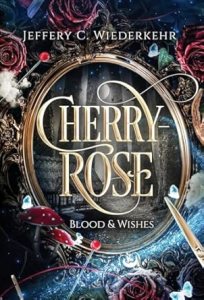
Cherry-Rose cover, with mushrooms and scissors and all things dark and fairytale

Zilla: Cherry-Rose: Blood & Wishes is a fairy-tale that exists at the boundary of reality and fantasy, and a book that I unabashedly loved. We’re lucky enough to have Jeff Wiederkehr with us to tell us about his moody, atmospheric novel. Jeff, take it away!

Jeff: Cherry-Rose: Blood & Wishes is a horroresque fairy-tale retelling that turns wishing upon a star into an allegory for when wishes go wrong. Set in modern California, this coming-of-age story is woven with beasts, a Blue Fairy, and an unexpected romance all set against the backdrop of classic fairy tale horror.

Cherry-Rose finds herself reborn into a world that seems too good to be true, because it is exactly that. Too quickly her loving sisters vanish and the dark secret behind her mother’s magic is revealed. In time she breaks free from the isolation of the forest and her mother’s spell in the hope of finding her sisters. However, on the other side of the forest, she seems to have found more trouble than she had at home.

On the journey to find her sisters, Cherry-Rose is pursued by a gang peddling a drug called pixie-dust, she finds help in the form of a beastly mentor, and she is presented with the prospect of love in a world that just might be more dangerous than the forest filled with all of its chasing wolves.

Zilla: The theme of the cycle of abuse really spoke to me. Even Sal, who recognises the lure of the cycle, can’t stop himself from repeating it. Is it the animal or the human, the wolf or the mother, bear or father, which compels this cycle?

Jeff: That’s the thing, it is the great universal Mother-Animal-Man which is compelled by the Hunger. Mother, because it is the omnipresent. Animal, because it is hungry and it must eat. And the human, to ensure that the cycle is unbreakable.

Zilla: Everyone in this book has something they need to escape, whether it is in their past or present. Sometimes they run, sometimes they turn to the Blue Fairy, and sometimes they turn to blue pixie dust. How intertwined are these three options?

Jeff: These options, like the cycle of abuse, are inescapable, we have fight or flight, drugs and dreams, and … or death. Here we have the desire to escape, the desire for something other than our station, and we have methods of distraction (pixie-dust) and hope for something greater than ourselves (the moon, the stars, the Blue Fairy).

Zilla: There are many births in this book, but every birth comes with a death. Is the reverse true? Or is there death without birth?

Jeff: The silly answer, the quip of an answer, and the real answer are all the same: yes (to all).

Zilla: Many of the characters carry double names: Marybelle/Mother, Just John/Brother John, lost/Gideon, Sky Blue/Shy Blue. Often in stories, a character with two names chooses the second name for themselves, as a sign of agency. Here, both names are gifted to them by others, or represent their relationship to others. Is it possible for a person to define themselves?

Jeff: Possible? I could make an argument, that no one could do it without help. Foucault would say, we cannot be who we are until we see ourselves reflected back from another. Think about it, who would we be if we lived alone on the moon? All of our insecurities, our issues with our own bodies, the fight between who we want to be and who we think we should be … it wouldn’t exist. For me, I’d say that others are signposts, not intentionally guiding, but unconsciously showing us the ground we are standing upon. Cherry-Rose had to go through a lot to accept the truth that we all know and rarely accept and look where she ended up ~ you have to read the book to find out.

Zilla: You mix together the real and the unreal–Hollywood and William Hale Academy for Children of All Sorts, wine and pixie dust. What is the line between reality and fairytale? Is there a line?

Jeff: This is the fun of writing fiction. I wrote and wrote as if I were on the moon and then when I came back down to earth too soon, often I was shocked by what I read. Whenever that happened I’d stop writing until I could get back to the moon. At every turn, whenever I got insecure and wanted to tell myself that I had gone too far, that there is no way … I somehow found a way to go further. And in the end, when I had to write ‘The End,’ I was pleasantly surprised by how shocked I was. For example, the chapter titled Moon Love Ritual … it is bizarre and beyond and I wish I could say more, but I don’t want to spoil the fun. The intention was to blur all of the lines. To say, “Why not?, Why the hell not?!, Hell yes!” Because we, the reader and the writer, decide where all the lines go.

Zilla: And last but not least, I know there’s a Spotify playlist—can we have it?

Jeff: It is called Honey and Gold. You can find it here.

Zilla: Thanks for sharing your story and your process. We’re looking forward to reading! Where can the Night Beats community find you and your book?
Jeff: Find me and the book at my website.

Behind the Screens: Tuesday Author Interview

Every Tuesday, get to know a bit about the stories behind the books you love, and discover your next favourite novel.

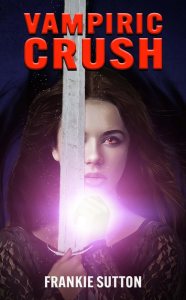
Vampiric Crush cover with a brown-haired woman carrying a glowing sword

Zilla: Danger and romance are hand-in-hand with Frankie Sutton’s paranormal romance, Vampiric Crush. Frankie, can you introduce us to your book?

Frankie: Shae Taizer hides in the protective Royale Realm, away from the reach of Gerard, the infamously manipulative Vampire King. She seeks a way to rid herself of the vampire’s crush on her, denying him an ally in his crushing quest for pleasure. She would rather die than become his Vampire Queen.

Her only plan is visiting the deadly Battle Realm. There, she hones her weapon and magic skills as a Deviant.

But after recalling a childhood of being raised among Civilians, she is gifted her own Pandora’s Box. She discovers a prophecy bonding her to two Civilians, Nickolas and Kiran. One is the key to defeating Gerard. However, reuniting with them ignites something more sinister—her own Vampiric Crush.

Zilla: What inspired you to write this book?

Frankie: Vampires such as Selene from the Underworld series and Saya from the Blood+ anime. And my love of swords, as well as Japan.

Zilla: Is there a visual image that inspired you?

Frankie: Oh yes. Back around 2000 I was part of a select group of Hollywood entertainers. Not mainstream, however. But they were professional tap dancers, singers, and actors. One of them was a female singer. She had a photoshoot and one of the pictures was her posing with a sword. I used that image as personal inspiration for my main character in Vampiric Crush.

Zilla: And that image inspiration made it to the cover, which is also a picture of a woman with a sword! I love that. Next question—if your characters met you, what would they say to you?

Frankie: I reckon they’d say, “Thank you for listening to us and sharing our story.”

Zilla: What background did you need to develop your story?

Frankie: When creating the prophecy for my ‘chosen one’, I discovered where exactly to set the story. Normally, the color blue isn’t associated with Halloween, but it fits for my story.

Zilla: What’s your next writing project?

Frankie: There’s actually two. One is a women’s fic inspired by my love of techno music and Celine Dion. The other one is an experimental dark fantasy—a short story collection that actually tells one whole story. It’s all connected!

Zilla: Thanks for sharing your story and your process. We’re looking forward to reading! Where can the Night Beats community find you and your book?

Frankie: Thanks everyone for taking the time to read about me and my creations. For more information about me, please visit BlueSky, Instagram, or my website. Vampiric Crush is available at Amazon, Barnes and Noble, Apple Books, Walmart, Kobo, Bookshop.org or Books-a-Million.

Behind the Screens: Tuesday Author Interview

Every Tuesday, get to know a bit about the stories behind the books you love, and discover your next favourite novel.

The Switch cover with an android-looking person on the cover

Zilla: Something about the world today just feels right for reading dystopias…and here’s April McCloud with a great one! April, can you introduce us to your novel, Switch

April: A hundred years in the future, Complete Life Management is selling perfection in the form of the latest technologically enhanced bionic body, the Apogee. As an elite runner and inadvertent spokesperson for humanism, NYPD Detective Naomi Gate has eschewed vanity upgrades. However, if she hopes to survive in New York City’s fierce criminal Underground and find her wayward brother, she has no choice but to undergo an illegal body transfer. 

Plunging into the Underground’s den of black-market body modifications and bionic hit squads, it turns out to be the first of several body transfers. And as the stakes rise, Naomi fears the price for saving her brother may be the thing she values most—her own humanity.

Zilla: What inspired you to write this book?

April: The Switch is a work that focuses on embodiment, and what it can mean for a variety of marginalities (with special focus on trans people and disabled humans). Two ways in which I have personally learned to be more inside of my own body is through martial arts and zen meditation. The focus on our inner world coupled with tying that to our physical body, was a concrete way to explore the theme of what it means to be human in a world of advancing technologies.

Zilla: Do you have a playlist for your book?

April: I find music inspirational and for The Switch, I have different songs for the various energies of the novel. There’s Nails, Hair, Hips, Heels by Todrick Hall for the glorious gender-bending and chaotic pansexual vibe. On My Way by Alan Walker, Sabrina Carpenter, and Farruko, leans into the emotional heart of how hard it is to be a warrior. And Light ‘Em Up by Fall Out Boy for the sheer explosive fun of kicking butt and blowing stuff up.

Zilla: If you could meet your characters, what would the conversation look like?

April: I think if I explained to them that I was their author, they might just arrest me for violating the Geneva Convention’s rules against cruel and unusual punishment. Otherwise, though, I’d try to distract them with talk of running and weapons, as well as introduce them to my cat. If I could have any one thing though, I would want my character Inari to meet my cat who inspired her, also of the same name. It’s possible if they teamed up that they would take over the world, but there are some things that just can’t be helped.

Zilla: How much research did you need to do for your book?

April: I had a lot of fun researching the current state of bionics. There’s incredible work being done with jaw-dropping results. My favorite spokesperson for bionics and physical disabilities is Tilly Lockey, who can often be seen showcasing her Hero Arms from Open Bionics. Odes to Tilly’s personal journey can be seen in my work, especially how unfair the health care system can be.

Zilla: What’s your next writing project?

April:I’m working on an adult romantasy, lovers-to-enemies novel that looks at the thin line between good and evil, and what drives us to both.

Zilla: Thanks for sharing your story and your process. We’re looking forward to reading! Where can the Night Beats community find you and your book?
April: The print book and ebook are available from Amazon: https://tinyurl.com/msz7pn62. You can find me at my website (www.aprilmccloud.com) on Goodreads (https://www.goodreads.com/author/show/50156312.April_McCloud) or on Twitter/Instagram (@mccloudwrites).

Behind the Screens: Tuesday Author Interview

Every Tuesday, get to know a bit about the stories behind the books you love, and discover your next favourite novel.

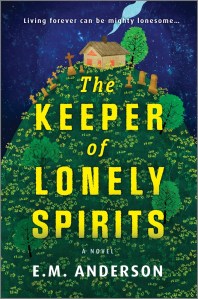
keeper of lonely spirits cover, with a graveyard on the top of a cheerful hill

Zilla: Sometimes we want to cuddle up with a cozy book in the dark of winter, and E. M. Anderson has just the thing! They’re here to tell us about their paranormal mystery, The Keeper of Lonely Spirits.

E.M.: The Keeper of Lonely Spirits is a queer cozy fantasy in which an old man cursed with immortality hunts ghosts rather than making mortal friends who will die one day. When the residents of an Ohio town beset by a vengeful spirit adopt him as their own, he must decide: leave to protect his heart, or stay to save their lives?

Zilla: What inspired you to write this book?

E.M.: There’s a soft old man character in my debut, The Remarkable Retirement of Edna Fisher. While he’s a more minor character, he’s also one of my favorites. I really wanted to write a book about a soft old man, and then when my nesting partner drove us past a cemetery one day, I had a vision of a soft old man working the grounds. That was the initial inspiration for The Keeper of Lonely Spirits, although the main character is also inspired by my maternal grandfather in many ways.

Zilla: That’s very sweet—and shows that you’re a character-centered writer. If your characters met you, what would they say to you?

E.M.: I’m pretty sure my characters would mostly go, “DEAR GOD WHY” if they met me! Peter, the main character of The Keeper of Lonely Spirits, has even more reason to react to me that way than most of them do, between the immortality, the unsettling relationship with ghosts, and the sheer number of people he’s lost, but maybe he’d refuse to speak to me at all. Which is too bad, because I’d really like him to be my grandpa.

Zilla: Oh dear! Who is your favourite character you’ve written, and why?

E.M.: I love all my characters, but Edna Fisher—the titular character from The Remarkable Retirement of Edna Fisher—is a massive comfort character. She’s the quintessential grandma, she’s cheerful, she’s always there for anyone who needs her, and she aggressively adopts every young person who walks into her life. No problem is too much for her, even if she has to sit and feel things about it for a while before tackling it. And even though she isn’t cursed with immortality, in my head she’ll live forever.

Zilla: What’s your next writing project?

E.M.: Currently, I’m partway through a second draft of a queer cozy mystery starring a grumpy old lightkeeper. I’m also revising another queer cozy fantasy for my publisher, MIRA; hopefully it’ll be cozy, anyway—it’s getting a tad dark. But the main character adores romance novels, so the book has sort of turned into a 1980s bodice-ripper thinly disguised as a fantasy novel.

Zilla: Thanks for sharing your story and your process. We’re looking forward to reading! Where can the Night Beats community find you and your book?

E.M.: My website is elizmanderson.com, and I’m also elizmanderson on Instagram, BlueSky, and Facebook (as well as a couple other platforms where I’m less active). Here are BookShop links to The Keeper of Lonely Spirits and The Remarkable Retirement of Edna Fisher, but a more complete list of retailers is available at my linktree (linktr.ee/elizmanderson).

Behind the Screens: Tuesday Author Interview

Every Tuesday, get to know a bit about the stories behind the books you love, and discover your next favourite novel.

Up the Entropic Hill cover with a cyberpunk looking person sitting on a fence

Zilla: Social media can be a wonderful place to meet strange new people, and Mattie Bukowski, who I met on Tumblr, certainly qualifies as wonderful! He and I bonded over our shared love of deep, queer science fiction, so I am delighted to announce that he’s published a novel that promises to be as introspective and engaging as he is. Expect a review from me soon, but til then, Mattie, can you tell us about your novel Up the Entropic Hill?

Mattie: Up the Entropic Hill—my debut novel—is a queer, existential space adventure.

In the distant future, humans live in a utopia where even death is not the end—for everyone except Amber’s parents. At 25, she is a cynical, aloof Ph.D. in history who resents her sheltered life at home and yearns to find her place in the world. Then, an exciting job offer comes her way—the chance to uncover the mystery of a civilization that disappeared thousands of years ago. Teaming up with the archeologist Lullaby, Amber embarks on a hitchhiking quest to find the fabled Aquamarine Moon and, perhaps, some much-needed meaning in her life.

Zilla: What inspired you to write this book?

Mattie: A few things! First is a biophysics lecture I attended while in undergrad—it was about the laws of thermodynamics, and entropy, and information, and how those concepts are connected. This lecture was somehow quite philosophical, for me at least. It made me think about existentialism and the nature of reality and human purpose. That’s where I got the main themes of the book. Another major inspiration is Hitchhiker’s Guide to the Galaxy—I love the series and it was constantly in the background of my mind as I was writing. That’s why the novel is mostly one long space hitchhike. Lastly, I was inspired by some other philosophical questions that were tumbling around my brain at the time, especially questions about free will and anti-natalism. So this book is quite philosophy heavy, though hopefully not in an academic sense.

Zilla: If your characters met you, what would they say to you?

Mattie: I think Amber, the protagonist of the novel, would hate my guts for all I put her through! Especially because of the ending (spoilers…). Amber is not a people person to begin with, she hates almost everyone she meets. I think the idea of having an author in control of her narrative would infuriate her, even though I feel like Amber was more in charge of this book when I was writing it than I ever was. 

Zilla: You’ve told us about plot, and about characters…so is your book more plot-driven or character-driven? Or a secret, third thing?

Mattie: It might actually be the secret third thing! My first instinct is to say it is character-driven because of how much it focuses on Amber and her experiences and reflections and character development, but based on some of the feedback I’ve gotten, it’s a mix of both. The book is quite fast-paced and adventurous too, there’s something happening every chapter, so I think typical space opera readers wouldn’t be bored with it.

Zilla: Once I finish reading this, what do I have to look forward to next? What’s your next writing project?

Mattie: I’m working on a dark academia horror with a M/M romance! Here’s the pitch:

When two researchers discover a horrifying truth about consciousness and death, their obsessive devotion to each other pushes them to do the unthinkable.

Zilla: Okay, I’m sold on both of these books now! Thanks for sharing your story and your process. We’re looking forward to reading! Where can the Night Beats community find you and your book?

Mattie: You can find me on Tumblr.  The novel is available on publisher’s website and Amazon.

Behind the Screens: Tuesday Author Interview

Every Tuesday, get to know a bit about the stories behind the books you love, and discover your next favourite novel.

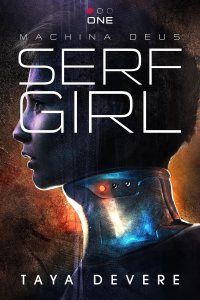
Serf Girl cover with a young woman with a metal collar on

Zilla: The best science fiction makes us think about our own world—the people and politics that inhabit it—while still telling a great story. Which is why we have Taya DeVere here today to tell us about her novel Serf Girl (Machina Deus Book 1). Taya, tell us a bit about yourself and your book!

Taya: Hello! I spend half of the year in Finland, the other half in Spain, and visit my third happy place, Maine, whenever possible. I write dystopian sci-fi stories under the pen name Taya DeVere.

My new release tells the story of Sam, a PTSD-driven woman who volunteers in a human experiment in the year 2150. To escape the horrors of Slumland, she moves into a questionable haven; an abandoned mall. She’s no different than any other Serf in the mall program… except for the secret that would terrify them all.

Zilla: What inspired you to write this book?

Taya: The idea for Serf Girl came to me while sitting in the Maine Mall food court. It’s not a brand-new idea; people living in repurposed buildings due to housing shortages and overpopulation. But that’s where the story originated—and then along came Sam. With Sam’s nightly flashbacks and nightmares, Tourette’s syndrome, antisocial ways, and PTSD symptoms, she was in for a (torturous) ride. While writing the first draft, I let Sam lead the way. I started to enjoy the time I spent in her headspace more and more. During the second draft, I pushed her to overcome her trust issues and defenses – no matter how much blood she had to spill along the way.

Zilla: How much research did you need to do for your book?

Taya: My partner, Chris, has Tourette’s syndrome. All the ‘twitches’ in Serf Girl are from real life and what we call Chris’s “Demon.” In addition to interviewing Chris about his twitches and tics, I also did extensive research on the syndrome to avoid the biggest pitfalls.

Zilla: Have you ever killed off a character your readers loved?

Taya: Yes, I’m known to kill off my characters, whether they’re loved or hated. I had to slow my roll while writing my previous series, Unchipped, because my development editor threatened to quit her job if I slaughtered any more of her favorite people. People do die in Machina Deus, but I think we’re moving in the right (happier) direction. I did read somewhere how European writers are expected to kill their characters, no matter the genre, how interesting is that? Good thing I’m not writing romance or children’s books!

Zilla: I’ve never heard that, but it checks out. Speaking of other people’s books, what book do you tell all your friends to read?

Taya: I’m currently devouring The Ministry of Time by Kaliane Bradley. It’s a story about time traveling, romance, expats, and refugees. I can’t wait for bedtime to dive back in!

Zilla: Thanks for sharing your story and your process. We’re looking forward to reading! Where can the Night Beats community find you and your book?

Taya: Serf Girl is available on Amazon (e-book: https://www.amazon.com/dp/B0CYX85MNB) and anywhere paperbacks are sold. 

Find me on Facebook (https://www.facebook.com/tayadevereauthor) and on Instagram (https://www.instagram.com/tayadevere_author/).

Behind the Screens: Tuesday Author Interview

Every Tuesday, get to know a bit about the stories behind the books you love, and discover your next favourite novel.

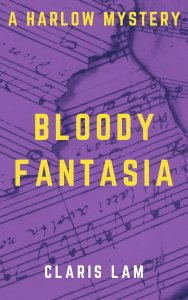
Bloody Fantasia cover with torn pages of sheet music

Sabitha: We’re so excited to have Claris Lam back to tell us about her third mystery in the Harlow Mystery series. Winner Takes All and Engagement to Die For were great, so I can’t wait to hear what Bloody Fantasia has in store for us! Claris, can you introduce us to the book?

Claris: In Bloody Fantasia; Aubri Harlow and her friends believe that their days of investigating murders are over. However, when Aubri’s sister, Aria, moves into her new music school, the Da Capo Music Institution, the school’s acting president suddenly dies during the welcoming ceremonies.

However, the acting president’s death is far from the first murder committed on campus. A string of past murders haunt the school’s reputation and its students. It doesn’t take long before new corpses start piling up, and Aubri, Aria, and their friends realize they must take up the mystery-solving mantle once more and find out who the murderer is.

Will they figure out the person responsible for causing these new tragedies, or will they become part of its bloody history? Find out by reading Bloody Fantasia!

Sabitha: You’re on a roll with the Harlow Mystery Series … what inspired this third book?

Claris: Fun fact: Bloody Fantasia was initially supposed to be a crossover between the Harlow  Mystery series and a different standalone book I had planned years ago!

The other standalone book would have featured the events of what happened at the Da Capo Institution prior to the current events of Bloody Fantasia. That book, and Bloody Fantasia, were both inspired by a fusion of La Corda D’Oro (a manga series) and The Secret History by Donna Tartt, and elements from several other mystery books set in school settings.

However, I ended up dropping the standalone book idea, and Bloody Fantasia became this project that was still influenced by La Corda D’Oro and The Secret History. I had to significantly simplify the story since I didn’t have the other standalone book (which took place before the events of Bloody Fantasia) to provide context for the story to make complete sense.

Sabitha: Do you have a playlist for your book? Can you tell us why you picked a couple of the songs?

Claris: I have playlists for all the main characters! I’ll link to each of them below.

Aubri Harlow: https://open.spotify.com/playlist/3BXi63oe0OFdmi24HltNhk?si=a30a0685c2b64fa2

Bastian Faulkner: https://open.spotify.com/playlist/1tzPptocq3hD9wA6WNkBIs?si=91052ffc89e64627

Aria Hawthorn: https://open.spotify.com/playlist/4umEcteGfZ4lTnt2nm6KO2?si=4044368c94b846bd

Nick: https://open.spotify.com/playlist/2AvgBWVf9QOBhjo71jrTj5?si=238f145183d547a6

I hope to share playlists featuring the antagonists/murderers of each book and a playlist for the whole Harlow Mystery series (or separate playlists for each book) in the future.

Sabitha: I can’t wait for that! As a prolific author, do you have any tips to help people become better writers?

Claris: Please give yourself some regular breaks and take care of yourself.

I’ve gone through burnout as a writer back in 2023. Despite taking time to recover from said burnout, I kept going through an unhealthy cycle of getting everything writing-related done as fast as possible. I felt this pressure to keep producing content at such a fast pace to be a “successful” writer, especially when seeing other authors who published multiple books in a year with high sales and rankings.

It’s only recently (early July 2024 onwards) that I’ve decided to slow down a bit and take my time with writing. I find that by doing so, it gives me more opportunities to enjoy the actual process of writing again. I’ve missed that for a long time, and I’m glad to rediscover joy in the process again.

Also, figure out what your definition of “success” as a writer is.

Everyone’s definition of how they want to reach “success” as a writer will be different. Mine has changed drastically in the past few months so I can have a writing journey that gives me more joy regardless of how fast or slow I am with having new work published. It’s really important that when you figure out your definition of success, it’s because it’s something you genuinely strive for versus doing it because everyone else seems to be working for that same type of goal.

Sabitha: That is solid, hard-won wisdom. Taking that into account, what’s your next writing project?

Claris: I’m currently writing two poetry chapbooks and several fantasy books. They’re drastically different from the Harlow Mystery series but writing in these genres brings me the most joy right now. I also want to write more short stories and individual poems, and experiment with those forms more.

Sabitha: Thanks for sharing your story and your process. We’re looking forward to reading! Where can the Night Beats community find you and your book?

Claris: Want to check out my website, socials, & newsletter? Check out all the links in my Carrd: https://clarislam.carrd.co. Currently I’m more active with my newsletter than anything else, so I’d highly recommend that you subscribe to it! I send newsletters every 2nd and 4th Tuesday each month.
Here’s the link for where you can find Bloody Fantasia: https://books2read.com/u/38veQa