Behind the Screens: Tuesday Author Interview

Every Tuesday, get to know a bit about the stories behind the books you love, and discover your next favourite novel.

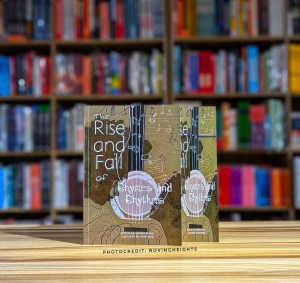
The book The rise and fall of rhythm and rhymes sitting on a table at a bookstore.

Zilla: Poetry is a delight for all ages—Yewande Akinse has written some for children. Today, Yewande is here to talk about it!

Yewande: I am excited to introduce my latest poetry collection, The Rise and Fall of Rhymes and Rhythms. This book is a heartfelt exploration of life’s essential lessons, crafted specifically for children. Comprising 100 poems, it aims to engage young readers through playful language and vivid imagery, while imparting valuable insights on themes such as kindness, resilience, curiosity, and self-discovery. Written in the structured form of dizains, each poem is designed to be both rhythmic and memorable, making it accessible and enjoyable for children. The collection reflects my deep love for my daughter, serving as a guide to help her navigate the complexities of growing up. The Rise and Fall of Rhymes and Rhythms is not just a collection of poems; it is an invitation for children to explore their emotions and the world around them. I hope that through these verses, readers will find inspiration, joy, and a sense of connection to the lessons that shape their lives.

Zilla: You write about birth and death. Do you see this as a linear passage or as a cycle?

Yewande: I  see the themes of birth and death not as a linear passage but as a profound cycle. This cyclical perspective reflects the interconnectedness of life, where each ending gives way to new beginnings. Birth represents not only the physical arrival of life but also the emergence of ideas, experiences, and transformations. Similarly, death is not merely an end; it signifies a transition, a release that allows for renewal and growth. In my poetry, I explore this cycle by highlighting the beauty and complexity of both birth and death, emphasizing how they coexist and inform one another. This perspective encourages readers to embrace the full spectrum of existence, recognizing that every moment of joy and sorrow contributes to the richness of the human experience. Ultimately, viewing life as a cycle fosters a deeper understanding of resilience, continuity, and the enduring nature of love and memory.

Zilla: What do you want to teach people through your poetry?

Yewande: Through my poetry, I aim to teach people about the beauty of resilience, the importance of empathy, and the power of self-discovery. I want to encourage readers to embrace their emotions, whether they are joyful or painful, and to recognize that each experience contributes to their growth and understanding of the world. I also seek to illuminate the richness of cultural heritage and identity, fostering a sense of pride and connection among individuals from diverse backgrounds. By exploring themes of belonging and community, I hope to inspire readers to appreciate the shared human experience and the stories that unite us. Ultimately, I want my poetry to serve as a catalyst for reflection and dialogue, prompting readers to consider their own journeys and the impact they can have on others. Through my work, I aspire to create a space where individuals feel seen, heard, and empowered to express their own truths.

Zilla: Your poems are about community. What communities nutured you during your life?

Yewande: Throughout my life, I have been nurtured by several communities that have profoundly shaped my identity and creative voice. First and foremost, my family has been a foundational community, providing unwavering support and encouragement for my artistic pursuits. Their love and values instilled in me a deep appreciation for storytelling and cultural heritage. Additionally, the literary community has played a significant role in my development as a poet. Engaging with fellow writers, attending workshops, and participating in readings have allowed me to share my work, receive feedback, and learn from diverse perspectives. This sense of camaraderie and collaboration has enriched my understanding of poetry and its potential to connect people. These nurturing communities have collectively shaped my journey as a poet, providing the support, inspiration, and context necessary for my growth and creative expression.

Zilla: Thanks for sharing your story and your process. We’re looking forward to reading! Where can the Night Beats community find you and your book?

Yewande: My books are in bookstores and online on Amazon and Google books. My books can primarily be found on my website. I am on social media @adwande on Facebook, X and Instagram.

Behind the Screens: Tuesday Author Interview

Every Tuesday, get to know a bit about the stories behind the books you love, and discover your next favourite novel.

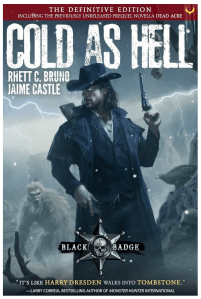
Black Badge Trilogy book 1 Cold as Hell cover. A Sheriff type fights ice monsters.

Zilla: Jaime Castle is here with a horror full of demons and angels. Jamie—can you introduce your book to us?

Jamie: On the run and out of time…

Everything changed back in Crescent City when Crowley made his choice to stand up to his angelic handler Shargrafein. It was either her or Rosa, and the choice was clear. Now, there’s no going back.

Something about Rosa has everyone scrambling—a hidden power. It’s up to Crowley to bring her back to land of the living, and discover exactly what she is. Only then might they have a chance against the forces of Heaven and Hell, both of whom want her for their own devices.

So what if that makes him a traitor to the White Throne? They kept the truth about her from him. Made him a pawn in their endless war.

But those above and below aren’t the only ones after Crowley and Rosa. An old rival has resurfaced and he’s out for vengeance, no matter what takes.

If they hope to evade capture, Crowley will need to trust old friends and allies. And trust doesn’t come easy to a man shot to death by his own boss.

Zilla: What inspired you to write this book?

Jamie: I’ve always been a fan of westerns, and I believe that’s true for most people, even if they don’t know it. In the science fiction and fantasy community, shows like Firefly, Mandalorian, West World, and The Witcher are huge—and they are all forms of westerns. Sure, they don’t all have cowboys with pistols, but the concept remains the same: a sole individual rides into town, beats the hell out of injustice, and rides off into the sunset. For me, what could be better than smashing together a true western with the fantastical elements you might find in a Harry Dresden novel?

Zilla: How much research did you need to do for your book?

Jamie: Black Badge, the series, required a ton of research and a historian on hand. We wanted these books to feel authentic to the era in all possible ways. We researched guns, ammo, city maps from the time period, technology, and did all we could to incorporate those things into the story in a believable way.

Zilla: Is your work more plot-driven or character-driven?

Jamie: My books, including those I write with Rhett Bruno, are heavily character-driven. I believe a plot can only take someone so far if the character feels like cardboard. Meanwhile, I’ll read a book about nothing if the character is someone I can get behind.

Zilla: What’s your next writing project?

Jamie: I’m currently working on book two of a literary role playing game novel. Book one, An Unexpected Hero, is out and if you enjoy comedic fantasy with heart, it’s for you.

Zilla: Thanks for sharing your story and your process. We’re looking forward to reading! Where can the Night Beats community find you and your book?
Jamie: You can find my books at www.jaimecastle.com. Additionally, we own aethonbooks.com. You can find me anywhere on socials at Jaime Castle.

Behind the Screens: Tuesday Author Interview

Every Tuesday, get to know a bit about the stories behind the books you love, and discover your next favourite novel.

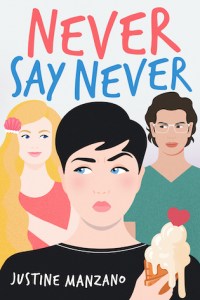
Cover of Never Say Never with 3 teens, one of them holding an ice cream

Zilla: I fell in love with Justine Manzano’s books when I first read her YA fantasy romance Never Say Never. When I got the chance to interview her about her works, I jumped at it! Justine, can you tell us a bit about your books?

Justine: I’m the author of four YA Fantasy novels. I have an action/adventure series, Keys & Guardians, about a teenager entering a corrupt monster-hunting organization and fighting to overthrow it from the inside. I also have a standalone romantic comedy, Never Say Never, which is about a girl who, after the divorce of her parents, declares she’ll never fall in love. But Aphrodite, disguised as her human teenager friend, sees that as a challenge.

Zilla: What inspired you to write these books?

Justine: Never Say Never was inspired by being a child of divorce, but not just any divorce. I was a kid who grew up knowing my parents didn’t belong together and would be better off without each other. But I’d never read a book about a family like mine. So I wrote one.

For Keys & Guardians, the series was about the abuse of absolute power in its many dynamics. I grew up in an abusive household, and there’s the exploration of neglect, and child abuse, abuse of power in society, in politics…I wanted to explore all of the ways I felt helpless in my life…and then I wanted to craft a character who would stand up against that. In many ways, the main character, Jacklyn, was my hero too.

Zilla: I can see how characters play an important role in your stories—is there a character in fiction that’s been important to you during your life? 

Justine: Batman is my special interest. I love the idea of a hero who chose to protect people. He doesn’t have any special abilities to protect him. Everything about him he chose to hone and to dedicate toward the people of Gotham. He’s a hero built from the strength of his brain more than anything else and I love that.

Zilla: You’ve got so many stories inside you—what’s your next writing project?

Justine: I currently have two writing projects in progress. The first is a short story collection that takes place in the Keys & Guardians series. I’m unsure about the title currently. I’m still sorting that out, but it’s in edits. I believe it will be called Tales of the Dawn.

The other project I’m working on is a new book called Reality Check. It’s a YA Contemporary novel. Leah Marinello deals with an abusive life by throwing herself into imaginary worlds—but when her school theater club offers her an actual escape, she discovers her imaginary friend might not be so imaginary—and he doesn’t really want to let go.

Zilla: Thanks for sharing your story and your process. We’re looking forward to reading! Where can the Night Beats community find you and your book?

Justine: My books are available anywhere books are sold. My website is justinemanzano.com, and you can find me on social media as @justine_manzano on Instagram and Threads, @justine_manzano1229 on TikTok, and as @justinemanzano.bsky.social on Blue Sky.

Behind the Screens: Tuesday Author Interview

Every Tuesday, get to know a bit about the stories behind the books you love, and discover your next favourite novel.

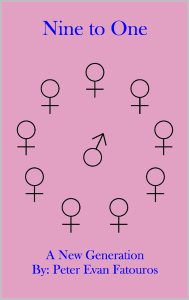
Nine to One cover with symbols of men and women in pink and blue text

Zilla: Science fiction exists to show us an alternative future—and sometimes, an alternative past. That’s what we get in Peter Fatouros’ novel, Nine to One: A New Generation. Peter, can you introduce us to your book?

Peter: Nine to One: A New Generation is a story that takes place in an alternate universe where starting in 1965, the birth ratios changed so that instead of boys & girls being born in essentially equal numbers, from that point on, nine girls were born to every boy. The book follows several characters as they navigate their lives in a world that’s struggling to adjust not only to the changes of the 60s, 70s & 80s, but also the fact that the new generation is 90% female.

Zilla: What inspired you to write this book?

Peter: It started before the pandemic when I was riding the bus home from work. One day, I noticed that even though the bus was packed like a sardine can, there were only two or three guys on the bus. I ignored it at first, just a funny thing to notice. But then it kept happening, every night, five days a week. No matter what time I took the bus, it was the same thing, a bus load of women with a handful of men. I started wondering what was going on. That led to me imagining if the whole world were like this & what that would be like. That then led to me wondering how such a world might have come about. Before I knew it, the ideas for a book were coming to me.

Zilla: What a neat beginning! From there, did you do a lot of research?

Peter: A good bit. I spent a good deal of time looking up historical figures, election results, and government agencies that don’t exist anymore. Towards the end of the book & into the sequel that I’m writing, historical accuracy isn’t as important as things have changed wildly. However, at the beginning, a number of things happening in history would still be happening in the book, even with a change as wild as this book’s premise. So I wanted the beginning of the book at least to be as historically accurate as I could get it.

Zilla: Is your work more plot driven or character driven?

Peter: Character driven. There are a few subplots here and there, but it’s mostly a story about these characters and the world that they are living in. A look into how they’re changing themselves, trying to change society, or just growing up in a situation unlike anything that the world has seen before.

Zilla: What’s your next writing project?

Peter: The sequel to this book, which will pick up where it left off in 1985 and continue the story. I’m also working on a science fiction podcast called What Could Have Been.

Zilla: Thanks for sharing your story and your process. We’re looking forward to reading! Where can the Night Beats community find you and your book?

Peter: I can be found on Bluesky, Instagram, Threads, and Tik Tok. My Book can be found as an Amazon eBook, Amazon Paperback, or read about it on Goodreads.

Behind the Screens: Tuesday Author Interview

Every Tuesday, get to know a bit about the stories behind the books you love, and discover your next favourite novel.

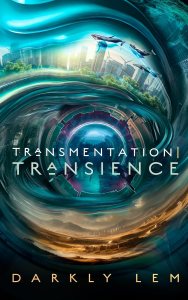
The cover of Transmentation | Transience with worlds spirilling together.

Zilla: Transmentation | Transience is a novel of a science fiction multiverse that blew me away with the rich characters and deep worldbuilding. Its creators are collectively known as ‘Darkly Lem,’ a five-author collaboration consisting of Josh Eure, Craig Lincoln, Ben Murphy, Cadwell Turnbull and M. Darusha Wehm, who make up part of the larger writing collective Many Worlds. Being a huge fan of writing collectives in general and Darkly Lem in particular, I was delighted that they agreed to join us for an interview. Before we get into my questions, can you tell us a bit about the book?

Darkly Lem: Transmentation | Transience is the first book of the Formation Saga, a novel trilogy set within the Many Worlds shared multiverse. The trilogy is an introduction to the much larger Many Worlds narrative universe, which already consists of short stories by numerous authors, which can be found on the Many Worlds website and in the Many Worlds print anthology.

The publisher’s blurb for Transmentation | Transience is:

Over thousands of years and thousands of worlds, universe-spanning societies of interdimensional travelers have arisen. Some seek to make the multiverse a better place, some seek power and glory, others knowledge, while still others simply want to write their own tale across the cosmos.

When a routine training mission goes very wrong, two competing societies are thrust into an unwanted confrontation. As intelligence officer Malculm Kilkeneade receives the blame within Burel Hird, Roamers of Tala Beinir and Shara find themselves inadvertently swept up in an assassination plot.

Meanwhile, factions within Burel Hird are vying for greater control over their society in a war of cutthroat machinations–at a heavy price. Elsewhere, two members of rival societies lay their own plans for insurrection–with ramifications that will ripple across the Many Worlds …

Zilla: I was fascinated by the mode of travel between dimensions, where characters inhabit different bodies. I’ve often thought about the distinction between my “self” that is my identity and the chemical and physical “self” that is my meat prison. I come at it from the perspective of mental illness, but I’ve often had these conversations with disabled and trans friends. As authors of these characters, and as humans in your own right, how do you grapple with this duality?

Cadwell: I think this has been a big question for us, and something we’ve only cracked the surface of. In our stories and within the Formation Saga we’ve explored the cognitive dissonance of entering bodies that don’t quite match the traveler’s sense of self. Often the differences are more superficial: muscle mass, hair and eye color, height. But these differences can also be fundamental: ethnicity, gender, orientation, formative memory, even personality. We’ve done a lot with memory and personality, but there’s still so much we can explore with other aspects of identity. That sort of exploration can be tricky, so we’ve been very careful so far. But as the project progresses, we’ll be looking for more opportunities to push our boundaries.

Darusha: If I had to choose my single favourite part of the Many Worlds narrative, this is it. I’m obsessed with questions of individuality, authenticity, selfhood and how those intersect with embodiment and time. I feel like there is no one answer, not in our reality or in the reality of the Many Worlds multiverse, but it is in asking the questions and interrogating our experiences we can come close to glimpsing a grimy reflection of the truth.

Craig: I find the implications of traveling meaning you’re exposed to new environmental and chemical stimuli, from the world you enter as well as the new tailor-made body for you to inhabit, to be exciting and worth exploring. Part of my personal experience with this is also related to my son’s journey with ADHD, and how different medications vastly altered his demeanor until we honed in on one that worked for him. I imagine similar things can and will happen to people who get new bodies, whether it be subtle or overt and obvious.

Zilla: Your world building is stunning, with multiple distinct societies that cross dimensions, and each flavoured subtly differently depending on the universe where we encounter them. But one commonality is that most (maybe all) of your characters are compelled by a desire to belong to one of them—to be part of a society that’s bigger than themselves. Are all people susceptible to this? Would it be better if these characters could escape it?

Ben: I think this is partly a product of simply being the first book in a series, so we’re keeping the difficulty (relatively) low. As such, things like unaffiliated travelers or “city-state localities” just haven’t shown up yet–but they’re certainly out there! At the same time, you’re pointing to a topic that we explore with greater depth in subsequent books; these characters exist within the context and the schema of the “society,” and they don’t necessarily see all that many viable alternatives to it. In much the same way that the nation-state feels like a rather inescapable paradigm to many of us in our own earth-type locality, the society is likewise (seemingly) pervasive as the default unit to organize people in the multiverse.

That’s not to say it’s a rational way to organize people, any more than the nation-state necessarily is, but it’s hard for some of our characters to conceive other ways of being. Whether we’re all susceptible to that pressure I couldn’t say. As one of your previous questions suggests, it’s worth asking how much of our identities are a product of the chemical cocktail percolating in whichever meat-mech we’re piloting at a given moment, and whether such considerations are even meaningful. But I do hope some of our characters can find a place they’re happy–whether it’s within a society or without.

Craig: Some of our travelers’ societal memberships come about not so much from desire as it is that these societies are monolithic presences within the localities people travel to, so you have to interact with them frequently if you travel. Of course there are also plenty of true believers.

Josh: We do have a character in the Formation Saga who does not initially belong to any given society, but you’ll have to wait to read about them.

Zilla: I look forward to it! Looking at reviews of this book, one common element is readers commenting on how, despite 5 authors contributing, the story read as a seamless whole. I completely agree. What process did you use that resulted in a novel with such coherent plot, characters, and world building?

Cadwell: I’m curious what others of us might list here, but I think the big thing we did to create a consistent voice was simply spending a lot of time talking with each other. We planned the series together, outlined together, edited together, and (especially in the beginning) wrote sections of the novel together on a singular Google document. That process was as chaotic as it sounds. But because we were motivated by the same/similar goal, we played off each other really well. When we didn’t align, we debated, talked it out. Sometimes that process was challenging, but almost always it resulted in a more synchronized view of what the story and characters needed.

Ben: What Cadwell said. We’re conditioned to think of writers as lone, towering geniuses, but there’s no reason the process of writing can’t be as collaborative as making music. It’s just a very, very, very slow form of improvisation.

Craig: Slow improv is a great way to put it! I’d say our process also evolved from lessons learned, and we weren’t afraid to change things when things didn’t work as well as we hoped.

I also feel like having an odd number was a real boon for us. Debating some things can take a long time, and if we’re under time pressures we can simply take a vote on it. Ultimately, though, we try to satisfy everyone’s concerns as much as possible, even if someone gets out-voted.

Josh: The band analogy is the most accurate for sure. We also evolved the process over the years to the point where we give each other grace re: writing tendencies which aren’t singularly our own. One of us may tend to write with more or less commas, for example. Or one of us uses character interiority while another tends to drill down into setting detail. We let the fullness of our writing selves bloom—creating a new self, I suppose.

Darusha: Oh, commas! How many hours have we lost to commas? The other thing no one has mentioned yet is that we all touch every word. It’s a demanding process but by the end of it there’s no part of the book that hasn’t been informed by each of us, creating what is ultimately a unique voice: Darkly Lem.

Zilla: Where can people find the book? And where can they find y’all on the internet?

Darkly Lem: Links to most stores are here and you can find Darkly on our website here. We post very sporadically on BlueSky.

Behind the Screens: Tuesday Author Interview

Every Tuesday, get to know a bit about the stories behind the books you love, and discover your next favourite novel.

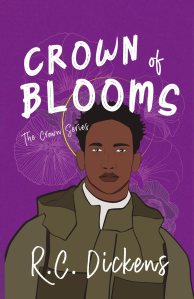
Crown of Blooms cover with a young adult man on the cover

Zilla: Growing up is complicated—particularly when you’re a gay kid living in the Bible Belt. R.C. Dickens has given us a fantastic queer coming-of-age novel, , and we’re lucky enough to have them here to answer our questions about it. R.C., can you tell us the blurb for your book?

R.C.: Kayden Moses has worked for 15 years to be a good pastor’s son. He’s volunteered at every Vacation Bible School, never missed a youth group meeting, and tries to follow the example of his spiritually gifted twin sister, Delilah. However, all his diligent efforts are disrupted when he meets the biggest stumbling block of his life:

Alex. The new boy in youth group. Bubbly. Opinionated. Dizzyingly nice to look at.

Suddenly, Kayden finds himself caught in a spiral of confusion and asking questions he’s never asked before.

Who is Kayden Moses? Because he’s certainly not a good pastor’s son anymore.

Zilla: What inspired you to write this book?

R.C.: This book initially started as a short story imagining a young man protesting a pride parade seeing his ex-lover from across the fence. That conflict of faith and sexuality became the core of Crown of Blooms and it sort of spiralled from there.

Zilla: It sounds like a very personal story. If you could meet your characters, what would you say to them?

R.C.: Sorry not sorry, lol. But to be serious, I would probably tell Kayden that there is an entire world outside of the Bible Belt, full of people who will love you as you are. The world is not nearly as hopeless for a queer kid as it feels, as you’ve been told over and over again for your entire life. It’s cliche to say, “It gets better”. I think it’s more honest to say, “You can make it better.” You can break free of those chains, form your own beliefs, find your own tribe. Your Pink Pony Club is out there, somewhere, waiting for you.

Zilla: That’s really beautiful—thank you for saying that. Is there a fictional character who has been with you through your life?

R.C.: Zuko from Avatar: The Last Airbender (ATLA) was my first love. I wrote three novel length ATLA fanfictions between the ages of 12-16 about Zuko and my self insert Mary Sue OC. No one understands Zuko like I do. I genuinely owe my whole writing career to this character as I wouldn’t have discovered my love of writing if not for my obsession. He’s just such a compelling, well rounded character with endless depth. I could talk about the intricacies of his character arc for days.

Zilla: What’s your next writing project?

R.C.:  I’m currently looking for beta readers for the sequel, Crown of Thorns, which is very exciting. I’m also publishing a serial romance on the Radish app called Prince and the Gladiator if you’re interested in a high-heat trope driven romp.

Zilla: Thanks for sharing your story and your process. We’re looking forward to reading! Where can the Night Beats community find you and your book?

R.C.: You can find me on TikTok @babyraythesadclown or on Instagram @rcdickens_author. If you want to go purchase your copy of Crown of Blooms, sign up to be a beta reader or read my other work, check out my link tree: https://linktr.ee/RCDickens

Behind the Screens: Tuesday Author Interview

Every Tuesday, get to know a bit about the stories behind the books you love, and discover your next favourite novel.

The Mona Lisa Sacrifice by Peter Darbyshire, showing the arm and wing of an angel.
Version 1.0.0

Zilla: We have Peter Darbyshire here with a wild, magnetic fantasy novel, The Mona Lisa Sacrifice. Peter, can you tell us a bit about the book—and the rest of the trilogy?

Peter: The Mona Lisa Sacrifice kicks off the Cross series of supernatural thrillers, where the immortal rogue Cross moves through a hidden world of faerie, gorgons, ghosts and more to stop a war among fallen angels. Cross is no hero but he may be the only one who can stop the end of the world.

Zilla: What inspired you to write this book?

Peter: When I was in university I read an Old English poem called “The Dream of the Rood,” which told the story of Christ’s crucifixion from the cross’s point of view. It was such an interesting angle that it stuck with me. Years later, I was thinking about it again and I had this idea: what if Christ’s body was like that cross? Something that held his spirit but then remained behind when he left our world? And what if another soul somehow came to occupy that body after the Ascension? That’s how I came up with the character of Cross, an immortal, drunk, thieving murderous angel killer who’s the one you really want to handle your supernatural problems.

Zilla: Were you inspired by an image when you wrote this?

Peter: I’ve long found the Mona Lisa painting to be rather eerie — to me it’s like a portrait of someone not quite human in an alien landscape. So when I was looking for the first story for Cross, I knew it had to involve the Mona Lisa but with a magical twist. I made the book The Mona Lisa Sacrifice centre around the weird entity the painting is supposedly based upon in Cross’s world. There are actually a number of paintings that appear in the book, and Cross even manages to get himself trapped inside one of them!

Zilla: Did you do much research for this book?

Peter: I did a lot of research for The Mona Lisa Sacrifice and the other books in the Cross series (The Dead Hamlets and The Apocalypse Ark). They are set in our world and involve key moments in history as well as real people from history — Shakespeare and Christopher Marlowe, for instance. So I wanted to make sure I got all the details right, so that when people read my version of Shakespeare wielding a magical quill that gives him the power to change reality or ink that grants immortality, they’ll be willing to buy that magical element because everything else is so real.

Zilla: What’s your next writing project?

Peter: I’m about to tackle the edits for the fourth book in my Cross series, which is out later in 2025. After that I’ll be starting the fifth book in the series. Hopefully there’s many more books to come!

Zilla: Thanks for sharing your story and your process. We’re looking forward to reading! Where can the Night Beats community find you and your book?

Peter: You can find me and links to buy my books at peterdarbyshire.com. I can also be found at the usual social haunts with the handle @peterdarbyshire.

Behind the Screens: Tuesday Author Interview

Every Tuesday, get to know a bit about the stories behind the books you love, and discover your next favourite novel.

Weapons of Choice boxset with soldiers on the cover

Zilla: Whether you’re in the mood for science fiction action or dark fantasy, Nick Snape has you covered! Nick, can you tell us a bit about your serieses?

Nick: Weapons of Choice has 8 books in an action science fiction series with an emotional storyline. Join Finn, Zuri and Corporal Smith (deceased) as they explore new worlds and face hostile alien contact during their desperate search for a pathway home, in this thought-provoking, scifi thriller series. And my humorous but dark science fiction thriller, The Scorching, has this tagline: On a devastated Earth, the Drathken arrive promising to heal the planet. Joshua Nkosi, joker, vlogger and sea-cop and his modded octopus partner find themselves between the Earth’s future and the terrorists looking to break the alien/human accord.

Sabitha: What inspired you to write this book?

Nick: I love the Saturday afternoon 1970s/80s American science fiction series and the old black and white Flash Gordon serials. Amazing memories, and that ‘tune in for the next episode’ approach where the storyline is complete, but the overarching nefarious plans are yet to be resolved.

Sabitha: Do you have a playlist for your book? 

Nick: Beat the Devil’s Tattoo by BRMC, and the Welsh artist Ren whose storytelling is superb–especially Hi Ren.

Zilla: If you could meet your characters, what would you say to them?

Nick: We always have conversations and the internal monologue often adds unexpected plot twists. If I met them, I would ask them to read the ‘mirror’ book I wrote – Bk7 – where clones of my main characters go through emotional and physical hell. And I’d say, “See, it wasn’t so bad.”

Zilla: What book do you tell all your friends to read?

Nick: Tom Lloyd’s The Stormcaller—dark fantasy ratcheted up to eleven—leaves you raw.

Zilla: Have you ever killed off a character your readers loved?

Nick: I killed off the two clones of the main ‘love and bullets’ interest. They fell out of love—an emotional disconnect due to the horrors of war, ending with the funeral attended by their originators—powerful stuff.

Zilla: Do you have any suggestions to help people in our community become better writers?  

Nick: First, write, have it read, and listen to those readers, whoever they are. Secondly, write the first line of the next chapter when you finish the previous one—keep the mental momentum going for just one more line.

Zilla: What’s your next writing project?

Nick: A Dragon of the Veil, where artifice dragons arise in a world where magic has been suppressed. First of three, with a soul-eating enemy to follow.

Zilla: Thanks for sharing your story and your process. We’re looking forward to reading! Where can the Night Beats community find you and your book?

Nick: On all socials and my website is www.nicksnape.com. My books are on Amazon, the newer ones will be on all retailers.

Behind the Screens: Tuesday Author Interview

Every Tuesday, get to know a bit about the stories behind the books you love, and discover your next favourite novel.

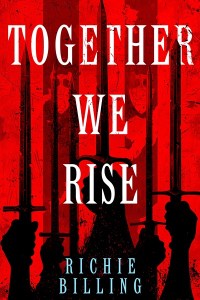
Together we rise cover with the people holding up swords on a red background

Zilla: When things feel hopeless, fiction can be the place to remind us that the community has the power to resist. That’s why I have Richie Billing here, to tell us about his fantasy novella, Together We Rise. Richie, can you start by sharing your blurb?

Richie: In the crumbling city of Pietalos, where corruption and poverty reign, the fires of revolution burn hotter each day. An oppressive government has bled its people dry for the benefit of the elite, but the citizens have had enough.

Eight lives—each scarred by loss, betrayal, and violence—intertwine as they fight for their own futures and that of the city.

Zilla: What inspired you to write this book?

Richie: Together We Rise is a story of a people’s revolution against a corrupt government—very timely given today’s political scene. I’ve been fed up with the state of politics for a long time. I’ve seen the worrying shift to the darker reaches of the right and felt quite helpless about things. Writing this story was my way of fighting that despair, and it provided a welcome escape too. Being something I’m passionate about, I loved every moment of writing and editing it and I can’t wait to share it with the world.

It’s a nice, short story (about 150 pages) with a unique structure. It’s split into eight parts, with each part featuring a different character. Working like a sort of literary relay race, each character takes the story up to a point and then hands it onto the next character.

The idea behind this was to explore the issue of rampant, unchecked capitalism from the points of view of the many different people it affects. My favourite TV show is The Wire, and part of the reason for why is its ability to look at a single issue critically from different perspectives (in that case, the war on drugs).

In Together We Rise, you can find the perspective of a healer, a worker, a street kid, a drug dealer, a guard (the equivalent of the police). It’s all set in a fantasy world, which gives it a unique spin, and something else I’ve done is incorporate an original soundtrack. Each character has their own song which mirrors their emotional journey in the chapter. You can scan a QR code at the start of each chapter to listen. Hopefully, it adds another layer of immersion to the experience.

Zilla: With such a wide-ranging cast, who’s your favourite character? If you can pick!

Richie: The roots of this story lie in a character called Tillia. I created her many years ago when I first started writing. She was a key part of a fantasy novel, set in the same world, and her part of the story was actually my favourite. I’d taken another big chunk of that novel and used it in another story I’m working on, leaving just Tillia’s story. I decided it was too good to waste.

You don’t see all of this in Together We Rise, but learn of it. Tillia is the daughter of a blacksmith (and also a master swordsman), but becomes ensnared by a deceptive evil man, named Vaso, whom she ends up wedding. Over time, he beats and abuses her, destroys her will, and the evil bastard also kills her father and destroys her childhood home. She’s trapped, powerless, helpless, until one night she happens upon a city guard assaulting a woman. She intervenes and ends up killing the guard, and she feels power like she hasn’t felt in a long time. It sets her on a path of vigilantism, taking out the bad guys on the streets and cultivating a murderous alter ego named Shadow. After a while of doing this, she realises it isn’t enough. She has to do more to fight the problems corrupting the city. And that’s when she decides to start planning a revolution. Together We Rise is the story of Revolution Day.

Zilla: I am so here for characters standing up to abusers and abusive systems. Would you say this story is more character-driven, then? Or plot driven? 

Richie: This particular story is very much character-driven. As mentioned, there are eight unique characters in this story, and while the plot is very much about a revolution against a corrupt regime, the thrust of the tale is about the internal revolution that each character goes through. That’s one of the key points of this story, that even when the world is rubbish and doesn’t feel like it won’t get any better, we all have the power to change things, but to see the change we want in the world, we maybe have to change some aspect about who we are first.  

Zilla: Thanks for sharing your story and your process. We’re looking forward to reading! Where can the Night Beats community find you and your book?

Richie: You can learn all about Together We Rise on Goodreads, or get it at this link.

Here are some other helpful links:

YouTube – @richiebilling

Website: www.richiebilling.com

Patreon: https://www.patreon.com/richiebilling/   

Facebook – @richiebillingwriter

Instagram – @richiebilling

X – @Magpie_Richie

Tiktok – @richiebillingwriter

Behind the Screens: Tuesday Author Interview

Every Tuesday, get to know a bit about the stories behind the books you love, and discover your next favourite novel.

Audacity Gambit cover with a garden arbour on fire

Zilla: I just ordered my paper copy of The Audacity Gambit (my review will go in the newsletter—I am PUMPED to read this) but while I wait for it to arrive I’ve got B. Zedan here to tell me all the details of their fantasy novel. So, with no spoilers, can you introduce me to your book, B.?

B.: Here’s The Audacity Gambit’s blurb:

It’s the back half of the 1990s and recently-graduated Emily’s big life plans include maybe getting promoted at her grocery store job, and not much else. It’s not that she doesn’t have ambitions, it’s that she feels more or less fulfilled already. She has a roof over her head (her aunt’s trailer), friends (the much-younger kids she babysits), hobbies (babysitting, reading), what more could she want?

Of course, it’s not about what she wants. It’s about what she was made to do. With little choice in the matter, Emily is plunged head-first into a fairy world that isn’t nearly as fabulous and fantastical as books would lead you to believe, though it’s a nice enough place for a vacation.

Zilla: What inspired you to write this book?

B.: I’m from a poor rural part of Oregon, originally, and boy-o one just doesn’t see that world in fiction unless it’s romanticised by people who haven’t lived it. So why NOT have the chosen one live in a trailer and treat it like its normal to live in a trailer, actually.

Zilla: I love that. Were you inspired by an image when you wrote this?

B.: In a way yes—the idea of the garden arbour on fire is so central to the book it’s on the cover. I love the idea of something so mundane as a portal.

Zilla:  Is your work more plot-driven or character-driven? Or a secret, third thing?

B.: The real truth of it is: I am a Nickelodeon run on Aarne-Thompson-Uther Index tokens. I like to take the structures of folktale types, use those as the scaffolding and see what I can build. It’s very obvious in the context of The Audacity Gambit, but more so in other work I do. I don’t mean “remixed Cinderella,” btw, though that’s great, I mean like “type 565, “the magic mill” and looking at the actual components of that story type.

Zilla: I love when stories are in conversation with other stories that way. After all, an author is always influenced by every book they’ve read, so why not put the inspiration to direct use? Now that this book is out in the world, what’s your next writing project?

B.: I am desperately trying to finish a story that combines food review writing like Jonathan Gold’s with cosmic horror. Which means I’ve been working on anything else.

Zilla: Okay, so you need to tell me when that one comes out, though I relate far too much to the issue of working on the alternative projects instead of the “main” one. For everyone who hasn’t ordered your book yet, where can the Night Beats community find you and it?

B.: You can pick up The Audacity Gambit just about anywhere (a handy books2read page of places) but if you want to read it for free I’ve also serialised it and it’s available here: https://bzedan.com/blog/the-audacity-gambit-serialised/I have other writing work on my site (https://bzedan.com/blog/writing/), I kind of just… put things up and hope people read them sometimes. I’m also on all the places as “bzedan” but mostly you’ll find me on Tumblr.