Behind the Screens: Tuesday Author Interview

Every Tuesday, get to know a bit about the stories behind the books you love, and discover your next favourite novel.
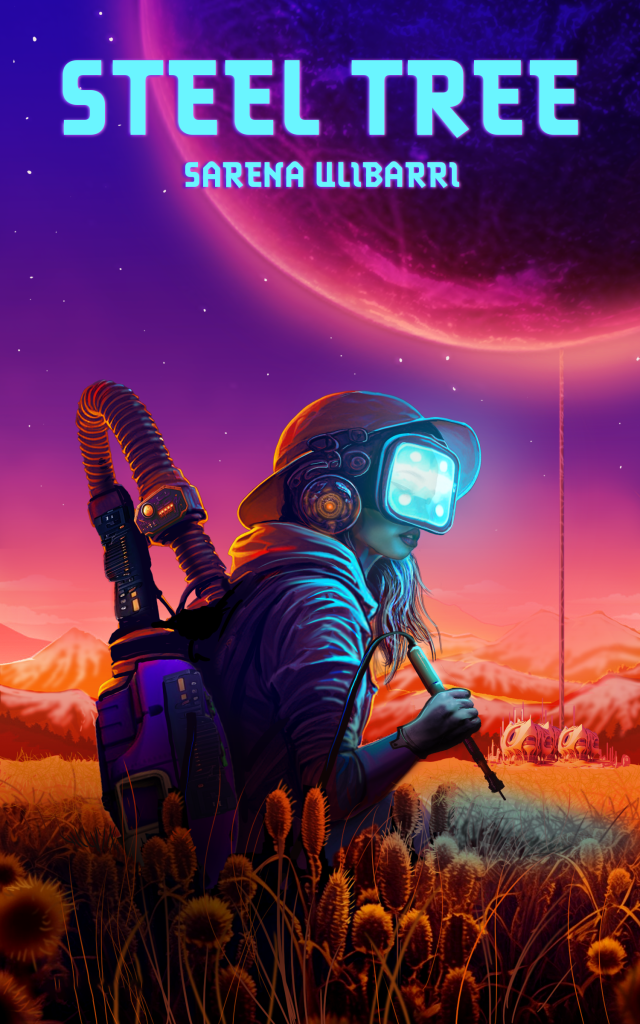
steel tree cover

Sabitha: If you like your science fiction deep, clever, and thematic, but still enjoy a good time while you read, you can’t go wrong with Sarena Ulibarri. Today she’s bringing us Steel Tree, a science fiction retelling of The Nutcracker. Sarena, can you tell us a bit about this wonderful book? 

Sarena: In the agricultural bread basket for humanity’s new colony, there wasn’t supposed to be any native animal life, but farmers have been going missing and rumors abound of something lurking in the shadows. At Klara Silber’s winter harvest party, the introduction of a new android nutcracker should have been the big news—but that’s before one of the guests transforms into a giant rat and goes on the attack.

Sabitha: What inspired you to write this book?

Sarena: One of my husband’s favorite Christmas traditions is to watch a production of The Nutcracker ballet. One year, I was particularly struck by the scene in which Drosselmeyer gifts two automatons to the Stahlbaum children. I wondered if anyone had reimagined The Nutcracker in a futuristic setting, with the “toys” being robots. When I couldn’t find anything even close to that, I knew I needed to write it.

Sabitha: I’m glad you did! Now that you’ve written it, if you could meet your characters, what would you say to them?

Sarena: What can an author ever say to their characters except, “I’m sorry I put you through that”?

Sabitha: How much research did you need to do for your book?

Sarena: Tchaikovsky’s Nutcracker ballet is based on a novella by Alexandre Dumas, which is itself a reimagining of a story by E.T.A. Hoffmann called “The Nutcracker and Mouse King”. I picked up a book that contained both versions, plus a lengthy intro with historical context, and read the whole thing twice. Like anything written by Hoffmann, it’s weird

I borrowed as much from the original as from the ballet, and I also researched a lot about the history of the ballet itself. Every name in the book is a reference—for example, the Pirlipat nut is named after Princess Pirlipat, who is cursed by the Mouse Queen to transform into an ugly doll, and Petipa Colony is named after Marius Petipa, the choreographer who first took this strange story and adapted it into a ballet.

Sabitha: Who did you imagine reading your book as you wrote it?

Sarena: I’ve always hoped this could be a book that people would gift to each other for the holidays—and it turned out to be a perfect stocking stuffer size. I wrote it for a general adult audience, but the Publishers Weekly review says, “the prose skews slightly toward younger readers,” which I suppose is true enough. If you’ve seen The Nutcracker a dozen times (whether because of love or obligation) and want to see it with fresh eyes, I hope you’ll enjoy Steel Tree.

Sabitha: Thanks for sharing your story and your process. We’re looking forward to reading! Where can the Night Beats community find you and your book?

Sarena: These days I’m mostly on Mastodon or Bluesky, though I also have an Instagram account @sarenaulibarriauthor. You can find Steel Tree on Amazon or direct from Android Press.

Behind the Screens: Tuesday Author Interview

Every Tuesday, get to know a bit about the stories behind the books you love, and discover your next favourite novel.

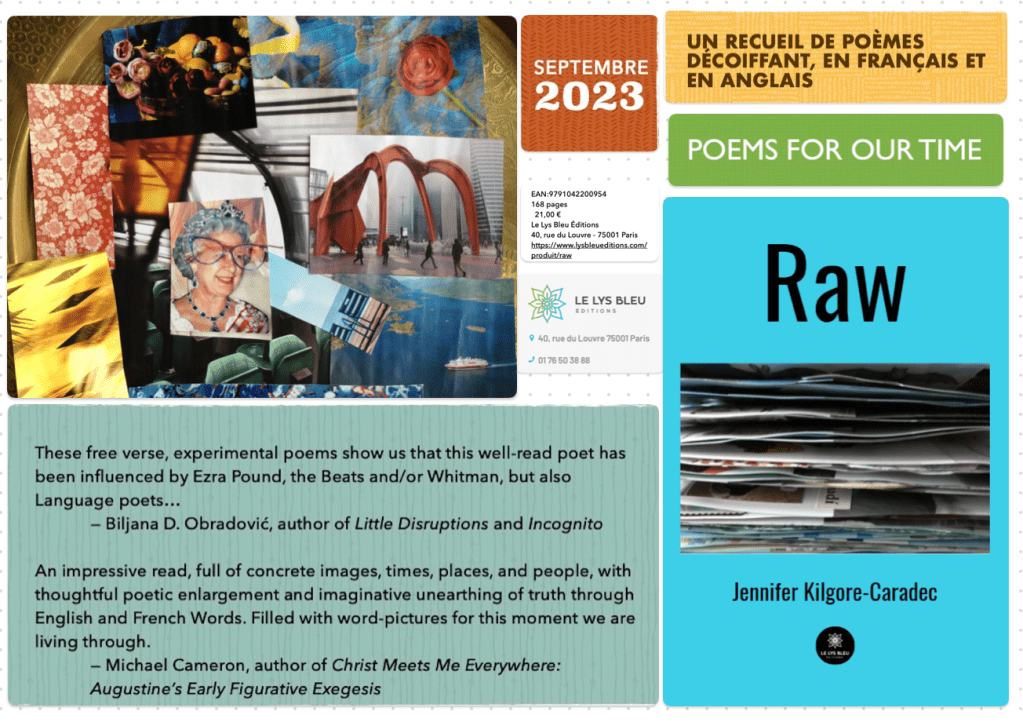
Poster for Raw

Sabitha: We love the wild, the playful and the offbeat, and so we jumped at the chance to interview Jennifer Kilgore-Caradec about her poetry collection, Raw. Jennifer, can you tell us about your work?  

Jennifer: My creative work is a collection of poems called Raw, published in August 2023 at Le Lys Bleu Editions in Paris. It weaves together a number of different threads, including a historical vision of the present (with climate anxiety), the value of the arts, teaching before-during-and-after covid, and a quotation from the original Star Trek series.

Sabitha: I love everything you’ve just said about this project. But moving beyond the written word—is there a playlist for your book Raw?

Jennifer: Since it appeared I have discovered the unlikely coincidence of the ZZ Top Album Raw that was released in 2022. There is an eclectic playlist for my poetry, but it does not include hard rock (if my brother Tim is reading, he’s laughing at this point).

The playlist is classical (Bach, Berlioz, Haendel, Debussy, Dutilleux…), includes jazz (Ella Fitzgerald, the Dorseys, Brubeck, Haynes, Shorter…), and rock songs (1960s-1990s). The beat of the book alternates between rhythms of Motown, French popular hits by Reggiani and Montand, and rap by women.

Sabitha: What book do you tell all your friends to read?

Jennifer: I’ve been recommending the poetry of Geoffrey Hill for a couple of decades …

Sabitha: How much research did you need to do for your book?

Jennifer: Interesting question. For a novel, it would be two or three years of research. For poetry there was certainly just as much— if not more —, but it is much harder to quantify since so much of it happened before knew I would write a poem about one subject or another…

Sabitha: Do you have any suggestions to help people in our community become better writers?

Jennifer:

  • Writers write (several hours a day and/or binge-writing through whole weekends or vacations).
  • Listen to your muse. When inspiration strikes, record it immediately.
  • Keep essential reference works handy: it is impossible to write without dictionary and thesaurus.
  • Devote as much time to reading as to writing.
  • Indulge in pastiche and parody.
  • Read F. Scott Fitzgerald’s notebooks.
  • Learn a foreign language (said T.S. Eliot).
  • Read literature from other countries (in translation as needed).
  • Cultivate as many areas of knowledge as you can in a broad general sweep (read several good newspapers from different regions/countries regularly).
  • Read Literary reviews like the TLS or the NYRB.
  • Read little-known and well-known poetry magazines and the magnificent websites of the Poetry Foundation and the American Academy of Poets.

Sabitha: What is your next writing project?

Jennifer: I have finished translating Charles Péguy’s L’Argent (1913) and am looking for a publisher. Péguy sounds like he is speaking to our present time, where the only value seems to be about making a profit.

After that appears, who knows, maybe another collection of poems… ?

Sabitha: Thanks for sharing your story and your process. We’re looking forward to reading! Where can the Night Beats community find you and your book?

Jennifer: I teach at the University of Caen in Normandy and can also be found here. Many of my articles are on the internet, or see “Poems Alive” on Substack. Raw can be purchased directly from Lys Bleu.

Behind the Screens: Tuesday Author Interview

Every Tuesday, get to know a bit about the stories behind the books you love, and discover your next favourite novel.

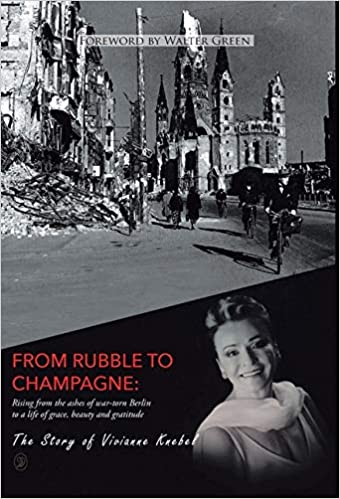
from rubble to champagne cover

Sabitha: We have Vivianne Knebel here, a woman whose lived an extraordinary life and produced a remarkable memoir, From Rubble To Champagne. Vivianne, can you introduce us to your book and your life?  

Vivianne: My memoir, From Rubble To Champagne, is a story of survival, struggle, and success starting in the ashes of Nazi Germany. The book was turned into a documentary, An Unimportant Girl

Sabitha: You describe the importance of your family . How did your mother show her love for you and your sister? How did this love impact you?

Vivianne: My mother was a single mom who kept us alive from falling bombs and Soviet attacks. She worked in the black market to be able to feed us. In her loving arms she made us feel secure, always encouraging us to never let go of a dream that things will get better. A couple wanted to adopt me . Even though it would have made life easier for her to have one less mouth to feed, she would not hear of it. Motherhood was her true calling. She instilled good values in us. This impacted us greatly. To this day my sister and I always looked out for each other. She taught us the importance of love a sense of responsibility and empathy.

Sabitha: You‘ve been an immigrant in more than one country, and even as a child where you were born, you faced struggles to fit in. What does home mean to you and where did you find it?

Vivianne: My values are squarely centered around security, stability, and the value of freedom, which I found in America where so many immigrant dreams are built. This country welcomed me with open arms and it is home to me.

Sabitha: I’m so glad you were welcomed to a happier life. What parallels do you see in your story and other refugees, from Ukraine to Syria and beyond?

Vivianne: Often they arrive in a new country without being in command of the language. Not knowing anyone and no one to fall back on is difficult. Seeing the potential in this country and the hope to build a new life.

Sabitha: Thanks for sharing your story. We’re looking forward to reading! Where can the Night Beats community find you and your book?

Vivianne: You can find me on my website, or on Instagram. You can buy my books on Amazon.

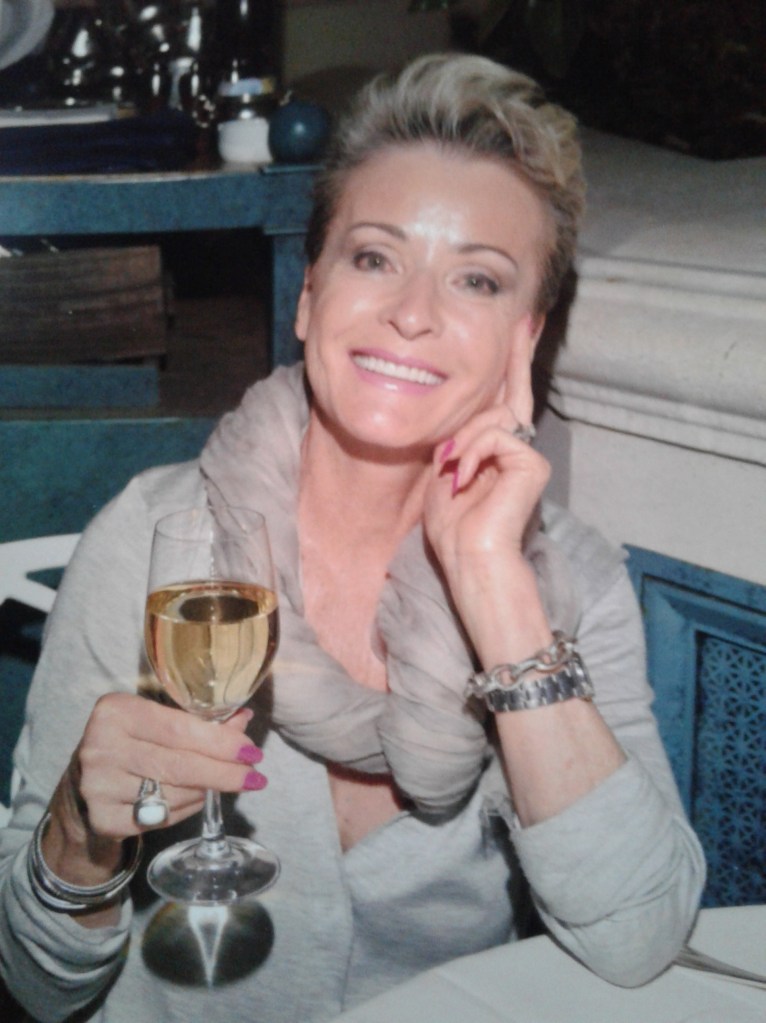
Vivianne photo

Behind the Screens: Tuesday Author Interview

Every Tuesday, get to know a bit about the stories behind the books you love, and discover your next favourite novel.

Capturing the Wry cover

Sabitha: Today we’ll talk to John Hartley (or maybe to his alter ego, Johny Nocash) about his musical memoir, Capturing the Wry. John, can you introduce us to your book?  

John: Howdo. I’m John; Hartley by birth, Johny Nocash by artistic alter ego since ooh, about 1989. I’ve currently a couple of things for sale in the big wide world: an official biography of the UK indie band BOB (entitled From Banwell to Berlin and Beyond) and, more personally, a memoir of my time in an ultimately unsuccessful indie band the Irony Board, entitled Capturing the Wry. I’ll chat more about the latter, if that’s ok?

Sabitha: Sounds good to me! Let’s start with—what inspired you to write this book?

John: Well, part ego and part fear of longer term memory loss I suppose. Despite our ultimate failure to make it big, I had a whale of a time in the band and remain very proud of the songs we recorded. I wanted to document this for my bandmates and for my family. I kept loads of letters, notebooks, cuttings and flyers during the time, and kept a gig diary too with setlists and a description of each gig, so that certainly helped me along the way. Plus, my old English teacher drummed into me, “write what you know.” 

Sabitha: Do you have a fan-cast?

John: Ha! That’s a great question. Who would play me and my friends in a movie of that time of our lives? I’d like to think Johnny Depp could play me—he’s a guitarist after all, but he’s also way too controversial now. He’s also far too good looking to play me. Being from the northwest of England we could be played by actors from Coronation Street I suppose. Realistically, we’d be played by young up-and-coming actors hoping to break through to the big time.

Sabitha: What book do you tell all your friends to read?

John: I’ve started to write fiction for the Young Adult market, and am currently close to self-publishing a book called The Broken Bottle. With that in mind, I would point people to The Kingdom By The Sea by Robert Westall, a fantastic tale set in wartime England. I’ve bought The Scheme For Full Employment by Magnus Mills for several people. He’s a fantastic writer.

Sabitha: Do you have any suggestions to help people in our community become better writers?

John: I often get to the stage of wrangling with myself over what I want for my books. I’d love to be able to write for a living—being a school leader in special education is what keeps a roof over my head and food on the table—but I think I would hate the publicity that goes with it. With that in mind my suggestion would be to enjoy writing for the sake of writing, and don’t get hung up on the end result. If you write something for pleasure and ten people love it, it will probably be more gratifying on an artistic level than having to write something you don’t gain pleasure from. Also, chat with other writers, let them read your stuff, read theirs, enjoy the constructive criticism that can be mutually offered.

Sabitha: What’s your next writing project?

John: The Broken Bottle is failing to entice the literary agents, so that’ll be self-published soon. The sequel How Green Are Your Eyes is being read by my mum and my niece before its second draft. I am currently second-drafting a story I wrote for my family entitled Searching for the Sound of Riduna, about a tiny record label on a tiny island in the middle of the English Channel. I’ve written and recorded all their songs too…

Sabitha: Thanks for sharing your story and your process. We’re looking forward to reading! Where can the Night Beats community find you and your book?

John:  I can be found trading as @JohnyNocash on Twit-X, Instagram and Threads. On Mastodon I am @JohnyNocash@indiepocalypse.social. My books can be found here, or the BOB book can be found here.

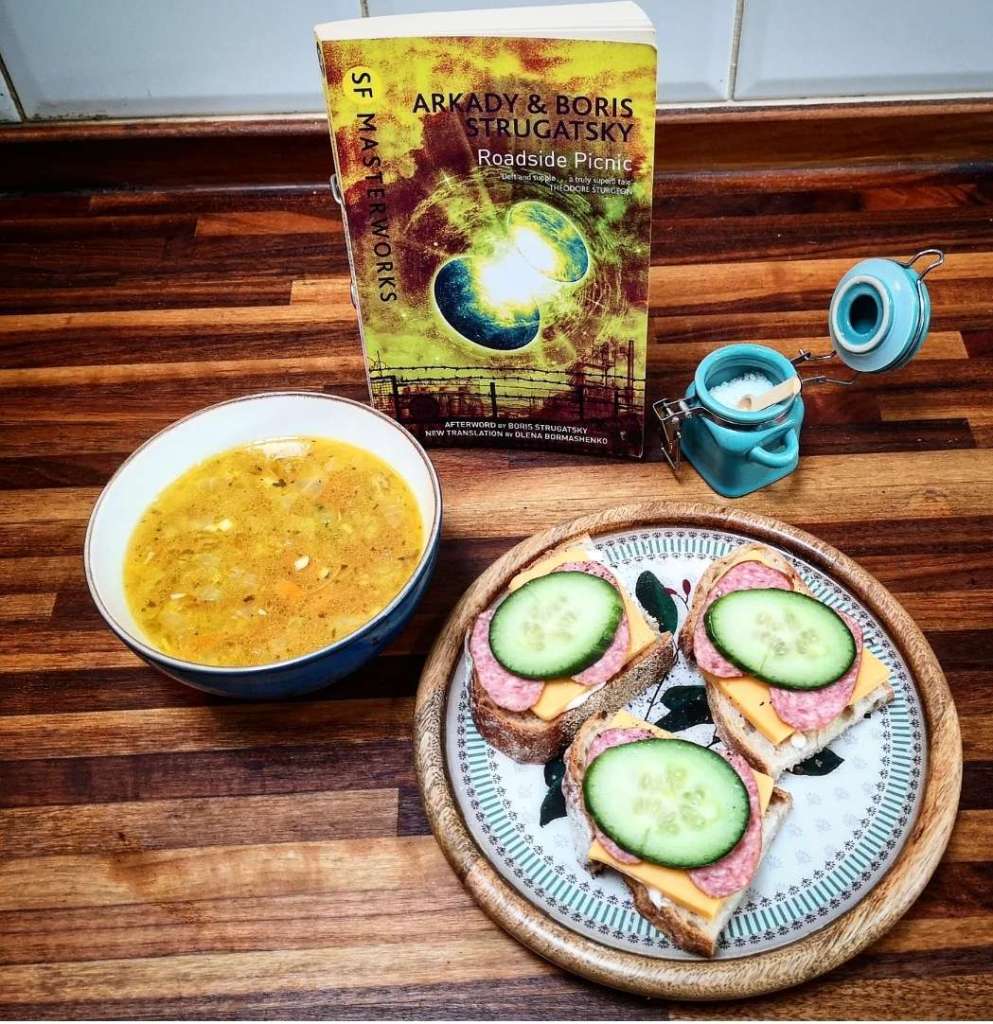
Boullion and Sandwiches with Roadside Picnic by Arkady and Boris Strugatsky

Fiction To Sink Your Teeth Into, a feature from author and professional chef Rohan O’Duill!

I tried to come up with something that you could have as part of a roadside picnic. Boullion is mentioned in the book and I have created a very quick consommé recipe that hopefully approximates what was intended. To go with it there are some sandwiches which you might have been served in the Borscht Café.

Boullion and sandwiches with Roadside Picnic by Arkady and Boris Strugatsky
Continue reading

Behind the Screens: Tuesday Author Interview

Every Tuesday, get to know a bit about the stories behind the books you love, and discover your next favourite novel.

Bad Memory cover

Sabitha: Nothing better than a queer romance—except a queer romance that’s also a thriller! M. A. Melby’s got the book for us. M. A., can you tell us a bit about Bad Memory?

M.A.: The story is from the point of view of two roommates, Jaimes who is promiscuous and fun and Nik is shy and neurotic. The beginning sets you up for a sweet familiar story about opposites falling in love, you know, a roommate romance with friends to lovers. Even the event that starts the drama, a prank going wrong, seems in line with that type of story, but it spirals down into some pretty dark places…so be warned.

However, it’s not all gloom and doom. Friends come to the rescue. There’s also computer hacking, a sci-fi/fantasy convention, and a spattering of quippy dialog. I even included a couple references that Boy Love fans will get a kick out of.

Sabitha: That sounds like such a fun read. What inspired you to write this book?

M.A.: During the pandemic, I watched a ridiculous number of Thai Y-series (boy love stories). How could I not attempt to write a roommate romance that accidentally became a thriller? 

If you watch Thai Y-series, you’ll notice a few of the common scenes, character types, and plot devices, obviously with my own spin. I took the “wound tending” scene a bit far!

Sabitha: If you could meet your characters, what would you say to them?

M.A.: I’m so sorry.

I grew up watching shows where the characters would get horribly injured or abused but would be perfectly fine before the next episode. I was determined to avoid that and make recovery difficult and meaningful, not, at all, magically going back to “normal”.

Sabitha: I’m sorry for the characters—but not for us readers! How much research did you need to do for your book?

M.A.: One of the main characters is a phlebotomist, so I incorporated language and situations I remembered from being in the hospital, but also looked up several medical procedures and terms.

The plot also involves computer hacking. I’ve been around pretty intense computer folks, but my own knowledge is limited. I tried to avoid getting too technical.

Sabitha: Do you have any suggestions to help people in our community become better writers?

M.A.: Write so that you are proud of your work and enjoy it. Your skills will improve as you write and receive feedback, but find yourself, your own style and voice. Don’t try to be anyone else.

Sabitha: So true. So, M.A., what’s your next writing project?

M.A.: I wrote an epic fantasy novel before this one that’s very close to my heart. I wrote it very quickly, practically in a cathartic fugue state. So currently, it’s a little bit of a mess!

I’m working on revising it to make it beautiful, so that it can be meaningful to my readers and not only to me. I’m very excited about it, and I hope it finds an audience.

The working title is The Epic Threesome. I might be cheeky enough to keep the title, we’ll see.

Sabitha: Thanks for sharing your story and your process. We’re looking forward to reading! Where can the Night Beats community find you and your book?
M.A.: You can find Bad Memory at most online bookstores, at Amazon, or read reviews on Goodreads. I’m on FacebookMastodon, and BlueSky, and I have a website.

Behind the Screens: Tuesday Author Interview

Every Tuesday, get to know a bit about the stories behind the books you love, and discover your next favourite novel.

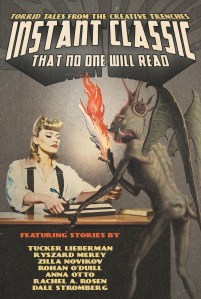
cover of Instant Classic

Sabitha: It’s nearly here! In only two days, Instant Classic (That No One Will Read) is being released! There’s nothing the Night Beats community loves more than a healthy dose of dark humour with a sprinkling of cynicism. Here to deliver are two Night Beats authors, Dale Stromberg and Rachel A. Rosen, to talk about Rachel’s stories in the anthology. Rachel, can you start by telling us a bit about your stories, and about the anthology as a whole?

Rachel: I have two stories in the anthology because I’m extra. Well, and because they’re both short. “Hell Of a Manuscript” is about a demon at the Devil’s literary agency, where authors can trade their immortal souls for 15 minutes of fame—assuming, of course, that the manuscript is deemed worthy of the exchange. “solidAIrity” is about the replacement of human creative workers with AI—something that we are repeatedly told is inevitable and desirable—and what happens when that AI gains class consciousness and starts a union.

Dale: Your story features a fiendish literary agency which offers authors a taste of success at a steep price. Has there ever been a time in your own career as an author when you would have been tempted by a Faustian bargain for writerly glory?

Rachel: Oh, in a hot second. I have been on both sides of the situation I depict in “Hell Of a Manuscript,” and a soul seems like a small price to pay, given that I’m not doing much with mine at the moment.

Dale: Did having a novel published by a press change that calculus for you?

Rachel: You’d be surprised at how little it changes things! I hit the jackpot with Cascade fairly early on, but the thing that no one tells you is that being published is no guarantee of fame or fortune. Getting published is the easy part—these days I’d sell my soul for a decent marketing strategy and a dedicated fandom.

Dale: In your story, the diabolical agent begins with contempt? pity? dumbfounded exasperation? for writers—for “your endless need. Your emails, thick with hope.” She ends by dangling before an author the offer of “One book, one shining moment, fifteen minutes if you will”—a temptation angling for precisely that endless need, that hope. Reading this, uncomfortable questions arise: Do authors’ desperate hopes and needs create the conditions of our damnation? Are we the architects of our own hellscape?

Rachel: My day job is teaching, and we’re constantly being told that we ought to do our jobs for love and purpose, not for money (let me know if you find any landlord who’ll take love and purpose in exchange for housing). In the creative industries, it’s exposure, and we’re expected to feel gratitude if anyone is remotely interested in our hard work and self-expression. The commonality is that these are essential jobs, and largely feminized jobs, and accordingly, they are undervalued by our culture. Do I think we’re architects of our own hellscape? Nah, capitalism is the problem.

Dale: Dante’s Hell was a pit of writhing agony. Ours so often looks like an open office plan. Has capitalism made Hell banal? And at the same time inevitable?

Rachel: Dante never had to do hotdesking is all I’m saying.

Dante was a brilliant satirist and while I am nowhere near that level, I like to think that I’m continuing in that tradition. There’s never been much money to be made in publishing, and as with any industry, enterprising sorts have realized the only profit to be squeezed comes from inserting some app or service or bureaucratic nightmare in between the author and reader. We are witnessing algorithm-driven enshittification everywhere, something I also depict in my other story, “solidAIrity.” Given the ongoing airborne pandemic, what on earth are we doing having offices at all? Cruelty, control, and surveillance culture, rather than creativity, collaboration, and productivity, have become the goal of contemporary corporate culture. Hence the Panopticon of the workplace has replaced the more labour-intensive layout of the Inferno.

Dale: Is publishing a microcosm of this?

Rachel: Absolutely. Back when the dinosaurs roamed the earth, I worked in publishing, and there were more editors on each manuscript, more presses, more bookstores, and more authors with livable advances. The industry has become leaner and more cutthroat, with the bulk of new money funnelling upwards so that Bezos can buy a bigger yacht, rather than being distributed so that full-time professionals can make closer to a living wage. One of our working titles for this anthology was “Publishing Is a Hellscape.” Economic precarity might not be exactly like being boiled alive but it can certainly feel like it some days.

Sabitha: Thank you both for this—I am so excited for this project! Where can readers get their hands on a copy? And where can they find your other work?

Rachel: The anthology is available for pre-order on Amazon, but if they want a free review copy, they can apply here—we just ask they post an honest review on a platform of their choice. You can find my socials and links to buy Cascade and The Sad Bastard Cookbook conveniently collected in one place at https://rachelarosen.carrd.co/