Behind the Screens: Tuesday Author Interview

Every Tuesday, get to know a bit about the stories behind the books you love, and discover your next favourite novel.

Assassin of Reality cover

Sabitha: Vita Nostra is a book that the three of us list as one of our all-time favourites —a story about magic, language, the darkness of academia and the hope of growing into yourself. We’ve been desperate to read the sequel, but unfortunately none of us read Russian. Luckily, Julia Meitov Hersey (winner of the 2021 Science Fiction and Fantasy Rosetta Awards) translated Assassin of Reality, and it’s coming out in March (in e-book and hardcover). Rachel A. Rosen got a review copy and can’t wait to tell you about it in an upcoming issue. While Zilla and I wait for it to be released, Julia’s agreed to do an interview telling us about fantasy, culture, and the process of translation. 

Marina and Sergey Dyachenko’s books defy easy characterization. Julia, how would you summarize Assassin of Reality?

Julia: As the sequel to the critically acclaimed Vita Nostra, Assassin of Reality follows the next stage of Sasha Samokhina’s journey.

Sabitha: The wording in Vita Nostra felt incredibly deliberate, as if every word was carefully selected to convey not only a meaning but a sense of the story, the world, and the characters. It worked especially well for a book where the use of language was a part of the story. When you’re translating a book like Vita Nostra or Assassin of Reality, how do you balance direct, literal translation with translating the vibe of the story?

Julia: I think the secret is to look at the sentence, better yet the paragraph, rather than individual words. You must see the picture in your mind and retell it in the target language. The danger there is to insert too much of yourself and walk too far from the original. At the end of the day, it’s a question of tasteful balance, especially in the case of a meta-novel such as Vita Nostra, where words matter more than anything.

Rachel: Vita Nostra is grounded in an Eastern European tradition of fantasy, which has significant differences from the Anglosphere’s tradition of fantasy. Did these different cultures of literature pose any difficulty when translating?

Julia: Those marvelous differences are the main reason we read translated literature, isn’t it? It’s not just about an unexpected plotline or unfamiliar characters; it is also about a fresh perspective, a novel view, a deeper insight into a different mentality. These cultural differences are what makes the translation process so challenging and so rewarding.

It never ceases to amaze me how easily Eastern European fantasy authors operate with open epilogues and unhappy endings.  They absolutely refuse to coddle their audience, so there is nearly always an element of surprise. If you’re craving a Hollywood ending, you should probably walk away from Eastern European fantasy. I love anticipating that gasp of surprise that is sure to accompany that last page. It’s a lot of fun to translate with that gasp in mind.

It’s worth mentioning that, since I translate from my native language into my second language, the challenge lies less in researching and understanding the culture of the source material and more in localizing and adapting it for the Anglosphere (without losing its flavor and style). I tend to make a lot of unpopular choices, such as standardizing the first names (because the emotional impact of name variations — Sasha vs Sashka vs Sashenka — is pretty much lost on the English-language readers) or loosely translating traditional Eastern European academic terms (finals vs sessions, etc.). Not everyone agrees with that, but I stick with what feels right to me. I am not alone in this effort —the editorial team at Harper Voyager are beyond wonderful, and I am forever grateful for their impeccable taste and eternal patience.

Zilla: When I’m an author, I pour my identity into the story. When I’m an editor, I try to step back and let the story tell itself, but I can’t avoid editing with my point of view. How personal is the translation process?

Julia: Traduttore, Tradittore. Translating a book is akin to fostering a child. The child’s not yours; there is no DNA of yours on those pages. And yet, you take care of the manuscript, you teach it to speak, you make sure it can walk… It’s very hard not to give it some of your identity, and I believe most of us translators fail at that in the most spectacular fashion.

Rachel: We all loved Vita Nostra and hoped to one day read the sequel. We had two problems. First, we only read English, so thank you for translating it! Second, we couldn’t imagine how a sequel could exist, given that Vita Nostra felt like a seamless, complete story. Can you tell us where the sequel fits in, or would that be giving away spoilers?

Julia: Trust me, I was afraid of reading the sequel, even though I was one of the people who tried their best to influence the Dyachenkos to write it. While the open ending allowed for the continuation of the story, I just couldn’t imagine where it would go. I was certainly surprised and decidedly not disappointed. Conceptually, Vita Nostra is a book about youth — radical, cruel, selfish, idealistic youth. In Assassin of Reality, rather than entering the next stage, most logically the world Sasha had created, we return to the familiar world. The difference is that Sasha is now an adult, and the challenges she faces are different — they are less about pushing herself beyond the limits and more about considering the needs of others. The Russian original novel is called Correcting Errors. Think of this telling title and of the fact that Assassin of Reality is heavily influenced by the authors’ immigration experience — and pick up this novel thinking of second chances, the ungrateful task of proving oneself again and again, of the mythical nature of a perfect world — and of the terrible beauty of adulthood.

Sabitha: We’re so glad that we can finally read this book—and to have someone who really gets the heart of the story translating it. How can our community connect with you and how can they buy the book?

Julia: They can pre-order the book in e-book or hardcover form. My Russian-to-English translation services are available at my website. I can be found on Facebook, Twitter, or Instagram

Behind the Screens: Tuesday Author Interview

Every Tuesday, get to know a bit about the stories behind the books you love, and discover your next favourite novel.

Skylark Bell image

Zilla: We have a special interview today. The Skylark Bell is a book in podcast form, with original music and story by Melissa Oliveri. Melissa, tell us about this delightfully spooky gothic story.

Melissa: The Skylark Bell is a fiction podcast in serial format. It is based on a book trilogy (not yet published) that is shared at a rate of one chapter per week, one book per season. The story begins with main character, Magpie, moving to the outskirts of a small town called Pocket. Afflicted with psychic visions, Magpie is entranced by a nearby house, apparently cursed with an inexplicable silence. Things aren’t what they seem in the quaint town of Pocket, and she finds herself tangled in its history as she strives to save its future. The Skylark Bell podcast also features bonus episodes that range from real-life paranormal experiences to spooky short stories and behind the scenes interviews.

Zilla: I’m not sure if the genre “cozy Gothic” exists, but that’s the sense I get when I listen to your story. Magpie is loved by her mother and her friend, and she’s in a beautiful rural landscape. She also lives in a remote farmhouse and has visions which point to secrets of a dark mystery. How do you strike the balance between warmth and eerie, between comfort and creepy?

Melissa: Cozy Gothic is a great term and should absolutely be a genre if it isn’t already! I think I’ve subconsciously intertwined comfort and creepy because, even in childhood, I would gravitate toward the spooky and supernatural, both fiction and non-fiction, and find comfort in the unknown aspect of it. I love exploring duality, maybe because I’m a product of it myself, growing up in a half-French and half-English Canadian household. Now I’m a dual Canadian/American citizen. Contrast is important, it’s what makes summer so delicious after months of snow and cold. I also think being all roses and pretty landscapes and happily traipsing through fields with rubber boots would make for a bit of a boring book, but a constant barrage of ghosts, visions, and existential threats would be exhausting. It’s finding that balance, that sweet spot, between the two that makes it work, and I mostly do that by ensuring there is both love and fear in each chapter.

Zilla: Your podcast has a single narrator but includes music and sound effects—like a richer version of an audiobook instead of a radio play. What drew you to that format for telling this story?

Melissa: Before The Skylark Bell, I primarily considered myself a musician who enjoyed making up and writing stories. One day a friend suggested I turn an unpublished book I had written into a podcast. I was mildly intrigued by the idea but didn’t get all that excited about it until it occurred to me that I could compose music for the project, and then I realised I could work in some sound effects. Creating an audio atmosphere to support this story I had written suddenly became very appealing, and it allowed me to marry my two creative passions, music and writing.

Zilla: The idea of marrying those two is fascinating to me. How does that creative process happen??

Melissa: Music and songwriting is a very visual experience for me. I see images, like a film, when I am listening to, or composing, music. The reverse is also true; when I see or imagine scenes, I hear coordinating music in my mind. For The Skylark Bell, I would read the chapter, story, or scene, and compose whatever would come to mind. There were instances where I composed spontaneously, plugging my keyboard into my laptop and just rolling with it, and sometimes things went in an entirely different direction than I thought they would, but somehow it worked. The subconscious is a powerful thing, and we should all give in to it more often.

Zilla: Thanks for sharing your story and your process. I’ve finished season one, and I’m hoping to catch up to the end of season two before season three comes out! For everyone who doesn’t know your work yet, where can they find you and the podcast?

Melissa: They can find all the information on The Skylark Bell on its website, Instagram, or Facebook, or via the Podcast Platform Links. I also have a website and a Patreon, as well as a Mastodon account. And they can find my music at the Cannelle website, on Instagram, via all major streaming platforms and on Bandcamp.

Behind the Screens: Tuesday Author Interview

Every Tuesday, get to know a bit about the stories behind the books you love, and discover your next favourite novel.

So Hard to Do cover

Sabitha: Today we have Sally Basmajian, eager to tell us about her romantic comedy, So Hard to Do. If it’s not too hard to do, could you please tell us a bit about your new novel?

Sally: It’s a fast-paced, contemporary novel. The cast is diverse, a few characters being on the autism spectrum. The plot revolves around the twisted love triangle of a middle-aged mother and her adult daughter who unknowingly fall for the same man. Tension and comedy build as they blunder their way forward, both convinced that they’ve found true love.

Sabitha: What inspired you to write the book?

Sally: In my immediate family, there are individuals who are neurodiverse, and I thought it would be interesting to explore a fictional dating world where the players may struggle for acceptance, but ultimately find their happy endings. I wanted readers to be entertained at the same time as they gained a heightened awareness of the challenges faced by people with ASD. Plus, when you think of it, don’t we all bumble along when we try to make our romantic lives work? As my older heroine, Suze, remarks, “We’re all on the spectrum when it comes to looking for love.”

Sabitha: If you could pick any author to read your book, who would you want to read it? Why them?

Sally: For sure, I’d love Sophie Kinsella to read it. She’s got such a light, optimistic touch with her romances, and a great sense of humor, too. Given my overdeveloped sense of the ridiculous, I also think that either Stephen Leacock or Terry Pratchett, if only either of them were alive, would “get” my jokes. I certainly like to believe they would!

Night Beats: We all love Terry Pratchett! Which character do you relate to the most, and why?

Sally: My favorite character is the delightful Lola Devine. She sprang fully-formed directly onto the pages, without any conscious planning or analysis from me. She’s an outrageous but caring soul—the kind of staunch supporter I’d love to have in my real life. Could it be that all those RuPaul’s Drag Race episodes I’ve watched spawned this Amazonian goddess of a fairy godmother?

Sabitha: Was there any music that inspired you while you were writing?

Sally: I didn’t consciously incorporate music, but it certainly ripples throughout the story. I’ve captured many of the songs that reflect the characters on a playlist, which I’ve posted on my website. They range from Neil Sedaka to Sir Mix-a-Lot. My own educational background was in Music History, but please don’t expect any of the classical masters to appear on this particular list!

Sabitha: What a fun collection! What do you most want your readers to take away from reading your book?

Sally: I want them to laugh out loud as they follow the paths of my two main characters. I want them to feel as if they’re out on a lark with some extremely fun companions. But also, I want them to walk away with a greater sense of understanding for those on the autism spectrum. Just last week, one of my advance review copy readers approached me, saying she wanted to thank me for giving her hope that her twelve-year-old grandson, who is on the spectrum, may be able to navigate our great big, scary world one day and succeed in work and love. Nothing—praise or criticism—can ever mean more to me than that.

Sabitha: That sounds both fun and deeply meaningful. What a wonderful thing. Where can our readers find you and your book?

Sally: You can find my novel at the universal link. I’m on Instagram and TikTok, and I dabble in Twitter and Facebook, plus I’ve got a website. Thanks very much, and please drop by!

Behind the Screens: Tuesday Author Interview

Every Tuesday, get to know a bit about the stories behind the books you love, and discover your next favourite novel.

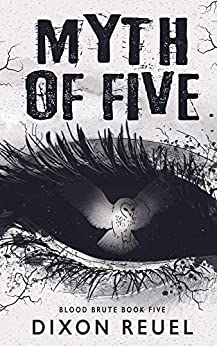
Myth of Five cover

Sabitha: Dixon Reuel joins us to talk about Myth of Five, the 5th book in her paranormal post-apocalyptic series, Blood Brute. Dixon, tell us a bit about the series!

Dixon: The six-book series follows the adventures of The Vampire Rise as a zombie apocalypse befalls humanity. Realizing that their supply of human blood is at stake, Rise takes the fateful decision to leave his coven’s secluded smallholding of Owl Court to bring back human survivors. However, not every survivor is happy to be vampire-succor, nor are the rest of his coven so open to new people, despite the apocalypse. Caught between humanity and his coven, Rise undergoes the worst transformation a vampire can imagine: being bitten by a zombie and becoming a doubly-undead blood brute. Thus begins Rise of One, Blood Brute Book 1.

Sabitha: There’s so much fun action there! What inspired you to write this book?

Dixon: The idea of Blood Brute–of vampires surviving a zombie apocalypse–came to me while playing one of my favorite games, 7 Days To Die. In that survival crafting world, you basically kill zombies and craft defenses against their hordes, however it also got me thinking … what would vampires do during a zombie apocalypse? How would their supply of human blood be affected? Are they on humanity’s side and want to help rid the world of zombies? Or, would the vampires enjoy the chaos and downfall of humanity?

That got me thinking of the earliest humans. There is a plotline in Blood Brute where Rise discovers the eldest vampire: literally a caveman-like creature dating back to the Neanderthals/Denisovians. As Rise is a zombie-bitten vampire, he has to determine who he wants to be in terms of this great, ancient lineage.

Sabitha: I love when one piece of art inspires another like that. Speaking of inspiring art, we have a lot of writers in our community. Can you share your writing process?

Dixon: With five books and two prequels under my belt by now, my writing process has thankfully become nice and streamlined. I’m a big ol’ nerd who loves spreadsheets and stationery, so I’ve created a series of printables that take me from that initial writing idea, to developed characters and arcs, on to a detailed chapter-by-chapter outline where I can begin the first draft. I deeply adore this progressive ‘handholding’ using my own printables, so I don’t forget to deepen a particular plotline or to make sure the beginning-middle-end structure is evenly balanced. As I write full-time, I devote three focused hours to drafting five days a week. I find that is a nice balance between burning out and feeling frustrated at doing too little. As I’m an indie author, all the other hours of the day are spent marketing and social media-ing!

Sabitha: Your world is full of entertaining characters. Which character do you relate to the most and why?

Dixon: The character I relate most to in Blood Brute is that of Salter. She is tall, like myself, and adores books, writing, and stationery. She is also indoorsy and shuns the outside, also a bit like myself! Salter likes to let things simmer and fester, whereas I’m much more direct!

Sabitha: Thanks for sharing your story and your process. We’re looking forward to reading! Where can the Night Beats community find you and your book?

Dixon: They can find Rise of One, Blood Brute Book 1 on Amazon KDP in ebook, paperback, and hardback here. I have a website. And if you sign-up to my author newsletter, you’ll receive a free Blood Brute prequel!

Behind the Screens: Tuesday Author Interview

Every Tuesday, get to know a bit about the stories behind the books you love, and discover your next favourite novel.

One Lucky Christmas Cover

Sabitha: Today we’ll talk to Regina Brownell about her newest holiday romance, One Lucky Christmas. Regina, can you introduce us to your book?

Regina: One Lucky Christmas is about Kasey Johnson, a twenty-four year old woman who wishes her mother would accept who she is and not run her life. She agrees to go on blind dates set up by her mom. After several failed dates she meets date #31, a pastor’s son, Tobias Scott. She expects it to all go wrong but he takes her by surprise. He and his family accept her with open arms unlike her own, but with her meddling mother, his ex-girlfriend, and an accidental discovery, things might not turn out the way she hoped. 

Sabitha: What inspired you to write this book?

Regina: I was inspired by a Wattpad short story contest. The prompt was that your MC went on 121 dates and found the one. What started out as a short story soon turned into a whole book. I could not let go of these characters. 

Sabitha: We have a lot of writers in our community. What’s your writing process?

Regina: I’m a pantser, so things tend to get a little chaotic at times. I mostly jot down a few ideas, make a mood board and just start writing when it feels right—when the characters won’t stop talking. I write notes like characters’ names, their appearance, their likes, random chatter that goes on in my head, into a notebook. After my first draft, I let it sit and then do a reverse outline of sorts, writing everything down chapter by chapter in my notebook too. Then when that’s all done and it’s kind of edited I send it to my betas, then the pulling it all apart begins and the developmental edits happen and line edits after. 

Sabitha: Do you have a “fan-cast” – do you have actors you’d cast as your main characters?

Regina: Yes! I have always pictured Tobias the love interest as Nathan Parsons. He did a movie on Hallmark channel and the female lead Jonna Walsh also looked exactly how I pictured my MC Kasey. 

Sabitha: What book do you tell all your friends to read? Besides yours of course!

Regina: The Kiss Quotient by Helen Hoang and Josh and Hazel’s Guide to Not Dating by Christina Lauren are my comfort reads. Will always recommend those. 

Sabitha: Thanks for sharing your story and your process. We’re looking forward to reading! Where can the Night Beats community find you and your book?
Regina: You can buy my book on Amazon. You can find me at my Amazon author page, my Twitter, my Instagram, or my website.

Behind the Screens: Tuesday Author Interview

Every Tuesday, get to know a bit about the stories behind the books you love, and discover your next favourite novel.

It Came to me On a Whim cover

Sabitha: Maria Bouroncle joins us to talk about her fascinating new-crime novel, It Came to Me on a Whim – The Story of Ingeborg Andersson, Child Murderess. We’re very lucky to have her, since this story was just published in English for us to enjoy! Maria, can you tell us about your book?

Maria: It Came to Me on a Whim tells the story of my great-aunt who killed her three children in a small Swedish village in 1929. The story and what happened that day was a well-kept family secret for seventy years. I stumbled upon it back in 1999, as one of my cousin’s patients asked if we were related to “that old murderess Ingeborg”. We both knew her very well as children, since Ingeborg lived with our grand-mother, but we had no idea she had been married or had any children, let alone three.

I was 34 years old at the time and had just given birth to my daughter. I simply couldn’t grasp the news. It wasn’t until my father passed away twelve years later that my thoughts of Ingeborg resurfaced. I finally decided to ask my relatives what happened, and I began digging through the archives.

Sabitha: I can’t imagine what that would feel like. Is that what inspired you to write this book?

Maria: It was never my intention to write a book about Ingeborg. However, after years of research to shed light on the tragedy and trying to understand how a woman I’d loved as a child could have committed such a horrific crime, I got truly obsessed with the story. It wasn’t until an old relative passed me the letters she wrote to her husband from prison that I knew I had to put her words on paper. I’ve included these letters in my book. In one of them, she writes, “I think about the children all the time and about you but forgive me I didnt know what I was doing O God if it could be undone.”

Sabitha: How did you choose the title? Is that part of the story?

Maria: When asked why she killed her children, Ingeborg simply replied, “It Came to Me on a Whim”.

Sabitha: What do you most want your readers to take away from reading your book?

Maria: Ingeborg was born in 1901. Her parents were farmers, and she was the second to youngest of seven siblings. She went to primary school for six years and when she was 23 years old, she got married to the boy next door, who was a relatively well-to-do farmer. Artur was seven years her senior and seems to have been a modern and kind man. Pretty soon after their beautiful wedding, they had three children together, two boys, and one girl. But Tor only lived to be five years old. Efraim was three and Lucia was only one year old when their mother killed them.

I’ve tried to capture this troubling story without too many gruesome details. By letting my narrative jump back and forth between different time periods, as Ingeborg’s thoughts probably did, I hope to put the reader inside her mind to understand her, just like I’ve tried to do. Despite the rigid structures of the prison, I also wanted to show the kindness of the staff who cared for her. I’ve dedicated my book to Tor, Efraim and Lucia, and it’s my sincere hope that Ingeborg’s story will bring mental health issues into the light. 

Sabitha: Thanks for sharing your story—such a fascinating and tragic tale. We’re looking forward to reading! Where can the Night Beats community find you and your book?

Maria: It Came to Me on a Whim is available on Amazon. Links to my socials can be found here.

Behind the Screens: Tuesday Author Interview

Every Tuesday, get to know a bit about the stories behind the books you love, and discover your next favourite novel.

Melancholic Parables cover

Sabitha: We’re joined by Dale Stromberg, here to tell us about his collection of strange and mesmerizing microstories, Melancholic Parables. Dale, best of luck explaining this fascinating book to us.

Dale: Melancholic Parables is a collection of microstories that mix whimsey and dolor, irony and absurdity. With a frequently appearing protagonist who is not always the same person, they are not linked and not unlinked. Sometimes they horrify; sometimes they are almost dad-jokes.

Sabitha: This is not a typical book. What inspired you to write it?

Dale: While a musician in Tokyo, I decided to blog daily for a year to connect to fans. The blog was bilingual. I soon strayed from writing about music to writing about anything, including tiny stories. I was in a psychologically troublous period, so these fragments had a consistently melancholy tint, though I often took refuge in humour. I’d come home with a couple bottles of cheap wine and start writing. By the time the wine was done, I was done (e.g. unconscious)—which was one reason to keep it brief. Another was the fact that working in two languages required me to write everything twice. After a year, I had about 300 fragments, and I thought of collecting those I liked best into a book.

Sabitha: We have a lot of writers in our community. What’s your writing process?

Dale: Think about it. Draft it. Manicure it. If it’s not working, rewrite from scratch. Produce more than I can use, then select the good bits.

Sabitha: How did you choose the title?

Dale: Fiction writers often hope readers will “willingly suspend disbelief,” but I wondered, do I hope this? A teller of parables doesn’t necessarily have the same expectation: it is not at cross-purposes for a reader to simultaneously believe the “story” and also disbelieve and consciously examine it. I came to see my stories as parables instead—not lessons (nobody should take lessons from me) but pieces which were about something other than what they were about.

Sabitha: What book do you tell all your friends to read? Besides yours of course!

Dale: Recent good reads: Edie Richter is Not Alone (Rebecca Handler), Ghosts of You (Cathy Ulrich), An Inventory of Losses (Judith Schalansky), Knickpoint (MBF Wedge), Lilith’s Brood (Octavia Butler), The Ministry of Utmost Happiness (Arundhati Roy), Most Famous Short Film of All Time (Tucker Lieberman), Though I Get Home (YZ Chin), Warm Worlds and Otherwise (James Tiptree Jr.), The Word for World is Forest (Ursula K Le Guin), Something Like Hope (Hengtee Lim).

Sabitha: When you picture your ideal reader, what are they like?

Dale: When I first heard Sonic Youth, I thought they were doing it all wrong; when I first heard Sigur Rós, I found them boring; both ended up favourite bands of mine. I had to be in the right time of life before their music fit. Instead of an ideal reader, maybe I imagine the reader being in an ideal place—similar to where I was when I was writing. I was shut up in myself, seeing everything in dim grey colours, aware I was an ill fit, aware it was all in my head, but unable to get out of my head. I don’t wish for anyone else to end up like that, which implies that I hope not to have ideal readers. I guess that’s weird.

Sabitha: Not as weird as you think. Thanks for sharing your story and how it came to be. We’re looking forward to reading—look out for a Book Report from Zilla! In the meantime, where can the Night Beats community find you and your book?

Dale: You can mute me on Twitter or chuckle at my clumsy web design here. Preorder Melancholic Parables ahead of 29 November 2022 at Kobo, Barnes & Noble, Amazon, Apple Books, or Smashwords; if you prefer paperback, a print version will go live on Amazon in late November. A lovely way to support any indie author is to leave an honest review on Goodreads or wherever you leave your reviews.

Behind the Screens: Tuesday Author Interview

Every Tuesday, get to know a bit about the stories behind the books you love, and discover your next favourite novel.

He's no angel cover

Sabitha: Today we’ll talk to Ryan Uytdewilligen about his satirical novel, He’s No Angel. Ryan, can you introduce us to your book?

Ryan: Charlie Fritz is a Hollywood talent agent hanging onto his career by a thread. After embarrassing himself at a movie screening, he’s in need of a comeback and a superstar client. Luckily, success comes his way in the form of his presumed-to-be dead father. When Bernie Fritz mysteriously arrives in the middle of Los Angeles by taxi, it’s evident he doesn’t remember anything about his prior life, but the white-robe-wearing man does have a cryptic message from the afterlife to share with anyone who will listen. Is he an angel from above or someone who’s simply lost his memory? 

After Bernie’s message goes viral and creates a social media sensation, Charlie seizes the opportunity to become his dad’s agent. It’s the perfect opportunity for them to finally connect and find a little meaning in their lives—even if for one of them, life is technically over.

Sabitha: That sounds delightfully absurd. What inspired you to write this book?

Ryan: I lost my father nearly ten years ago and I went on a walk one day, wondering, “What if I ran into my dad?” Then a few moments later, I thought “What if I ran into my dad, and he didn’t remember me or anything about his life?” I thought that was an intriguing premise and fleshed it out from there.

Sabitha: We have a lot of writers in our community. What’s your writing process?

Ryan: I’m one to plan ahead, so after coming up with the premise, I made a “beat sheet” with the entire plot and then wrote that exact plot, which took about seven months. I like to edit as I go too, so the first draft is very concise and polished by the end.

Sabitha: Do you have a “fan-cast” – do you have actors you’d cast as your main characters?

Ryan: Slovenly Bill Murray would make a perfect Bernie Fritz while motormouth Charlie Day would make a great Charlie Fritz. Perhaps the dearly departed Anne Meara would be a perfect Nancy Fritz. News anchor Ted is blatantly Ted Knight.

Sabitha: What was the hardest part of editing?

Ryan: It’s always tough taking criticism, but I think for this book, most of the feedback was that the protagonist was not a likeable person. But he’s not supposed to be. Some said they liked his “nasty to nice” transformation while others didn’t. That was a tough line to walk.

Sabitha: How did you choose the title?

Ryan: The movie We’re No Angels with Robert De Niro and Sean Penn is an inviting and curious title that has often stuck in my head. When I first played around with that, He’s No Angel seemed like it could strike the right chord.

Sabitha: What do you most want your readers to take away from reading your book?

Ryan: If you’ve ever had a loss and wanted to reconnect with a family member, I hope this book tugs at the heartstrings, shows grief in a relatable way, and gives people hope alongside a good laugh.

Sabitha: Thanks for sharing your story and your process. We’re looking forward to reading! Where can the Night Beats community find you and your book?

Ryan: They can find my book here, or connect with me on Facebook.

Behind the Screens: Tuesday Author Interview

Every Tuesday, get to know a bit about the stories behind the books you love, and discover your next favourite novel.

Sigrid and Elyn cover

Sabitha: Today we’ll talk to Edale Lane about her newest novel, Sigrid and Elyn: A Tale from Norvegr (Tales from Norvegr). Edale, we’re excited to have you! Tell us a bit about your book.

Edale Lane: Attracted by passion, repelled by war. Can two shieldmaidens navigate battlegrounds of the sword and the heart?

Sigrid the Valiant is legendary throughout the kingdoms of Norvegr for her many heroic deeds, but her heart has not found a home. Now, racing on the heels of their father’s murder, a neighboring kingdom’s raids threaten an all-out war.

Elyn is a young shieldmaiden with a score to settle, fighting her own insecurities along with enemies who threaten her homeland, but she remains unconvinced all is as it seems.

When the two clash on opposite sides of their shield walls, sparks fly from both their swords and passions. But when they talk, the two discover an antagonist’s plot has pitted their kingdoms against each other.

Will Sigrid and Elyn move past their suspicions to forge a relationship and foil the villain’s scheme, or will the enemy’s assassins end their search for the truth?

Sabitha: We love a good sapphic romance! What inspired you to write this book?

Edale Lane: I am a historian and primarily a writer of historical fiction. I love anything Viking and have been excited by recent archeological discoveries confirming the authenticity of women warriors’ roles in Scandinavia’s past.

Sabitha: That’s fantastic. Once you have the idea, what’s your writing process?

Edale Lane: I’m a “plantser.” I engage in tons of research, write out character sheets, plot outlines, and lists of facts to include in world-building. But as I write, invariably new characters are added, plotlines may veer from their assigned paths, and I try to infuse something previously unexpected. Therefore, I plan a lot and pants a little for good measure.

Sabitha: What was the hardest part of editing?

Edale Lane: Not catching every mistake. I can take advice on content edits from betas, use my software, and hire a proof-reader, then reread. After half a dozen sets of eyes have scoured the manuscript, it still goes to print with a few mistakes. Luckily, as a self-published indie, once a reader points them out, I can easily upload a corrected copy.

Sabitha:  Which character do you relate to the most and why?

Edale Lane: I relate to both of my main characters for different reasons. As a younger person, I often found myself in doubt and indecision, like Elyn, but now, with years of experience and wisdom behind me, I display Sigrid’s confidence. At heart, I am as much a peacemaker as Elyn, but ready, willing, and able to fight off an attacker as they both are. I don’t have Sigrid’s temper or Elyn’s figure, but both women’s passions burn in my soul. I don’t shy away from a challenge.

Sabitha: When you picture your ideal reader, what are they like?

Edale Lane: She or he is someone who loves to become immersed in another world, who enjoys action, adventure, and romance, and is a sucker for a happily ever after. Ideally, this reader would love this book and go buy all my other ones—and post reviews!

Sabitha: We can relate—reviews are like gold for an author. Thanks for sharing your story and your process. We’re looking forward to reading! Where can the Night Beats community find you and your book?

Edale Lane: You can find more about me at my website, my Goodreads page, my BookBub page, or by signing up to my newsletter. You can buy Sigrid and Elyn here, or see all my books for sale here.

Behind the Screens: Tuesday Author Interview

Every Tuesday, get to know a bit about the stories behind the books you love, and discover your next favourite novel.

The Shareholders cover

Sabitha: Today we’ve got H.S. Down talking about a dark and exciting novel, The Shareholders. Can you tell us a bit about your book?

H.S.: In the late 21st century, Earth is ravaged by climate change. The billionaires have bioengineered immortality, fled to Mars, and rule Earth’s last biospheres as their personal shares. Those left on Earth struggle to find balance as the planet tumbles into its terminal years of habitability. Ian Gateman, one of Earth’s last bureaucrats, is tasked with finding a buyer for a fledgling colony of newly settled ecological refugees. As Ian travels to the estates of several visiting shareholders, it becomes clear the shareholders have other plans for humanity’s future. 

Sabitha: What inspired you to write this book?

H.S.: Panic. I am terrified that we will leave it up the billionaires to solve the climate crisis. The Shareholders explores this fear to what I believe will be its conclusion. The world building focuses on immortality, the colonization of Mars, and ecosystems sustained solely by prostheses. Many of the characters are hell bent on preserving an unsustainable status quo at the expense of life itself. I think the politics for the rest of this century will be framed around ‘letting go’. Letting go of postwar expectations of luxury consumption, perpetual growth, of capitalism as an organizing principle. I see The Shareholders as a crude and embryonic form of art for this movement. 

Sabitha: Was there any music that inspired you while you were writing?

H.S.: I listened to Dies Irae composed by Wendy Carlos and Rachel Elkind for the opening scene of Stanley Kubrick’s The Shining. It is a heavy, solemn electronic piece, but it’s the banshee caterwaul that calls just out of frame that does it for me. For Kubrick, the piece was an exploration of colonialism and the unspeakable violence that haunts western societies. A careful reader will see that The Shareholders is preoccupied with these themes as well, and that preoccupation registers in the names of some of the characters and the novel’s setting.      

Sabitha: How did you choose the title?

H.S.: In the novel, the billionaires of the early 21st-century have become shareholders of the last biospheres on Earth. They also own shares of a virus that extends their lives considerably. So, the title is a good description of the key antagonists in the novel, but there is more to it. As the world plummets into climate crisis, the action or inaction of governments and corporations is very much circumscribed by groups of shareholders. Shareholders are determining humanity’s future. The title puts that into focus. 

Sabitha:  If you could pick any author to read your book, who would you want to read it? Why them?

H.S.: I am drawn to the irreverence and storytelling of Kurt Vonnegut and J.G. Ballard. I’d love to receive notes from them on craft for this book, but not now of course, because that would have to come from beyond the grave, which would be, at the very least, distracting. Margaret Atwood wrote some of the first dystopian climate change novels, so I’d like to get her take on The Shareholders as part of the genre.

Sabitha: Thanks for sharing your story and your process. We’re looking forward to reading! Where can the Night Beats community find you and your book?

H.S.: You can find my book here, and I’m on Facebook.