Behind the Screens: Tuesday Author Interview

Every Tuesday, get to know a bit about the stories behind the books you love, and discover your next favourite novel.

Guaranteed Bestseller Cover Teaser

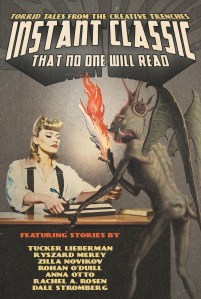
Sabitha: Today we’re turning the blog over to two Night Beats authors, Dale Stromberg and Tucker Lieberman, to talk about Dale’s story ‘Art is a Service’ in the upcoming anthology Instant Classic (That No One Will Read). Dale, can you start us off by introducing your story and the anthology?

Dale: The anthology collects satirical takes on the creative industries. Creators are indispensable in the crafting of the stories, songs, and images we all love, but their rewards are often paltry. If you imagine a stream of money trickling from the public towards the creator, then here and there farther upstream, various people have built dams. Each dam is a chance to skim a few bucks. One such enterprising skimmer is the interviewee in “Art Is a Service,” Nao Hovgaard, a publisher whose innovative marketing involves, among other things, a trampoline.

Tucker: So, novelists on trampolines. In “Art Is a Service,” Nao Hovgaard compares plugging novelists into AI to using “trampolines to the nth power.” Some authors might say it’s all unfair: the AI trampoline, the regular trampoline, everything. But if all trampolines are bad, how can authors write and market books? On what may we jump to elevate ourselves?

Dale: I feel there’s a nearly Darwinian, invisible-hand–like inevitability to the advent of the trampoline whenever art, music, drama, or literature are commodified and subjected to the inexorable libertarian robo-logic of consumerism. Authors who hope to make a living from their work are, in a pragmatic sense, engaged in a consumerist pursuit: offering a mechanically reproducible product for sale at a thin margin and hoping that a bunch of people will buy it—cumulatively earning one enough that, at the least, one’s bones don’t end up in a pauper’s grave. For this, one depends on an appeal to the many.

I see no inherent link between success in making such an appeal to the many and success in the loftier pursuit of “the good” (however you define it) in the arts. If the peacock with the biggest plumage gets the mate, then peacock plumage evolves bigger, even if it encumbers the bird’s ability to fly. When, in the creative industries, the bottomless inventiveness of a human on the make furnishes the world with a “trampoline”—a business tactic or marketing gizmo that appeals to different drives/desires than a creative work itself might appeal to—and when this trampoline produces more “sales experiences” than literary merit can do, then the trampoline gets the mate. It passes on its big-plumage genes.

If I’m not wrong, if the vending of stories on a consumerist model must lead in the end to trampolines, then what alternatives can we envision? The diametric opposite of the appeal to the many is the appeal to the one: scoring yourself a wealthy patron, like some kind of Renaissance poet sucking up to a viscount. Which sounds far-fetched to me, but—not gonna lie—it’s at this point that I run out of ideas. So I can write you a snotty satire of the garbage chute we’re all funnelling down towards, but if you want a ray of hope that things could be any different, I’ve got nothing.

Tucker: When you pick up a book, do you ever sense that the author or publisher believes they are performing a service? And does that make you feel well served or ill served?

Dale: Hmm… I want to think about “service” itself first. We will say so-and-so “served as president” or “served as CEO”, which certainly isn’t the same thing as “serving in the Navy” or “serving as a juror”. Furthermore, none of these positions is the position of a “servant” per se. I note that our society has a great penchant for talking about “service” even as we avoid referring to ourselves as “servants”.

To be a servant to an imperious master is a hard lot, but do we not also conceive of service as noble in its humility, as when one human bends voluntarily to wash the feet of another? Still, when I hear “service” (and maybe this is true for you as well), what comes at once to mind is an economic transaction (probably somewhat demeaning): the exchange of money for labour whose aim is not to make a thing but rather to do a thing.

So, if someone provides you a book not as a thing made but as a thing done, what are they doing for you? How are they “serving” you? Perhaps they are “serving your turn”—fulfilling some concrete use (and I am reminded of all those dreary claims that reading fiction will power-up your empathy, much as the consumption of fine cuisine can stock you up with antioxidants); if so, yes, I can easily imagine many authors/publishers solicitously offering a written work as a kind of utilitarian vitamin supplement to the soul.

Or perhaps they are “serving refreshments”—offering nourishment not because it will fortify you with nutrients but because to do so is a kindness, and will comfort you, and is one part of the conviviality and ease we hope our labours will purchase us. I tentatively speculate that this form of service is part of what motivates many or most true creators. I think it laudable.Or perhaps they are “serving you the ball” as in a game of tennis—sending something your way, maybe a lazy lob, maybe a more challenging slice, and provoking a response. A book like that will say, “Your move.” It will nudge you to hustle, to see and judge and react. My own values and preferences tell me that this is the sort of service I’d be glad to receive as a reader, and would hope to offer as a writer.

Tucker: Hovgaard spake, “Fuck the bestseller list.” Do you not think his judgment might be a bit harsh? Do bestsellers truly deserve the bad rap? I’ve heard that some bestsellers are good.

Dale: Oh, what Hovgaard hates is the list itself. He’s the publishing equivalent of a libertarian tech bro, which means he makes “disruption” a point of pride and nurses especial contempt for his victims.

Now, the NYT list is, of course, notoriously inaccurate, based on spotty data, and not in fact based on sales figures reported by publishers—entities which themselves appear to have little idea how many books of theirs actual readers actually buy. In other words, the list is emblematic of a shambolic industry which seems actively haughty about its ossified, opaque, esoteric and byzantine business practices. This is the sort of field any entrepreneurial legerdemainist like Hovgaard would hungrily eye, as a leopard on the Serengeti eyes a wounded impala: ripe for “disruption,” which is a stylish way of saying, “Finding someone who gets money doing a thing, and making that money come to you instead.”

Such disruptive exploits, to the extent they threaten to capsize the rusting hulks of the industry, might actually inspire some merry schadenfreude in authors, whose hopes and dreams have traditionally made us easy patsies for trade publishers—until we realise where we will end up sitting within the new model Hovgaard offers. It is, in truth, merely a new take on the same old crap: the capitalist monetising someone else’s years of silent, private, unpaid, invisible labour even as that labourer is made to feel fortunate for the chance to surrender most of the spoils… the offloading of risk down the hierarchy (where the authors dwell) and the shifting of wealth up the hierarchy (where Hovgaard waits to collect it)… the precarity, the exploitation… the pageantry, the hauteur… the squeezing of blood from every available stone. Same grift, new name—or, if you like, same book, new cover design.

On the other hand, my guess would be that Hovgaard has no opinion either way on bestselling books themselves. He’s agnostic. He’s never read one.

Sabitha: Thank you both for this—I am so excited for this project! Where can readers get their hands on a copy? And where can they find your other work?

Dale: They can get a free review copy of the anthology here—all we ask in return is they share the anthology on a platform of their choice. Or they can pre-order a copy on Amazon. I hang out on Bluesky, Medium, and Goodreads, and info about my work can be found on my website.
Behind the Screens: Tuesday Author Interview

Every Tuesday, get to know a bit about the stories behind the books you love, and discover your next favourite novel.

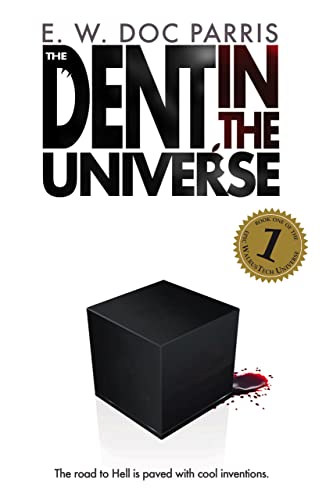
the dent in the universe cover

Sabitha: Want a witty science fiction thriller about the dark side of tech-bros? E.W. Doc Parris’s The Dent in the Universe is here to scratch that itch. Doc, take it away!

Doc: I tend to write matter-of-fact, hard science fiction grounded in the current scientific worldview, leavened with wit, and kindled by the warmth of human relationships. I’m a big fan of taking a scientific notion and asking, “What if?” Especially if that leads to questions of how badly this could go for humanity if things got out of hand.

For example: What if you could send information—internet data (emails, text, video, online orders)—into the past? What would you do? Order a pizza and have it arrive in an instant? Order that anniversary gift you forgot about? Place emergency supplies right where they’re needed before a tornado strikes? These sound like great ideas. What could go wrong? Well… what if your customers are monsters? Even just one? Because, y’know, some of them will be.

Sabitha: That sounds wild in the best possible way. What inspired you to write this book?

Doc: This story came from two conceptual vectors. The first was wondering how much trouble you could get into with the simplest possible time machine. Just a machine that allows you to send emails into the past. The second was, if everybody believes the zombie apocalypse is inevitable, how would it start? I mean, everybody has plans for the zombie apocalypse, right? Most movies don’t show us how it starts. Those two ideas came together in a really fun, scary way that you’re going to love.

Sabitha: I’m sure I will! Do you have a “fan-cast” – do you have actors you’d cast as your main characters?

Doc: The character Cliff Price was informed by a few performances by Cameron Britton (Mindhunter, The Umbrella Academy). Walrus Roberts could be played by some cross between Hurly on Lost (Jorge Garcia) and Jeff Bridges in The Big Lebowski. I only see Steve Jobs when I think of Stephen Lucas. Young Steve. 1990 Steve.

Sabitha: That gives me such a clear picture. What book do you tell all your friends to read? Besides yours of course!

Doc: I’ve just finished binge-reading The Murderbot Diaries, and I’m telling everyone about them. Most of them are novellas and quick reads or audiobook listens. Read those. Martha Wells is a genius.

Sabitha:  Do you have any suggestions to help people in our community become a better writers? 

Doc: Write those stories that you just can’t avoid. If you can sit and watch Netflix at night after work and think you’d like to be a writer, forget it. If you find yourself more interested in your story than in binging the latest streamer, if you can’t tear yourself away from your own story—those are the stories we want to read.

Sabitha: Absolutely. So what’s your next writing project you can’t tear yourself away from?

Doc: After The Aurora’s Pale Light, the next book in the WalrusTech Universe series, is released in the spring of 2024, I’ve got a story called The Land of Nod in the pipeline. It’s a story of the development of nanotechnology and machine learning being used to repair human neural networks for things like nerve damage or strokes. It feels like a miracle until things get out of hand.

Sabitha: Thanks for sharing your story and your process. We’re looking forward to reading! Where can the Night Beats community find you and your book?

Doc: The Dent in the Universe is available exclusively on Amazon through November. Kindle Unlimited readers can devour it for free. You can find the link on the Magic Genius Books website.

Behind the Screens: Tuesday Author Interview

Every Tuesday, get to know a bit about the stories behind the books you love, and discover your next favourite novel.

corona cover

Sabitha: Looking for a deliciously dark and dystopian science fiction novel? Look no further. We have David Arrowsmith here to tell us about his novel, Corona!

David: In a fallen London, how far will one man go to save his family—and himself…

…or is it already too late?

Trapped in his top floor mansion block apartment in Denmark Hill, South East London, can The Man escape and pick his way through the crumbling ruins of the city, avoiding the violent gangs that now vie for supremacy, and find his heavily pregnant ex-wife?

Can a belated act of heroism wash him clean of his sins, or is he too far gone?

In a world where civilization has fallen, what hope is there for the future?

Corona is a story about the dark—and the light—inside all of us. It’s about man’s inhumanity and humanity. It’s a story in which the threat, the danger, comes from within us—not from the undead or vampires or even a virus, but from our neighbours, our friends, and even ourselves. Corona combines elements of dystopian fiction with the literary survival horror of works like J.G. Ballard’s High Rise and Concrete Island. It’s the perfect read for fans of The Road, I Am Legend, The Last Of Us, Children of Men, The Walking Dead, Mad Max, or 28 Days Later.

Sabitha: What inspired you to write this book?

David: This novel began life as entries typed into the Notes app on my phone—a brief personal diary as I attempted to document the extraordinary and scary first few weeks of the lockdowns and that first summer under the cloud of Covid-19, trapped in a garden flat in SE London, with my wife and our young daughter. I didn’t want to publish a diary, or a factual account—and then I hit on the idea of turning it into a dystopian novel, inspired by my love of JG Ballard and his stories like High Rise, Concrete Island, The Drowned World, The Drought and The Crystal World. It’s also got some major The Last of Us vibes!

Sabitha: Do you have a playlist for your book? Can you tell us why you picked a couple of the songs?

David: I do! It’s on Spotify. I picked songs with a grimy, dark or mysterious and isolated London vibe – so there’s lots of classic 70s punk like ‘Anarchy in the UK’ by the Sex Pistols, ‘Guns of Brixton’ by The Clash, and ‘Message in a Bottle’ and ‘So Lonely’ by The Police. But the book also has a beauty and connection with the environment and the weather, hence tracks like ‘Bitter Sweet Symphony’ by The Verve, ‘Wild World’ by Cat Stevens and ‘Have You Ever Seen the Rain’ by Creedence Clearwater Revival. Give it a listen and let me know if you enjoy it!

Sabitha: Thanks for sharing your story and your process. We’re looking forward to reading! Where can the Night Beats community find you and your book?

David: All my social links can be found here. Check out Corona here or here. Read my short stories, Nevada Noir, here.

Behind the Screens: Tuesday Author Interview

Every Tuesday, get to know a bit about the stories behind the books you love, and discover your next favourite novel.

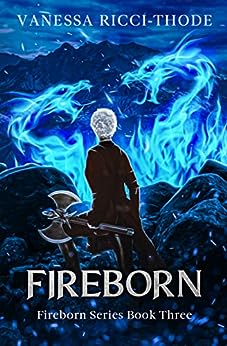
Fireborn cover

Sabitha: Looking for a queer fantasy adventure? Look no further! We’re talking to Vanessa Ricci-Thode about her novel, Fireborn. Vanessa, can you introduce us to your book?

Vanessa: Fireborn is a fantasy novel about a queer teen rebuilding her life and fighting to reshape the future after she loses everything. Like her mother and grandmother before her, Spark is a uniquely skilled pyromancer born immune to fire, with a deep family connection to the local dragon population. But her power draws the attention of a dangerous faction. Spark needs to learn finesse and to conquer old fears if she and everyone she cares for are going to survive.

Sabitha: What inspired you to write this book?

Vanessa: Fireborn was heavily influenced by the How to Train Your Dragon films and TV show, but with queer teens and a female lead.

Sabitha: Do you have a playlist for your book?

Vanessa: I listened to a lot of the How to Train Your Dragon soundtrack while writing it, to keep me in the spirit of the original inspiration for the book. And the Mad Max: Fury Road soundtrack came in handy when it was time for me to write this book’s climax. The climax includes a high-speed dragon chase through the desert, so Fury Road really set the mood.

Sabitha: If you could meet your characters, what would you say to them?

Vanessa: I would probably apologize. A lot. Especially to the main character Spark.

Sabitha: What book do you tell all your friends to read? Besides yours of course!

Vanessa: I’m obsessed with the Murderbot Diaries and recommend that everywhere. A less known book I also really love is World Running Down by Al Hess.

Sabitha:  How much research did you need to do for your book?

Vanessa: Spark is a blacksmith and I am very not, so I had to do a lot of research into how certain things are made and then figure out how and where Spark’s fire magic would fit into the process. I also did some research on aerial combat. Dragons are magic and don’t move quite like fighter planes, but having the basics and some terminology helped in describing some of the aerial fight scenes.

Sabitha: Do you have any suggestions to help people in our community become better writers?

Vanessa: Join a critique group, but make sure it’s the right fit!

Sabitha: Thanks for sharing your story and your process. We’re looking forward to reading! Where can the Night Beats community find you and your book?

Vanessa: You can buy Fireborn here. You can keep up with me at my website or my newsletter—subscribers get a free short story from the dragon’s POV. I use the handle vriccithode on all the social media platforms I use (currently mostly Discord and Bluesky),

Behind the Screens: Tuesday Author Interview

Every Tuesday, get to know a bit about the stories behind the books you love, and discover your next favourite novel.

Col Rush Cover

Sabitha: We have one of our Night Beats family here, Rohan O’Duill. Full disclosure—I’ve read Cold Rush and I absolutely love it. So of course we have him on the blog to tell us about his science fiction novella! 

Rohan: Cold Rising is told from the point of view of two characters. The first, Olgo, is a special agent tasked with improving the working conditions in the Martian underground metropolis. Olgo sees this mission as a stepping stone in their career and has little interest in the plight of the Martian people. The second main character, Suong, is a 12-year-old girl who works in a clothing company on Mars. After the two end up on the wrong side of the local cartel, they must work as a team to escape the caverns and what lurks there. 

Sabitha: As I understand it, the Cold Rush Novellas are not a traditional series—they’re a collection of stories set in the same time and place. How does Cold Rising relate to your larger universe and will we meet these characters again?

Rohan: Some of my friends would suggest that I never make life easy for myself, and the Cold Rush Novellas may be proof of that. I initially tried to put all of Cold Rush in one book, but that many POVs and storylines didn’t fit properly. I spent a long time playing around with the format and eventually landed on the idea of telling the story through interconnecting standalone novellas. I was careful not to fall into the Marvel trap where you have to have read 30 other books to get what’s going on in each one. Hopefully, I have created something that stands on its own feet while adding depth if you have read the other stories.

The next two novellas are complete and will not feature the main characters from Cold Rising, but Olgo and Suong will appear again in later novellas.

Sabitha: Having read several works in your universe, Olgo is by far my favourite of your characters. How did you conceive of them, and what was your process to make them such a compelling personality?

Rohan: I really enjoyed writing Olgo’s character even though Olgo’s backstory is not a happy one. They use an emotional control device to block the mysterious trauma they experienced as a child. The upside of the device is that it makes them an extremely effective and driven special agent. But they have limited battery life on the device, and when shit hits the fan on Mars they have to deal with the most trying conditions of their life. Olgo is forced to go through a major transformation to survive the pits of Mars. 

I think what makes Olgo stand out as a character is their uncomplicated, straight-talking view of their surroundings. They constantly make droll observations about human shortcomings while still being aware of how they are a pawn in a bigger game.

Sabitha: Hard sci-fi and Golden Age science fiction is a clear influence on your writing. These genres often star characters who are important explorers, scientists, and military and political leaders. In Cold Rush, you focused instead on the labour conditions of ordinary workers. Why do you think these stories are so important to tell?

Rohan: I think Golden Age sci-fi had a big influence on my life, never mind my writing. I grew up in a very conservative Catholic Ireland where I felt like an outsider. Finding the science fiction section in my library opened up a whole new world to me. I had no one to discuss these books with. Nobody I knew liked anything like this. So the books themselves were my companions. My first glimpse of a bigger, more diverse world came through these novels. And while these books didn’t talk directly about real world topics, they made comparisons and used fictional scenarios to examine genuine issues.

This is what I tried to do in Cold Rising—calling out our own hypocrisy in consuming products from countries with terrible working conditions and human rights abuses. As long as we can buy a steady stream of cheap goods, we turn a blind eye. Fiction can play a powerful role in reminding people about the woes of our world. I also think that pointing out these issues while telling an entertaining story can be more effective than slapping someone in the face with the facts.

Sabitha: Thanks for sharing your story and your process. We’re looking forward to reading! Where can the Night Beats community find you and your book?

Rohan: You can find my book here. You can find me through Night Beats and through Lower Decks Press. For now I’m still on Twitter, but I’ve also joined Blue Sky. And I’m on Instagram.

Behind the Screens: Tuesday Author Interview

Every Tuesday, get to know a bit about the stories behind the books you love, and discover your next favourite novel.

Shadows Gather cover

Two-book Tuesday! We’ll hear about the first two of Shana Stephen’s post-apocalyptic dark fantasy novels. Shana, tell us about your books!

Shana: This series is dark fantasy meets supernatural meets post-apocalyptic. Set in the United States in the present day, our story begins with our MC being abducted by an inhuman creature. Natural disaster follows. Alongside us for centuries were the Shadow Walkers, a species living in secret, bound by a magic pact. With the world turned upside down, and the Shadow Walkers revealed, what will happen? 

Both books are written in the first person. The blurb for the The Shadows Between is, “If you had told me last week that I would have been hiking through the woods with some weird, demonic, creature I would have said you were dreaming. Yet here I am, trekking through the mud, sleeping on the rock hard earth, and peeing in a hole in the ground. I don’t know what he wants, or why he took me. All I know is I need to survive. And I have a feeling that something bad is coming. For all of us.”

The blurb for Out of the Shadows is, “It’s crazy to think that just a month ago a supervolcano erupting was my biggest concern. Little did I know what was in store for me in the aftermath. Actions have consequences, I suppose. Breaking the pact freed the Shadow Walkers, but made me enemy number one. In the ash-filled remains of the world outside, I’m on a mission to bring peace. Too bad the world has other plans for me.”

Sabitha: What inspired you to write this book?

Shana: This series actually started as freethought writing, oddly enough. The first paragraph of Book 1 was born during journaling. When the freethought ended, the main male character, dubbed Death, materialized in my mind. The story just kind of took off from there. After the characters were formed, my inspiration for the plot was basically to focus on moral greys since that’s what I love to read and watch. 

Sabitha: We have a lot of writers in our community. What’s your writing process?

Shana: My writing process is a little chaotic. I will write when inspiration strikes, which is not regularly. Sometimes if I have an idea for a later scene, I will force myself to write to get to that scene, but when I do this a lot of editing has to occur later. If I’m feeling writer’s block I will usually switch to reading to get back into the right headspace. Then, as I go, I try to outline the plot or make character sheets, but I find it’s more so just what the characters would do in that given situation. In that sense, it almost feels like my choices are limited in where I take the story, haha. 

Sabitha: Do you have a “fan-cast” – do you have actors you’d cast as your main characters?

Shana: I haven’t given much thought to it but a friend of mine said Adam Driver, who plays Kylo Ren in Star Wars, would be good in the role of Death. I think the actor who played Dream, Tom Sturridge, in Sandman would also be a good Death. 

Sabitha: What book do you tell all your friends to read? 

Shana:  I have recommended the Hollows series by Kim Harrison to many friends because it is an awesome series, in my opinion, and is still going. If you like book one of that series, you are in for a treat because the books just keep coming. Another new favorite of mine is Can’t Wait to be Dead by Samantha Verba. I really enjoyed it so I recommended it to my friends and family. It has action, romance, vampires, and humor. What’s not to like?

Sabitha:  If you could pick any author to read your book, who would you want to read it? Why them?

Shana: I would love Neil Gaiman to read my book because I think that would just be so cool. And I believe any feedback he’d give would really help in my growth as a writer. 

Sabitha: Does the location the story takes place mean something to you or to the work?

Shana: The location for this series was basically a ‘write what you know’ situation for me. I live on the east coast of the U.S so that is where the story takes place. Any places I haven’t physically been I visited on Google Earth. Since this series is modern fantasy and not full-blown fantasy, I felt it was important to have a good mental visual of the location and scenery to best describe it to the reader. 

Sabitha: Thanks for sharing your story and your process. We’re looking forward to reading! Where can the Night Beats community find you and your book?

Shana: You can find me and my series on my Amazon author page.

Behind the Screens: Tuesday Author Interview

Every Tuesday, get to know a bit about the stories behind the books you love, and discover your next favourite novel.

Wild Heart of the Storm cover

Sabitha: Are you in the mood for a sword-and-sorcery fantasy? If so, you’re in luck—Erica Sebree is here to tell us about her novel, Wild Heart of the Storm

Erica: Wild Heart of the Storm begins with Ffion Ainsley, who leads a quiet life hidden away in the mortal realm. But when her dormant magic begins to manifest, her touch awakens a dead wolf. Drawing the attention of assassins, she narrowly escapes with the mysterious metalsmith who knows her true identity.

Wild Heart of the Storm is a celtic fantasy with a reluctant heroine, animal guardians, premonitory dreams, magic, and a bound protector. While it can be read as a standalone, it’s also the first volume of a five-book series. Book two, Wild Heart of the Crown, is also available.

Sabitha: It sounds dramatic! What sort of music that inspired you while you were writing it?

Erica: Soundtracks to epic big-screen fantasies, like Pirates of the Caribbean and Lord of the Rings.

Sabitha: We have a lot of writers in our community. What’s your writing process?

Erica: I used the Snowflake Method to plan my book. The process involves writing a single sentence about your story, expanding it to a paragraph, then a page, and finally to four pages. After that, you move on to each of your characters, outlining their motivations, goals, conflicts, and epiphanies, before repeating the same process of expanding each of their story lines from one sentence to a full page. Finally, you outline every single scene of the book in a spreadsheet. It’s a long process, but I highly recommend it for anyone who likes to organize their thoughts.

Sabitha: How did you choose the title?

Erica: My mom took me to see Wild Hearts Can’t be Broken when I was young, and it stuck with me. The movie is about a woman who rides horses off of high-dives, until she’s blinded during one of her jumps. I love a character who doesn’t give up, even when (or especially when) people tell her something isn’t possible or can’t be done. Ffion is like that in many ways, and becomes even more determined in book two as she takes on her new role.

The title also represents Ffion’s magic:

Wild = earth magic

Heart = life magic

Storm = storm magic

Wild Heart = independence

Heart of the Storm = the final battle

Sabitha: Does the location the story takes place mean something to you or to the work?

Erica: I wanted the mortal realm to have defined seasons, so I designed it with the midwest in mind. She grows her own food and tends an apple orchard. As someone who grew up in Wisconsin, I can still remember how fresh-from-the-tree apples were so ripe they smelled of cider before you even took a bite.

Sabitha: Thanks for sharing your story and your process. We’re looking forward to reading! Where can the Night Beats community find you and your book?

Erica: You can get Wild Heart of the Storm and Wild Heart of the Crown on Amazon. I’m on Bookbub, Goodreads, Facebook, Twitter, and Instagram. You can also find me on my website or subscribe to my newsletter.

Behind the Screens: A Bonus Monday Author Interview!

As a treat, we offer this bonus Monday writer interview!

Linguistic Worldbuilding header graphic

Sabitha: Every science fiction and fantasy author knows the importance of language. From Tolkien’s Elvish to the dialectic variations in The Expanse, language tells us about the world the characters live in and what they value. But how do you craft the perfect words for your story? CD Covington is here to tell us about her latest project, a Kickstarter-funded book designed to do exactly that.

CD: I’m a science fiction writer and a linguist, and I’m working on a writer’s guide to linguistic worldbuilding and funding it via kickstarter. Linguistic worldbuilding encompasses everything from what sounds exist in the language(s) in your setting to naming schemes to proverbs and cuss words. I’m going to teach you how to do it using both analysis of existing books that do it well and contemporary linguistics research.

Sabitha: What inspired you to write this book?

CD: Around the time I was finishing my thesis, I had the idea to write about how language and linguistics are portrayed in science fiction and fantasy. It was 2019, the movie Arrival had recently come out, and Gretchen McCulloch’s Because Internet had hit the shelves. The first few seasons of The Expanse were out on SyFy. There was a lot to write about! So I pitched a column to tor.com. After I wrote a few columns, I noticed some patterns in them, and they boiled down to linguistic worldbuilding. I initially started it with a Patreon, which was a mistake, because I never got enough subscribers to let me focus on the linguistics stuff. But I have a draft of the first quarter or so of the book ready to go and an outline for the rest.

Sabitha: What book do you tell all your friends to read?

CD: I always recommend CJ Cherryh because I love her writing, and she also does amazing linguistic worldbuilding. She’s very good at making non-human cultures that aren’t just humans with pointy ears or fur, and she uses their languages to reflect their (non-human) psychology. Foreigner is about translation and intercultural communication (and how it can go wrong), and the main character is a linguist-diplomat, so it’s got a special place in my heart.

Sabitha:  What’s your next writing project?

CD: If this Kickstarter funds, I’ll be working on this book until it’s ready. But when that’s done, I’ll revise my asexual lesbian science fiction romance and decide whether I want to self publish or go down the query rabbit hole.

Sabitha: I am so excited for this project. Where do we find the Kickstarter? And where do we find you?

CD: You can find the Kickstarter here. You can find my work on Tor, or on my website. I’m on Mastodon, Twitter (rarely), Tumblr, Instagram (mostly random pictures), and Youtube.

Behind the Screens: Tuesday Author Interview

Every Tuesday, get to know a bit about the stories behind the books you love, and discover your next favourite novel.

The Misery House Cover

Sabitha: Ready for something thrilling? David Kummer is here to talk about his suspenseful novel The Misery House. Take it away, David!

DavidThe Misery House is a psychological thriller with a family you’ll never forget.

Sometimes the quietest towns have the darkest secrets.

New Haven: This rural town has never seen a string of tragedies like this. A local store burns to the ground with two bodies inside. A newlywed couple goes missing, and all signs point to the abandoned house. With no answers, the townsfolk grow more and more worried.

The Woods family has lived here forever. But when their friends and their own children are put in danger, the threat hits home. This close-knit family must risk everything to find answers, but time is running out.

New Haven has secrets. And a haunted house like you’ve never seen before.

Sabitha: What inspired you to write this book?

David: I have been writing thrillers and horror novels for about 8 years, ever since I was in high school. This book is the next step, because it’s part of a series. I wanted to take some of the classic horror tropes, such as the haunted house or the creepy little kid, but to put a twist on those tropes. Sometimes it’s the way they’re framed or what they represent, but everything has a twist. There’s a lot that will catch you off-guard emotionally.

Sabitha: What book do you tell all your friends to read? Besides yours of course!

DavidThe Little Stranger by Sarah Waters is a book I recommend to everyone and it also got me started with this book. The description and the plot in that book are so amazing. Everything is very intricate, but by the end of the book it all seems so simple and impactful. Sarah Waters is really an incredible author, and I think of The Little Stranger as the perfect slow-burning thriller.

Sabitha: Have you ever killed off a character your readers loved?

David: Yes, absolutely. I have a tendency to kill off the most likable characters… That’s something I’ve grappled with writing this book and Books 2 and 3 in the series. There are lots of chances for characters to die. The tricky part is determining what’s best for the story and for the character. I’m trying to find a balance there.

Sabitha: Do you have any suggestions to help people in our community become a better writers? If so, what are they?

David: I think it’s important to never be discouraged by a first draft. All the magic happens in editing and rewriting. The first draft is just the first step. Get it done, do your best, and then take a break. Come back with fresh eyes, and then the magic happens. (Also don’t be afraid to try new ideas or weird stuff. You can always cut it out in edits, but sometimes it works perfectly.)

Sabitha: What’s your next writing project? 

David: I’m working on Book 2 and Book 3 in this series. Once I finish those and the series is over, I’ve got another couple books begging me to write them. I’m also teaching full time now, so I have a lot going on outside of writing!

Sabitha: Thanks for sharing your story and your process. We’re looking forward to reading! Where can the Night Beats community find you and your book?

David: You can find The Misery House on Amazon. I’m on a few different social media platforms, including TwitterFacebook, and Goodreads, but you can also connect with me at my website. There are links and info about all my books there. You can also sign up to my newsletter.

Behind the Screens: Tuesday Author Interview

Every Tuesday, get to know a bit about the stories behind the books you love, and discover your next favourite novel.

Harsh reality cover

Sabitha: We love a good paranormal romance, and Elle Ire is here with just the thing! Elle, can you tell us about Harsh Reality!

Elle: Cali McCade is happy being the only female sheriff in the West until evil destroys her town of Oblivion and everyone in it. But when a magical creature sends her forward in time, Cali gets a chance for justice—and to stop history from repeating itself.

Now, on the set of Harsh Reality, a television show that challenges average people to survive in historical settings, Cali isn’t just the sheriff of Oblivion—she also plays herself on TV. It isn’t easy to find her path in this new world, but at least she knows what her “character” would do… even if it’s a little strange to be navigating a blooming romance with the woman playing Arlene, her long-lost love.

When the elementals show up to destroy Oblivion all over again, can Cali find a way to defeat the demons, keep her cover, and still ride off into the sunset?

Sabitha: What inspired you to write this book?

Elle: Harsh Reality is what happens when I go to a late showing of the movie Cowboys and Aliens and eat a big meal before bedtime. My subconscious brain swaps in women who love women for all the major roles and then takes the story on a crazy roller coaster ride into modern day.

Sabitha: That’s a great way to get the spark of an idea! Once you’ve got that, what’s your writing process?

Elle: Actually, this pretty much sums it up—cram my brain with sci-fi and/or Sapphic film content, actiony instrumental music, and whatever speculative fiction or Sapphic romance novel I’m reading, and then go to bed. My subconscious is much better at all this creative business than I am while awake. Often, I’ll wake up with an entire novel plot ready to go, complete with characters, their names, and sometimes even large swaths of dialogue. Then I start writing. I’m a plantser, meaning I plan ahead about three chapters, then write those, and then plan three more. I tend to revise/edit as I go, so the first draft generally ends up being the final draft.

Sabitha: What book do you tell all your friends to read? 

Elle: The book by someone else that I tell everyone to read is One Last Stop by Casey McQuiston. Amazing story, wonderful, diverse characters, some crazy contemporary fantasy, and a lovely, heartfelt romance. It’s so unique, and I wish I’d thought of it.

Sabitha:  If you could pick any author to read your book, who would you want to read it? Why them?

Elle: If I could pick any author to read Harsh Reality, it would be Casey McQuiston or Tamsyn Muir, the author of Gideon the Ninth (which I also recommend all the time for completely different reasons). These are very different writers, but I loved their work so much, and I have so much respect for them.

Sabitha: Thanks for sharing your story and your process. We’re looking forward to reading! Where can the Night Beats community find you and your book?

Elle: You can find Harsh Reality (along with my other novels) here. And you can find me on Twitter. Thanks for letting me chat with you all!