Behind the Screens: Tuesday Author Interview

Every Tuesday, get to know a bit about the stories behind the books you love, and discover your next favourite novel.
Alien house cover with an alien hand carrying a mug of beer

Zilla: Science fiction gives a ripe field for comedy, and you find it in spades in Brian K. Lowe’s novels Alien House and Wasted Space. He’s here to tell us about them—Brian, take it away

Brian: Phil was sent to Earth to masquerade as a college student to size us up for invasion, but his ship crash-landed and he lost his weapons, papers, and most importantly, his clothes. Needing a place to stay, Phil pledges Alpha Tau Ceti, the worst frat on campus.

Resurrecting his mission from the ground up turns out to be the least of his problems: someone is shooting at him with lasers, the dean wants him to help with a TV show about UFOs, his fraternity brothers are hiding a secret in the basement, he keeps losing his pants, and worst of all, nobody warned him that Earth girls were so cute.

Conquer the Earth or spend time in the library stacks with a cheerleader? No one said college would be this hard.

Zilla: What inspired you to write this book?

Brian: There was no divine inspiration; it kind of just grew on me over the course of a few days until I had no choice but to write it. I still don’t know where it came from (but I have some vague hints).

Zilla: If you could meet your characters, what would you say to them?

Brian: When I meet high-school grads headed to college, I always tell them that the next four years will be the most amazing, inspiring, and enjoyable time of their lives, the period where they will enjoy the most freedom with the least responsibility. I tell them not to hurry and to appreciate the ride. If I were to meet the ATC gang, that advice would be superfluous, because these guys have mastered the art of college living. I’d probably just remind them, “Recycle your empties.”

Zilla: How much research did you need to do for your book?

Brian: I did very little research, because most of what happens was inspired (loosely) by real events. Most of the characters are amalgams or exaggerated versions of people I knew. Whether anyone I went to college with was actually an alien is a question we debate to this day.

Zilla: Is your work more plot-driven or character-driven?

Brian: Most of my work is plot-driven, without question. Alien House, though, I like to think of more as character-driven, because it’s Phil’s arc as college forces him to grow up (like a lot of us away from home for the first time). I feel the sequel, Wasted Space, is more of the plot-driven story that I typically write.

Zilla: What’s your next writing project?

Brian: Because I can’t focus on one genre, there’s an urban fantasy novel, the sequel to my first space opera, and a disparate handful of short stories all shouting for my attention. It’s anybody’s guess which one gets finished first.

Zilla: Thanks for sharing your story and your process. We’re looking forward to reading! Where can the Night Beats community find you and your book?

Brian: All my work is listed at www.brianklowe.wordpress.com. Alien House and Wasted Space available on Amazon.

Book Report Corner

by Zilla Novikov

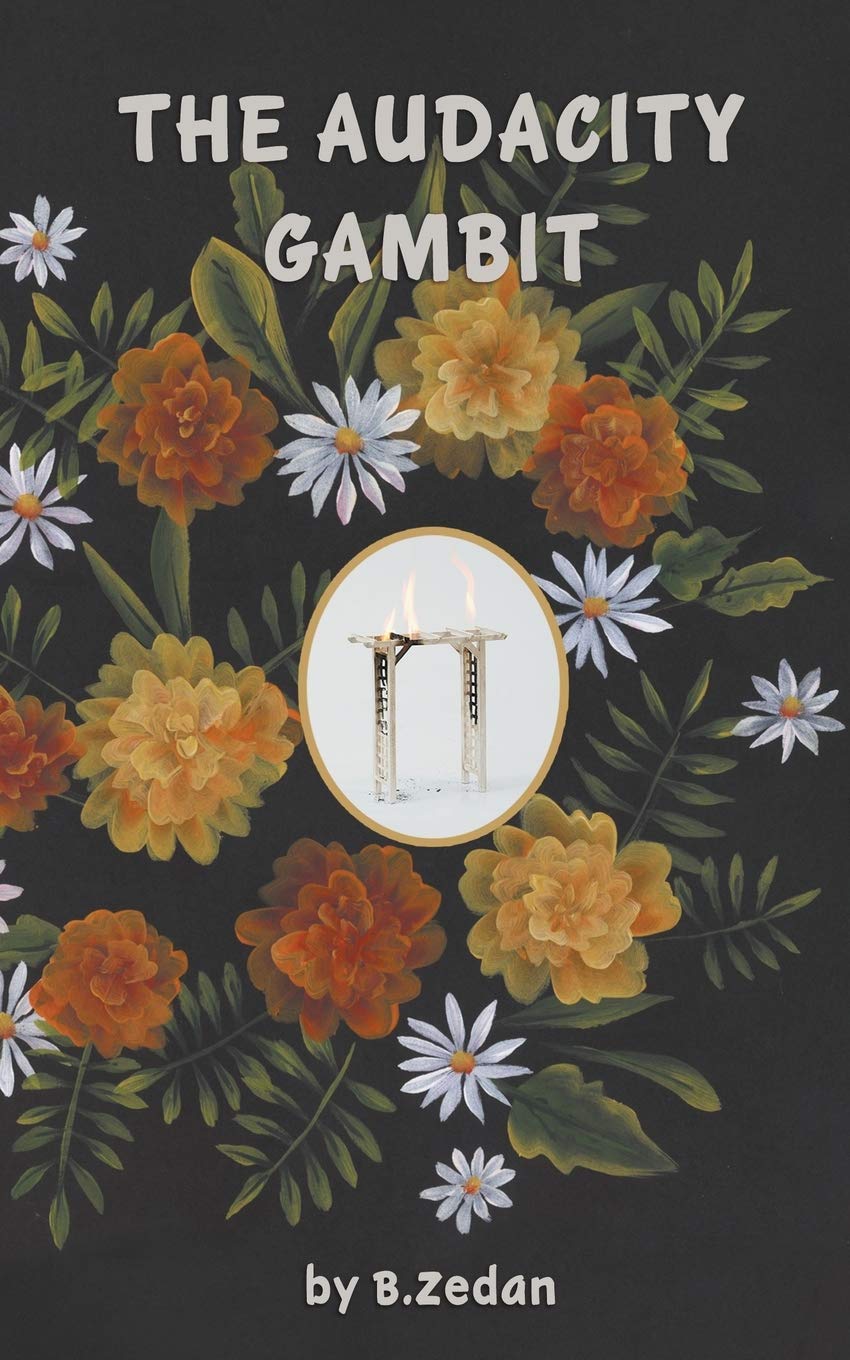
The Audacity Gambit cover with flowers and a burning gazebo

The Audacity Gambit by B. Zedan is a gentle fairy tale, though the underlying themes are as uncompromising as any Fae could demand. Emily is the Chosen One, the one who can restore her people to the Fae Kingdom–but this is no accident of fate. Her life has been manipulated since the moment of her birth to fulfil the esoteric needs of prophecy, and the trusted adults of her life have been concerned only with preparing the way. But, while the world can put a person in a box long enough that she assumes its shape, she can still choose who she becomes when she steps outside.

The fantastical world is a character in its own right, full of whimsy in the style of Frank L Baum or Cat Valente, where Polaroid cameras reveal hidden mysteries and trees may–or may not–be trustworthy. While I never feared for Emily’s life, I wondered what she would hold onto when everything changed.

Behind the Screens: Tuesday Author Interview

Every Tuesday, get to know a bit about the stories behind the books you love, and discover your next favourite novel.

Speculative Insight logo

Zilla: As someone who thinks far too deeply about the science fiction and fantasy she reads, nothing could be better than a journal of essays about exactly that. Today, instead of an author, we bring in the editor and publisher Alexandra Pierce to talk about Speculative Insight: a journal of space, magic and footnotes. Alexandra, what do you do?

Alexandra: I like to say I pay smart people to write clever essays about interesting science fiction and fantasy topics! We publish two essays a month online – one is free to read, the other is available to subscribers. Subscribers also get 6-monthly ebooks compiling the previous 12 essays, plus a bonus. (I’m also an historian; I’m not sure which one is my ‘main’ focus these days …)

Zilla: What inspired you to start this journal?

Alexandra: I co-edited two non-fiction anthologies (Letters to Tiptree, and Luminescent Threads: Connections to Ocatvia E. Butler) a few years ago. When I left teaching and was thinking about what things I might do instead, I was reflecting on how much I enjoyed putting together those anthologies … and realised that a journal would do a similar thing, but without the need to get everything done at exactly the same time. Once I had searched, “Who is allowed to start up a journal?” (true story; turns out there’s no answer online because the answer is “whoever is silly enough to want to do so”), I went from there. 

Zilla: What research did you do before starting your business?

Alexandra: I researched the functional, business side a fair bit … and also read up on a bunch of people who are writing really interesting nonfiction about SFF, as people who I hoped would want to write for the journal. 

Zilla: Who are your readers?

Alexandra: My hopes were and are that people who are interested in interrogating their literature would be the audience for the journal. While many of the essays are about a particular book or set of books, the intention is that they will deal with some topic that is applicable across other books too. So the essay about families of the future refers specifically to four books, but I think a reader could make connections to lots of others; same with the essay about whether Robin McKinley’s Deerskin counts as a “cosy fantasy”, for example. 

Zilla: And for my penultimate question, one about you. You must have plenty of speculative fiction loves. Who is your favourite fictional character?

Alexandra: Probably my two favourites are Cheris, from Yoon Ha Lee’s Machinery of Empire series, and Breq, from Ann Leckie’s Ancillary Justice trilogy. I am a huge fan of space opera, so both of these series have been near-annual re-reads for me for several years now. Cheris is a very complicated character for a whole range of reasons, and has done terrible things for (probably) good reasons. Breq is literally a fraction of who she used to be, and is making the most of a terrible situation. Both have an excellent line in snark, too. 

Zilla: Thanks for sharing your story and your process. We’re looking forward to reading! Where can the Night Beats community find you and your journal?

Alexandra: I’m on Bluesky @speculativeinsight.bsky.social and Instagram @speculativeinsight. Speculative Insight: a journal of space, magic and footnotes is here.

Wrong Genre Covers

Robert’s Rules of Order by Henry M. Robert III as a pulp paperback was suggested by…I’m not sure actually. Maybe Rachel just thought it was cool.For some reason. Have a funny idea for a Wrong Genre Cover? Email us at nightbeatseu@gmail.com, and if Rachel likes your suggestion, she’ll make it in a future issue. Or @ us on basically any of the socials.
There is so much chaos in this cover that I don't know where to start. It's Robert's Rules of Order, 12th edition, by Henry M. Robert III. It's a pulp style cover with a bearded white man holding up a red card and various strange looking fellows, one of whom has two heads (why?) in the background. Other text reads "challenge the chair! point of personal privilege! call the question! move to adjourn." In the foreground, a hand holds a card that says "The house WILL rise. Order is what separates men from beasts...and he's here to bring it!"

Behind the Screens: Tuesday Author Interview

Every Tuesday, get to know a bit about the stories behind the books you love, and discover your next favourite novel.

Nothing in the basement cover with a person falling down

ZZilla: What if the real horror was the friends we made along the way? What if it’s you? What if it’s me? … It’s probably me. 

These and similar questions were why I knew I needed to have Romie Stott on the blog, and I needed to get all the details about Nothing in the Basement. So … tell me about it!

Romie: It’s a haunted house story about middle-aged people who have a lot of trouble believing anything could be going wrong on the level it’s going wrong. I’m a longtime editor at Strange Horizons and you may have seen my writing in Analog, Atlas Obscura, The Deadlands, and Tractor Beam.

Zilla: What inspired you to write this book?

Romie: Have you had long theoretical conversations about what makes horror horrifying, and what does and doesn’t count as horror? I spent a lot of time hanging around someone who insisted horror has to meet two criteria: (1) it has to include an element of the supernatural, and (2) it has to scare you. That’s tricky for me, because I don’t believe in the supernatural and therefore am not scared of it. My reaction to most horror fiction is grief.

Some years ago, I was spending the weekend at a friend’s house, which is built on a hill. When you’re in the back yard, it’s obvious the front of the house is on the ground, and the back of the house is up on poles. I grew up in houses with crawl spaces, but rarely thought about them while indoors. I started playing with the idea that you could live your life standing on something without realizing how little was supporting you, both literally and metaphorically.

I was visiting my friend partly to see him in the play Wait Until Dark; he was one of the villains. I enjoyed being frightened by his believable on-stage cruelty (and loved that production overall). But it didn’t change my core understanding that when he stepped off stage, he was my friend. I wondered how much it would take to convince me otherwise.

When it comes to what keeps me up at night, I worry I could notice clear warning signs and then use my excellent coping skills and reasonableness to stay in a situation that has become very dangerous. Similarly, I worry that I appear ridiculous to other people, with no evidence this is true. So in my book, what haunts the characters is nothing; it’s nothing. These things happen to everyone. 

My goal while writing was for readers to think “oh no, is that what I’m like?” (The real horror is yourself.) The trouble when I finished was – oh no, what if my friends think I think that’s what they’re like? I ran it by my friend whose house and performance inspired the whole thing, and he was flattered. He asked me to be vague about the address so he doesn’t have to deal with tourists if the book becomes famous, which is a generous thing to worry about.

Zilla: Thanks for sharing your story and your process. We’re looking forward to reading! Where can the Night Beats community find you and your book?

Romie: Facebook, BlueSky, Tumblr, Instagram, YouTube, Spotify, Bandcamp, mailing list. You can buy Nothing in the Basement at Bookshop.org, Barnes and Noble, Amazon, and here’s the Goodreads page.

Behind the Screens: Tuesday Author Interview

Every Tuesday, get to know a bit about the stories behind the books you love, and discover your next favourite novel.

cover of CodeSkull with three 13 year olds running from a computer that is very clearly evil

Zilla: If you’re as nostalgic for Goosebumps as I am—young-adult horror with ‘90s vibes—then you need to read our next guest’s novella, CodeSkull. Chloe Spencer’s been on this blog before, and we’re delighted to have her back! What’s your latest book about?

Chloe: CodeSkull is a YAt sci-fi horror novella set in 1998 which centers on a gamer girl named Mick who is one day gifted an RPG by her rival, Tommy. When she plays it, she accidentally unleashes a demon upon her town which can possess and control any electrical object. Now, Mick, Tommy, and a fledgling occultist/punk rocker named Cain must team up to save their town from total annihilation. 

Zilla: What inspired you to write this book?

Chloe: I was inspired to write this book when my publisher, Mad Axe Media, put out the call for it. They were looking for books set in the 90s that could harken back to the days of Goosebumps, and I was stoked, because I hadn’t had the opportunity to write a YA novella yet. I wanted to write something that gave me the same spooky feelings I had when watching things like Scooby Doo on Zombie Island. I also wanted to try to write a book where romance wasn’t a big focus (this is one of 2 published novels or novellas that I have where the B-story isn’t romance) and reflected on a lot of my friendships growing up. One of the characters, Tommy, is inspired in part by my childhood best friend. 

Zilla: I love asking authors what their characters would say to them, but in your case it’s an extra-fun question since one of the characters is inspired by a real person. So—what would they all say?

Chloe: Mick would absolutely say, “How COULD you?!” 

Cain would ask, “Was all that necessary?” 

Tommy would say, “Actually, that’s not how any of this happened, can I rewrite this?” 

I have no doubt that all three of them would roast me. 

Zilla: That’s delightful. It sounds like you were following the old rule to “write what you know” for this book. Did you end up needing to do any research?

Chloe: One of my goals with writing CodeSkull was to create a story that was more geared towards a younger audience. My two other YA works, Monstersona and Haunting Melody, are more for readers who are 16 and up. When I was promoting Haunting Melody, I encountered a lot of teachers and parents who were desperately looking for something for their 13- and 14-year olds. And I was like, “Oh, surely there has to be a LOT of books out there for 13- and 14-year olds, right?” And I was surprised to discover that there weren’t that many! I remember having access to tons of books with characters that were close to my age when I was a kid, but nowadays, it’s very rare to encounter a character in the YA space that’s under the age of 16, which is interesting, because YA as a whole is supposed to be for kids between the ages of 13-18. 

I have a lot of knowledge in the YA horror space already, but I lacked that same knowledge in middle grade, so I ended up checking out a lot of books for that age range so that I could try to write something that could successfully serve as a “transitional” read between those two age groups. 

Zilla: Thanks for sharing your story and your process. We’re looking forward to reading! Where can the Night Beats community find you and your book?

Chloe: You can find out more about me at my website, www.chloespenceronline.com. I’m also available on Instagram, TikTok, and Bluesky @heyitschloespencer. You can get the paperback here, and the e-book here.

Behind the Screens: Tuesday Author Interview

Every Tuesday, get to know a bit about the stories behind the books you love, and discover your next favourite novel.

A webcomic panel of the characters at a military hospital.

Zilla: From the written word to the sketched image, stories have the power to move us. Artemy’s queer WW1 webcomic is a story you won’t want to miss, so we’ve brought them here to tell us about Gentle Hands.

Artemy: Gentle Hands is a queer-centric story about the home front and the medical system during World War One. After suffering a severe injury that has left him paralyzed and unable to talk, Dmitri finds himself in an institution in France. Jadyn, a retired military surgeon, is assigned to be his nurse, but after some investigation he gathers some alarming details. Is his placement with Dmitri an elaborate hazing? And can he prove himself as a capable doctor despite that? 

Zilla: What inspired you to write this book?

Artemy: When I was 17 I discovered I would be disabled for life. For this reason I really enjoyed stories about disabled characters and could never get enough of them. So when I discovered webcomics I knew I had to make my own. 

Zilla: The webcomic is clearly written from the heart—I can see how personal it is. Who is your favourite character in your story?

Artemy: My biases lie with the main love interest, Dmitri. I’ve always wanted to write a nonverbal character, and Dmitri was my way of experimenting with that. His thoughts and feelings are so complex, yet his way of expressing them is limited. This has led me to come up with creative ways to communicate those ideas. Character-wise he has a lot of contrast, and that seems to be my readers’ favourite thing about him. 

Zilla: How much research did you need to do for your story? (I ask this as though I didn’t meet you on a server about writing historical fiction!)

Artemy: Initially, I started this story as a relaxed side-project. I told myself I wouldn’t fuss over the fine details or research. It only took two days to throw that out the window. I have since been chest deep in articles and archives. 

Zilla: Who did you imagine as your readers?

Artemy: I imagined a lot of disabled trans men with uniform fetishes reading my book. That is precisely what I got and I couldn’t be happier with the result.

Zilla: Thanks for sharing your story and your process. We’re looking forward to reading! Where can the Night Beats community find you and Gentle Hands?

Artemy: My series can be found online for free on both Webtoons and Tapas with weekly updates. You can also find me on tumblr at @leonardoeatscarrots.

Book Report Corner

by Rachel Rosen

School of Shards (Vita Nostra Book 3) by Marina and Sergey Dyachenko, translated by Julia Meitov Hersey. The cover is dark blue with a closeup of a horse sculpture. The text is very distorted.

Some years ago, I had my brain melted and then rearranged by Maryna and Serhiy Dyachenko’s Vita Nostra, which still remains one of my favourite fantasy novels—and fantasy series—of all time. Its long-awaited conclusion, School of Shards, is haunting, moving, and absolutely perfect. It’s one of those books that I put down and immediately wanted to reread, not only because it’s stunningly written, but because there were layers of theme and character that I wanted to pick apart.

School of Shards picks up in the new reality that Sasha created in Assassin of Reality—a world without fear, without plane crashes, without child death, but without free will. Now the provost of the Institute of Special Technologies, she has become the same knd of inscrutable taskmasker who terrorized her as a student. But the Great Speech is falling apart, and with it, the world outside of Torpa. And so Sasha must pull from her own past—her half-brother Valya and the twin sons of her former lover Yaroslav—to fix what she’s broken.

Even with the world closing in on the town and its strange magic school, this final chapter in the trilogy feels like it has a much greater scope. The post-Soviet malaise of the first novel expands to a global scale. Words, language, no longer holds the fabric of reality together. The central metaphor is so apt for our present moment, and maybe I’m reading too much into it, but I just found myself thinking that this is a book that does what I want fantasy to do. This is why the genre is meaningful.

I would be remiss if I didn’t also note the elegance of Julia Meitov Hersey’s translation. As is fitting for a book about language, the language of the story itself is beautiful, lyrical, and melancholic.

I am grateful to Kyra DeVoe at HarperCollins for sending me an ARC.

Wrong Genre Covers

Selected Writings and Speeches of Maximilien Robespierre as an office equipment manual was suggested by the incomparable Zilla. For some reason. Have a funny idea for a Wrong Genre Cover? Email us at nightbeatseu@gmail.com, and if Rachel likes your suggestion, she’ll make it in a future issue. Or @ us on basically any of the socials.
Selected Writings and Speeches of Maximilien Robespierre as an office equipment manual

Behind the Screens: Tuesday Author Interview

Every Tuesday, get to know a bit about the stories behind the books you love, and discover your next favourite novel.

Antifa Lit Journal Vol. 1: What If We Kissed While Sinking a Billionaire's Yacht? Image shows a blue and red starburst, a sinking silhouette of a yacht, and two orcas leaping up.

Zilla: Joining us today, we have Night Beats’ own Rachel A. Rosen, talking about her title story in the Antifa Lit Journal Vol. 1: What If We Kissed While Sinking a Billionaire’s Yacht? This is a story about whales and capitalism, so why did you choose to make the protagonist an art major?

Rachel: Because of my own background, there are a disproportionate number of characters across all of my fiction who care a disproportionate amount about art and art history. For this, I blame my own high school art teachers for making the subject far too interesting to my adolescent mind. You know what you did.

In terms of the story itself, I needed a “useless” major that would accumulate a student debt that Maria could never hope to repay by normal means. I don’t believe there’s any such thing as a useless major, but I do find it interesting the degree to which Western governments focus on STEM and business as the only possible useful majors. (I say “interesting” in that these same governments are largely uninterested in funding scientific research or listening to what actual scientists have to say.) Studying visual arts has always been a path to poverty, but it is also a vital body of knowledge, as it teaches you, more than anything else, how to see what’s in front of your eyes. It’s why Maria is the only character who is able to see through Chase’s slick image to what he’s doing behind the scenes.

Zilla: Is “eat the rich” meant to be interpreted literally?

Rachel: No thank you, I’m vegan.

Seriously, though, the rich are apex predators, prone to biomagnification, and you shouldn’t eat them as you’ll be ingesting the same toxic media ecosystem that they did. You don’t want to get RFK brainworms or a prion disease, do you? A better idea is to compost the rich and grow tomatoes in the soil, and if you need a good recipe or two for your tomatoes, I’d advise readers to check out the Sad Bastard Cookbook that you and I co-wrote.

Or, I don’t know, we could just have a fairer tax structure. Seems like it would cause less fuss.

Zilla: Can orcas smile?

Rachel: They can! And they also “kiss,” which is to say, they lightly bite each other’s tongues. Romance. You know how it is. My browsing history has been forever destroyed in an attempt to research far more than anyone ever needs to know about orca mating habits. In order to find out what, exactly, makes an orca smile, you’ll have to read the story.

Other fun orca fact: An orca can eat a moose. This happens rarely, but often enough that when they list the components of an orca’s diet, they do have to mention moose.

Zilla: Why are orcas the perfect symbol of the resistance?

Rachel: The trend of orcas sinking yachts is iconic to the point where I had to furiously Google to see if anyone else had already written a story about it. Why do they engage in this kind of behaviour? It’s because orcas are highly intelligent, highly social animals that communicate and learn from each other. (A lesser-known, though still stylish, orca trend is the fashion for wearing a dead salmon as a hat, which goes around every few years or so, like bell bottoms or acid-washed jeans.) Some people suggest that they’re playing with the yachts, downplaying the possibility that after several hundred years of all-out abuse of the ocean at the hands of the most predatory forces of capitalism, one of said ocean’s most intelligent lifeforms has decided to take a bit of revenge. It seems to me that, being on the frontline of humanity’s most shortsighted and reprehensible behaviour, they are engaging in the kind of action that we here on land are not courageous or desperate enough to undertake, even though we know the stakes.

It’s important to know that our ocean comrades aren’t perfect, and they often direct their violence towards targets that don’t deserve it. In addition to the yachts, they have been known to hunt blue whales for sport, or sink the craft of innocent small-scale fishers. But no activist or organization is perfect, and analyzing their shortcomings is also critical for building effective social movements.

Zilla: In your story, Maria seemed pretty trapped. How can us non-orca-types engage in resistance?

Rachel: [The following paragraph has been redacted for the sake of not further adding to the workload of the CSIS agent tasked with monitoring Rachel’s internet activity.]

You should write strongly worded letters to your local representative.

Zilla: *looking around nervously* Where can the Night Beats community find you and read this story?

Rachel: I am everywhere, including on this very blog! You can find me via my website, my podcast, Wizards & Spaceships, my Bluesky account, on Mastodon, or even on Instagram if you’re still on Meta for some reason. You can find this and future issues of the Antifa Lit Journal through the publisher, Not a Pipe Publishing, or wherever you buy books on the internet.