Every Tuesday (and occasional Thursdays!), get to know a bit about the stories behind the books you love, and discover your next favourite novel.
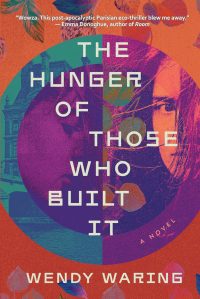
Zilla: Even climate repair can have its dark side—environmental justice is a choice that we need to make, not a guaranteed outcome of protecting the planet. And our estrangement from the natural world can mirror our more personal estrangements—from our family or our own histories. I am so excited for Wendy Waring’s novel The Hunger of Those Who Built It, and I am so happy that she’s here to tell us all about it!
Wendy: The Hunger of Those Who Built It imagines a near-future Paris encircled by vertical farmland built on the city’s beltway, the engineer who designed it, the people who co-opted it, and her loved ones who, years later, are battling to get past it…
Diane Griffith draws on engineering innovations in vertical agriculture for an ambitious model of green urban life meant to heal both city and planet. As the project transforms Paris’s historic core, unanswered questions arise—about care, responsibility, and what sustainable progress truly requires. The search for her missing activist sister forces Diane to engage with those questions. Told alongside the future perspective of her niece Lou, who must live with and fight within Diane’s legacy, The Hunger of Those Who Built It asks who gets to inherit tomorrow’s utopia.
Zilla: What inspired you to write this book?
Wendy: So many things! One: a Paris map torn from a nineteenth-century guidebook. Instead of the Périphérique highway surrounding central Paris, there’s a crenellated line marking the defensive walls erected by France’s last king. I wanted to imagine what that aristocratic barrier would look like in 2050. Because we carry our history with us into the future.
Zilla: What made this story the one you needed to tell?
Wendy: I am galvanised by fascism’s failure of imagination and capitalism’s future-blindness. I want to create a narrative lab where people can feel and inhabit the futures being constructed, consider what it might cost us if we refuse to fully imagine them, and even dream of alternatives.
Zilla: What would you do if you weren’t a writer?
Wendy: I started my life journey as a translator and an editor, detoured through academia, and tiptoed into the land of fiction writing. So I could pursue my love affair with words in other ways. But if there were some mass aphasia event, I’d dedicate myself to growing heat-hardy vegetables.
Zilla: Can you share some lines you’re proud of from the book?
Wendy: I’m more joyful of the discovery than proud… In the book’s far future storyline, Diane is en route to Paris by dirigible: “They lofted over the striated shimmer of a vast solar farm.”
Or here’s Lou, indentured inside the wealthy enclave her aunt helped build:
When people build a wall, they may think they’re dividing in from out, separating haves from have-nots. But they’re not. They’re marking a segregation that has already happened. They’re building two waiting rooms joined by a closed door. In one, you dread the coming invasion. In the other, you plan. […] If I get caught, they’ll say I was here for gain—for jewels, for goods, for gold. But I’m not. I’m here for hope.
I love how this short passage captures the book’s storyline and rebel Lou—so fierce yet tender.
Zilla: Thanks for sharing your story and your process. We’re looking forward to reading! Where can the Night Beats community find you and your book?
Wendy: At Stelliform Press!

