Every Tuesday, get to know a bit about the stories behind the books you love, and discover your next favourite novel.
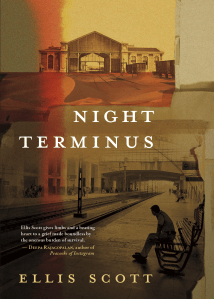
Zilla: Ellis Scott comes to us with an important and powerful story, Night Terminus, which memorializes his experiences of the AIDS crisis. Ellis, can you tell us about your book?
Ellis: Night Terminus explores the aftermath of the AIDS crisis and the fates of the survivors. The novel spans forty years and three continents. It mines the wreckage from the pandemic, set against a backdrop of late-twentieth-century political events, and features a cast of fugitives, young and old, all veterans of a war with many heroes but no parades. Night Terminus examines themes of agency over life and death, the existential role of art, statelessness and belonging, and the universal search for spiritual meaning..
Zilla: What inspired you to write this book?
Ellis: My debut novel relies on my experiences as a survivor of the AIDS crisis. Though fictional, many of the characters are amalgams of individuals I have met or inspired by personal stories I have heard over 45 years. Time collapses as one gets older, and when death strikes so young. Few novels have been written about the people who watched their friends and lovers die but who lived. These elders possess the wisdom — and burden — of history. There will be no witnesses left to tell their story, and so I wanted to do it before it was too late.
Zilla: Do you have an artistic inspiration for the book?
Ellis: A theme in Night Terminus is the existential role of art, and the images of 19th-century photographer Édouard Baldus feature in the book. He invented the large-format monumental photograph, leaving out the people who created the buildings so the structures would speak for themselves. In doing so, he creates a “geography of absence” where traces remain of the individuals who built them. In the novel, the dead also create a powerful presence in the story because of their absence, which is reflected in the photographs.
Zilla: What would it be like to meet your characters?
Ellis: Because some of my characters are based on real people, while others are fictional but infused with the factual, I feel like I have met many of them. So writing the novel resembled a family reunion of sorts. I would say that I tried to honour their lives; to show the terrible times but also the levity, and the great joy and resilience they showed in the face of extinction. And that I miss them.
Zilla: Do you surprise your readers?
Ellis: There are staggering moments and twists in the narrative, yes. They shouldn’t be gratuitous or for the sake of driving the plot forward. The AIDS crisis was shocking enough in itself. It is better to circle around a catastrophe or view it from a distance. Calamity doesn’t need embellishment of any kind; indeed, it requires the opposite. The most startling are the metaphysical connections and strange coincidences that come from concatenation.
Zilla: Thanks for sharing your story and your process. We’re looking forward to reading! Where can the Night Beats community find you and your book?
Ellis: On my website.