Every Tuesday, get to know a bit about the stories behind the books you love, and discover your next favourite novel.
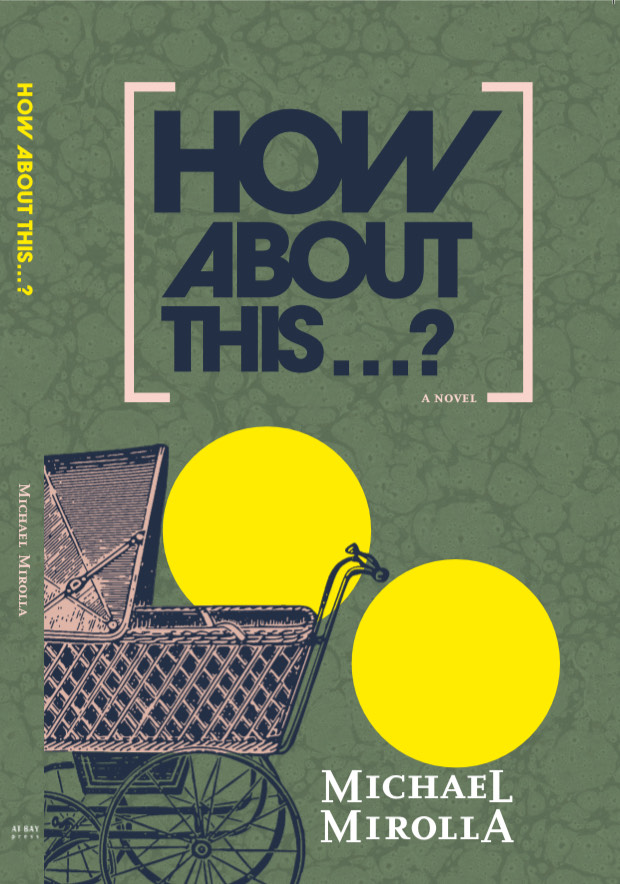
Rachel: With us today to talk about his latest book is Michael Mirolla! Michael, how about telling us about How About This…?
Michael: It’s a little after the middle of the 21st century. Loving couple Elspeth and Marybeth are both shocked and excited when a stroller with identical twins is left on their back deck with a recorded message that warns them not to try to return the babies or they could face arrest for kidnapping. Using false starts, footnotes, direct approaches to the reader, lists, questions about who the author(s) might be, and even a dose of self-criticism, the story unwinds from that point as El and Mar work hard to create a family under the circumstances. This becomes even more difficult when they discover the babies come with unusual features that perhaps might explain why they were left in the first place. And it all takes place in a disintegrating world that may leave humans incapable of telling their own stories.
Rachel: What inspired you to write this book?
Michael: I have an overriding theme that runs through most of my writing – and that’s the fluid, shapeshifting and very difficult to nail down nature of human identity. Another interest that runs through the majority of my work is the metafictional aspect of writing, the connection between the word and the outside world, the ability of fiction to create its own worlds. There is a good deal of this in How About This …? – as described in the blurb for the novel. In places, the authors (supposedly a collective of some kind) speak directly to the reader; in others, they explain situations through footnotes; at the end of the novel, a critic lashes out at the authors for what he feels are lacunae in their writing.
Rachel: In metafiction and experimental writing, characters often have direct interaction with their writers. What would yours say to you?
Michael: If my characters met me, they would at first have trouble recognizing me as the author who put them down on paper. That’s because my own life (bland and undramatic) has been nothing like that I’ve laid out for my characters. What would they say to me: “Aren’t you supposed to write what you know? You know love, marriage, children, grandchildren, family gatherings and even a touch of farm life. So what are you doing writing about characters who cut off their leg in order to replace a one-legged news vendor? How can you describe a character who spends his time recreating a Mussolini clone in order to shoot him? Who gave you the right to write about an institutionalized janitor who is found with computer files describing a philosophy professor’s surreal trip to Berlin?”
Rachel: Who is your favourite fictional character someone else wrote? And why?
Michael: Josef K. (Franz Kafka’s Der Prozess – The Trial). The story of a man who suddenly finds himself on trial, accused of some vague crime that could very well end up being the criminal act of being alive and conscious. Simply the guilt of being human. For me, it comes across as the finest, truest representation of the 20th century’s existential dilemma ever put on paper. And combining absurdism with dystopia in a way that foresaw many of the horrors of what took place later in the 20th century and continuing into the 21st.
Rachel: It’s hard to top Kafka for anything. But who is your favourite character you’ve written, and why?
Michael: I have a character named Giulio who has appeared in a string of my writings, starting with The Formal Logic of Emotion short story collection, the novel Berlin, and still going strong in my as-yet-to-be published magnum opus The Second Law of Thermodynamics. In The Giulio Metaphysics III, the character appears in each of the stories while at the same time not being recognizable as the same character other than his name. A protean character, in other words, lacking any form of so-called essential identity. As well, in The Giulio Metaphysics, the relationship between writer (creator) and character is explored. In the first half, Giulio is forced to do his creator’s bidding; in the second half, Giulio breaks away from his creator – only to find himself completely lost and unable to even remember his name, let alone where he is or why he does what he does.
Rachel: How much research did you need to do for your book?
Michael: For How About This …? the majority of my research had to do with the nature of intersex persons (twins) and their relationships both between themselves and with the world around them.
Rachel: Well, this sounds up our alley. Tell us where the Night Beats community can find you and find your work!
 Night Beats Extended Universe