Every Tuesday, get to know a bit about the stories behind the books you love, and discover your next favourite novel.
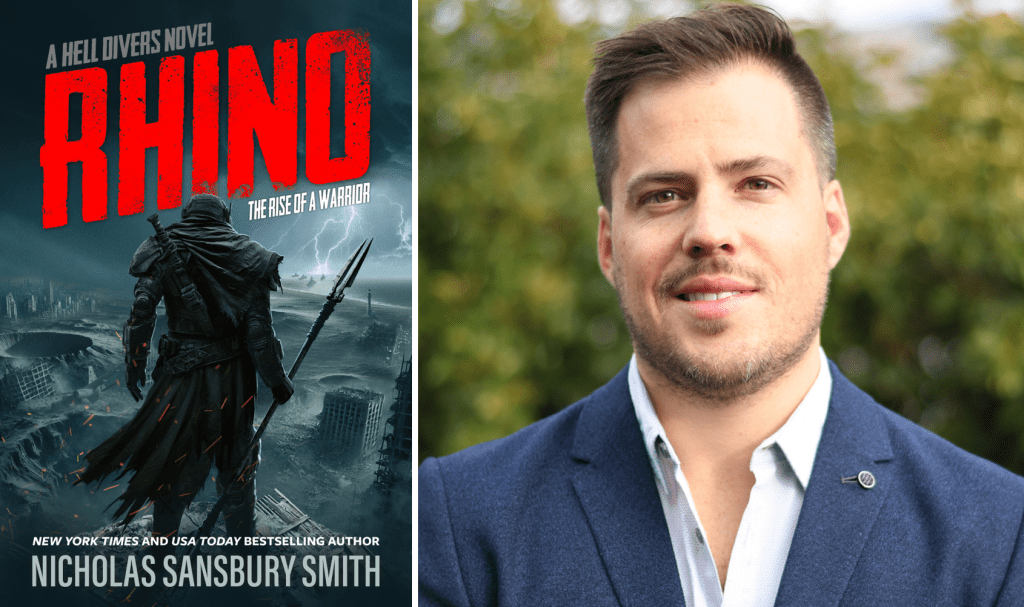
Zilla: Write what you know, they said, and what Nicholas Sansbury Smith knows is disaster management—so he wrote a post-apocalyptic adventure novel Rhino. Nick, can you tell us the blurb?
Nick: Centuries after the Third World War reduced civilization to ashes in a global nuclear inferno, humanity clings to life in giant airships sustained by Hell Divers—brave souls who risk their lives plunging to the surface to salvage essential supplies to maintain mankind. But this is not their story. This is the saga of the survivors before them, the survivors on the ground.
Embark on this riveting post-apocalyptic adventure centered on Nick Baker, a frail orphan born in the perpetual darkness of an ITC bunker. As raiders from the great Cazador empire descend—massacring and enslaving Nick’s people—witness his epic rise from boy slave to fearsome warrior bent on freeing his people from bondage. And discover the legend of a man whose enemies will come to fear as Rhino…
Zilla: I love a good fight scene, and it sounds like Rhino: The Rise of a Warrior delivers with plenty of them. As a writer, how do you keep action sequences engaging while also realistic? Within ‘realistic’ for science of course—I’ll accept a mech suit but I won’t accept someone twisting out of a well-executed arm lock.
Nick: My action sequences are often based on the characters and their personal limitations and skills. Rhino might be the best story I’ve written to explain just how this works. For example, in the beginning of the story, when Nick Baker is just a boy, he is frail and has no fighting experience. He has the fire inside of him, but fire doesn’t translate into knowing Kung-Fu. This isn’t the Matrix. Instead, Nick gains weight, trains, and eventually is taught the art of warfare. It takes years before he can actually fight. He learns different weapons and how to use them. Accurately describing weapons is another important part of realistic fight scenes, as is depicting how the action works.
One thing a lot of writers don’t understand, and a lot of people in general, is that fighting requires extreme endurance. Just look at how tired boxers get over the duration of a long fight that goes to the bell. With action sequences it’s most authentic to show your characters getting winded and fatigued from combat, and for injuries to not just slow them down but disable them if severe enough.
In Rhino, I used all of the above to illustrate one boy’s transformation into man, and ultimately—warrior.
Zilla: On the news, we see the horror stories of national emergencies, but we also see community resilience as people come together. What did your time in Iowa Homeland Security and Emergency Management teach you about people’s ability to look after each other, and how did that play out in the book?
Nick: My time at HSEMD taught me humans are inherently good and help each other in the face of natural disasters. I also saw political views being pushed aside and people coming together. Neighbors help each other and communities organize. Of course, there will be some anomalies where this isn’t true (thieves, opportunists—often from outside of the disaster area), but for the most part when disasters strike, human instinct is to help. That is, when there are resources. That often changes when food, water, and supplies run out. Then you’re talking more of an apocalyptic novel, and I’ve written about that a lot on how people react. There are still communities coming together, and neighbors helping each other, but when shit really hits the fan, you start seeing more desperation, which drives people to panic, and sometimes—violence.
Zilla: I am a massive Mad Max fan, plus I love all the various sequels and spin-offs. Are there specific motifs from that series that inspired you as you wrote?
Nick: Definitely the world building and the plot around controlling the petrol. If an apocalyptic world like that were to exist, just like in Rhino with the Cazador Empire he becomes part of, survival would be driven around resources, specifically fuel. This is a theme in this story and the entire series for that matter. Other inspirations would be from the modified vehicles. I’ve done that to the boats/ships in the Hell Divers series. You’ll see some of that in Rhino as well. I absolutely love writing in this type of destroyed environment. It’s haunting and brutal, in a beautiful way.
Zilla: What’s your next writing project?
Nick: I am working on multiple projects: a military sci-fi saga with a co-author, and then a LitRPG apocalypse trilogy, plus more Hell Divers books. I enjoy writing multiple storylines at once, as it keeps them from going stale for me. Readers are smart, they know when writers are bored with their work. I don’t get bored usually because I take time off from writing stories that might otherwise feel more like a chore if I had to write the same thing every day. I got asked the other day if I ever run out of ideas—nope, I wish I had more time to turn more of those ideas into stories!
Zilla: Thanks for sharing your story and your process. We’re looking forward to reading! Where can the Night Beats community find you and your book?
Nick: I’m on Instagram, X/Twitter, and Facebook. You order Rhino on Amazon, Apple Books, B&N, or| Bookshop.org.
 Night Beats Extended Universe