Every Tuesday, get to know a bit about the stories behind the books you love, and discover your next favourite novel.
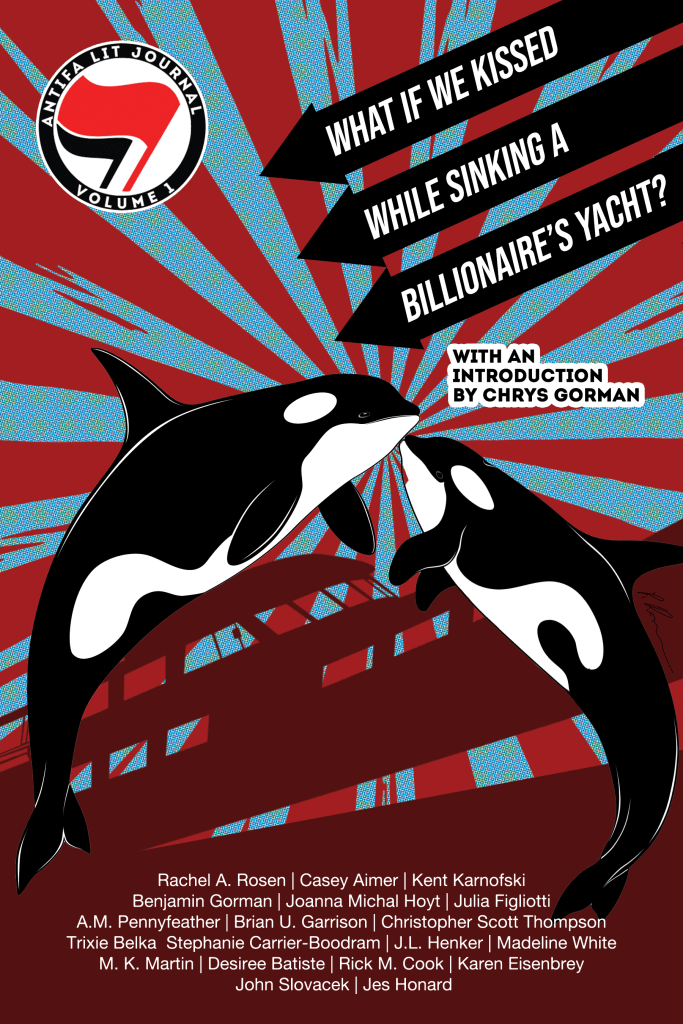
Rachel: With us today is Benjamin Gorman, editor and contributor to the Antifa Lit Journal, which, if I do say so myself, is a rad book. Tell us a little about the anthology, Ben! What is it, and how did it come together?
Ben: We had decided as a family that we would need to leave the US if Trump won the election, so between Election Day and Inauguration Day, we liquidated our possessions and Chrys (who wrote the introduction to Volume 1), our kid Franke, our three dogs, and our two cats relocated to Spain. In the midst of all the insanity of the move, I processed it by writing an explanation that started as a draft of a Facebook post, then a longer blog post, and became a whole book, Dear America: A Breakup Letter. It was published by Not a Pipe Publishing just as we were safely across the border, and it did surprisingly well. A lot of people were in the same headspace, though I understand not everyone can leave the country. Watching all that interest in the book while we were absorbing the daily nightmare of American news, Chrys suggested publishing an anthology of anti-fascist poetry and short fiction. Not a Pipe has published themed anthologies before, like Written with Pride, the all-LGBTQIA+ anthology, and Strongly Worded Women, by exclusively women authors. The response from authors and poets was overwhelming. So many talented writers were desperate to have a venue to speak out against fascism, to process their fear, and to provide readers with an alternate vision of the future. As we poured over all the submissions, we realized we could easily populate a regular journal with high quality short fiction and poetry. So the anthology became Volume 1. And our intention is to keep it going as long as there’s an appetite for it. I don’t foresee this regime going away nearly as quickly as some people expect, and I think we’ll see increases in fascism, especially in terms of would-be-autocrats leveraging anti-immigrant sentiment, all over the wealthy world as the people from countries we’ve made uninhabitable through our climate colonialism decide to move to the places where they can still live above water and below 130° F/ 55° C. There will be very real consequences in terms of housing, supply chains, etc., and I fear that instead of trying to be welcoming, a lot of countries will turn to demagogues. We’ll need people of conscience to speak out, and writers often fill that role.
Rachel: That’s very true. Speaking of antifascist art, literature, and music, what are some of your favourites pieces?
Ben: When I think of antifascist art, the first things that come to mind are dystopian sci-fi novels I love. These are cautionary tales like Octavia Butler’s Earthseed books (Parable of the Sower and Parable of the Talents) and Margaret Atwood’s MadAdam trilogy. Of course The Handmaid’s Tale has to be on the list, but between you and me, I think her prequel/sequel novel The Testaments is better. And George Orwell’s 1984 will always be one of my favorite novels. But antifascism doesn’t just take the form of dystopian lit. A lot of the punk music I grew up on was implicitly or explicitly antifascist. I used to make fun of my younger brother, Joe, for having eclectic music taste that included everything from Top 40 stuff to musical theater to funk, while I listened to punk music and my parents’ vinyl folk albums and understood the connection via the lyrics. But I’ve grown to understand that all different genres contain anti-authoritarian streaks. I’ve even (reluctantly) come to learn that old-school country music, which isn’t my taste musically, was deeply anti-capitalist, pro-worker, and anti-war once upon a time. Lately that eclecticism I’ve learned from my brother, diminished a bit by my dependence on lyrics, has me listening to a playlist that includes, in heavy rotation, “Fuel” by Ani DiFranco, “The Day the Nazi Died” by Chumbawamba, “The Revolution Starts Now” by Steve Earle, and “Arrest the President” by Ice Cube. When I feel less optimistic, I listen to a lot of Spanish Love Songs (a band that is not Spanish which produces songs that are not love songs) and the Scottish band Frightened Rabbit. So if folx find themselves despairing and want music that fits the feeling, check those bands out.
Rachel: I have been trying to teach people how to sing “The Day the Nazi Died” for years at demos, but the situation in Canada is a little different, politically speaking. Meanwhile, the US government seems to have been teetering on declaring antifa a terrorist organization, even though it’s neither terrorist nor an organization. Were you ever concerned about state repression while you were putting this together?
Ben: My concerns about state repression peaked while I was living in the US. Stochastic terrorism, the idea that leaders can call for violence without participating themselves and produce real-world violence which can act as de facto legal repression, is something I learned all too well. By the time we left, I was getting very scary death threats for my activism. I knew I had to get out in order to have the ability to keep saying the things I need to say. I’m not sure that will ever rise to the level of explicit legal repression because, in a very real way, it doesn’t have to. A government doesn’t have to say, “Thou shalt not publish work which challenges our authority” if they can simultaneously arrange to have you fired from your job, audited by the IRS, and physically attacked by their most devoted fans. I worry a lot for the safety of all people of conscience who are putting themselves out there, protesting, publishing, etc. White, middle-class, cishet Americans do not understand the way a system can turn on them because it has been working in our favor for the last 406 years. To a large segment of the US population, repression is something that happens in other countries because they cannot fathom the way it has happened to their neighbors in the US for centuries. I am very worried they are going to find out soon.
As for this anthology, we debated whether or not to call it “Antifascist” or “Antifa.” Trying to be the more palatable version of antifascism serves no one. A fascist regime will not honor the distinction, and we cannot allow the term to come to be defined by its opponents in the same way misogynists have tried to redefine feminism to mean misandry. In the same way the Democratic Party is ultimately going to have to learn to stop being the “We’ll hurt immigrants a little less” Party if they want to be relevant, people who oppose this regime are going to have to acknowledge we are all Antifa or we’re nothing. So we leaned into it. It might mean the journal is more likely to be blocked. It was already flagged by one of Amazon’s algorithms as something that might violate their content standards, though they ultimately decided to let it through. But that was the calculation we made: Better to say what we needed to say in a full-throated way than to try and whisper words of no consequence.
Rachel: It will be a surprise to no one who’s familiar with my other work that I agree! What role does artistic expression play in the struggle for social justice? What inspiration can we take from these stories?
Ben: The relationship is beautiful and reciprocal. Artistic expression, even when it is tame and seemingly apolitical, reminds us we have the power to imagine a better world, and that, in turn, gives us the ability to reject some authoritarian who stands up at a podium and tells us we are experiencing “American carnage” and need someone like him to lock up everyone with different skin color or sexual identity or birthplace in order to keep us safe and give our lives meaning. In this anthology, Joanna Michal Hoyt’s short story “Those Who Mourn” encourages us to give grace to others, even those who have the most diametrically opposed worldview, and then Julia Figliotti’s poem “Hand-me-down” is about letting someone who is hateful disappear from your life, and we put those right next to one another intentionally. They are both beautifully written, and they both touch on a tension we all feel. How do we build a better society with people who have adopted a truly terrifying, genocidal ideology? We don’t have a blueprint and a five-point plan. We have artists who feel that tension and force us to sit with our discomfort. Fascism provides easy, lazy, false answers. Antifascism is complicated and messy and honest. Not everyone wants that, but I really believe it’s the only way to build a better world.
Rachel: You mentioned that there were too many submissions for just one anthology! What’s next for the Antifa Lit Journal?
Ben: Yes! We’re going to launch a Kickstarter [it may be up by the time this is, so we can edit that to, We have a Kickstarter going right now] for Volume 2, and I hope people will back that and let us know if this is something valuable to them. Our plan is to release a new volume twice a year, but I would love it if we had enough demand to provide the support for it to be quarterly. The Trump regime has adopted the tech bro’s mantra “Move fast and break things,” and if anyone thinks they will stop at the federal bureaucracy, they are deluding themselves. These people have been explicitly clear that they have their sights set on remaking every facet of American life, and because of the United States’ outsized impact on the rest of the world, those changes will have consequences for literally every human on Earth. If the journal is released too infrequently, it runs the risk of being merely a historical document. I want this to be a means for artists to express themselves and have those words reach readers while they can still have an impact. Also, while we received a lot of poetry and short fiction, we didn’t receive much in the way of visual art, so we didn’t include any because it would have felt a little odd to only have one or two pieces. I hope that will change for future issues. I would love to have pieces of powerful visual art spread throughout future volumes!
6. Where can people find you/follow your work?
Because I have to be where the readers are, I’m on far too many social media platforms, so follow me wherever you like to digitally lurk.
Bluesky: @benjamingorman.bsky.social
Threads: @teachergorman
Twitter: @teachergorman
Instagram: @teachergorman
Facebook: https://www.facebook.com/Wrightword/
TikTok: @teachergorman
Mastodon: @BenjaminGorman@mastodon.online
And please follow Not a Pipe Publishing’s account there, too, so you can learn about books by these amazing authors I’m honored to get to work with:
Bluesky: @notapipe.bsky.social
Threads: @notapipepub
Twitter: @NotAPipePub
Instagram: @notapipepub
Facebook: https://www.facebook.com/notapipepublishing
TikTok: @notapipepublishing
Mastodon: @notapipe@mastodon.social
And, assuming the Kickstarter funds (and you can back that here: ) then the Antifa Lit Journal will be active on its own accounts:
Bluesky: @antifalit.bsky.social
Twitter: @AntifaLit
 Night Beats Extended Universe