Every Tuesday, get to know a bit about the stories behind the books you love, and discover your next favourite novel.
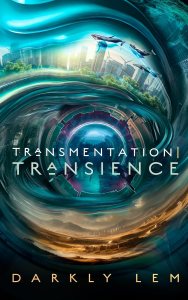
Zilla: Transmentation | Transience is a novel of a science fiction multiverse that blew me away with the rich characters and deep worldbuilding. Its creators are collectively known as ‘Darkly Lem,’ a five-author collaboration consisting of Josh Eure, Craig Lincoln, Ben Murphy, Cadwell Turnbull and M. Darusha Wehm, who make up part of the larger writing collective Many Worlds. Being a huge fan of writing collectives in general and Darkly Lem in particular, I was delighted that they agreed to join us for an interview. Before we get into my questions, can you tell us a bit about the book?
Darkly Lem: Transmentation | Transience is the first book of the Formation Saga, a novel trilogy set within the Many Worlds shared multiverse. The trilogy is an introduction to the much larger Many Worlds narrative universe, which already consists of short stories by numerous authors, which can be found on the Many Worlds website and in the Many Worlds print anthology.
The publisher’s blurb for Transmentation | Transience is:
Over thousands of years and thousands of worlds, universe-spanning societies of interdimensional travelers have arisen. Some seek to make the multiverse a better place, some seek power and glory, others knowledge, while still others simply want to write their own tale across the cosmos.
When a routine training mission goes very wrong, two competing societies are thrust into an unwanted confrontation. As intelligence officer Malculm Kilkeneade receives the blame within Burel Hird, Roamers of Tala Beinir and Shara find themselves inadvertently swept up in an assassination plot.
Meanwhile, factions within Burel Hird are vying for greater control over their society in a war of cutthroat machinations–at a heavy price. Elsewhere, two members of rival societies lay their own plans for insurrection–with ramifications that will ripple across the Many Worlds …
Zilla: I was fascinated by the mode of travel between dimensions, where characters inhabit different bodies. I’ve often thought about the distinction between my “self” that is my identity and the chemical and physical “self” that is my meat prison. I come at it from the perspective of mental illness, but I’ve often had these conversations with disabled and trans friends. As authors of these characters, and as humans in your own right, how do you grapple with this duality?
Cadwell: I think this has been a big question for us, and something we’ve only cracked the surface of. In our stories and within the Formation Saga we’ve explored the cognitive dissonance of entering bodies that don’t quite match the traveler’s sense of self. Often the differences are more superficial: muscle mass, hair and eye color, height. But these differences can also be fundamental: ethnicity, gender, orientation, formative memory, even personality. We’ve done a lot with memory and personality, but there’s still so much we can explore with other aspects of identity. That sort of exploration can be tricky, so we’ve been very careful so far. But as the project progresses, we’ll be looking for more opportunities to push our boundaries.
Darusha: If I had to choose my single favourite part of the Many Worlds narrative, this is it. I’m obsessed with questions of individuality, authenticity, selfhood and how those intersect with embodiment and time. I feel like there is no one answer, not in our reality or in the reality of the Many Worlds multiverse, but it is in asking the questions and interrogating our experiences we can come close to glimpsing a grimy reflection of the truth.
Craig: I find the implications of traveling meaning you’re exposed to new environmental and chemical stimuli, from the world you enter as well as the new tailor-made body for you to inhabit, to be exciting and worth exploring. Part of my personal experience with this is also related to my son’s journey with ADHD, and how different medications vastly altered his demeanor until we honed in on one that worked for him. I imagine similar things can and will happen to people who get new bodies, whether it be subtle or overt and obvious.
Zilla: Your world building is stunning, with multiple distinct societies that cross dimensions, and each flavoured subtly differently depending on the universe where we encounter them. But one commonality is that most (maybe all) of your characters are compelled by a desire to belong to one of them—to be part of a society that’s bigger than themselves. Are all people susceptible to this? Would it be better if these characters could escape it?
Ben: I think this is partly a product of simply being the first book in a series, so we’re keeping the difficulty (relatively) low. As such, things like unaffiliated travelers or “city-state localities” just haven’t shown up yet–but they’re certainly out there! At the same time, you’re pointing to a topic that we explore with greater depth in subsequent books; these characters exist within the context and the schema of the “society,” and they don’t necessarily see all that many viable alternatives to it. In much the same way that the nation-state feels like a rather inescapable paradigm to many of us in our own earth-type locality, the society is likewise (seemingly) pervasive as the default unit to organize people in the multiverse.
That’s not to say it’s a rational way to organize people, any more than the nation-state necessarily is, but it’s hard for some of our characters to conceive other ways of being. Whether we’re all susceptible to that pressure I couldn’t say. As one of your previous questions suggests, it’s worth asking how much of our identities are a product of the chemical cocktail percolating in whichever meat-mech we’re piloting at a given moment, and whether such considerations are even meaningful. But I do hope some of our characters can find a place they’re happy–whether it’s within a society or without.
Craig: Some of our travelers’ societal memberships come about not so much from desire as it is that these societies are monolithic presences within the localities people travel to, so you have to interact with them frequently if you travel. Of course there are also plenty of true believers.
Josh: We do have a character in the Formation Saga who does not initially belong to any given society, but you’ll have to wait to read about them.
Zilla: I look forward to it! Looking at reviews of this book, one common element is readers commenting on how, despite 5 authors contributing, the story read as a seamless whole. I completely agree. What process did you use that resulted in a novel with such coherent plot, characters, and world building?
Cadwell: I’m curious what others of us might list here, but I think the big thing we did to create a consistent voice was simply spending a lot of time talking with each other. We planned the series together, outlined together, edited together, and (especially in the beginning) wrote sections of the novel together on a singular Google document. That process was as chaotic as it sounds. But because we were motivated by the same/similar goal, we played off each other really well. When we didn’t align, we debated, talked it out. Sometimes that process was challenging, but almost always it resulted in a more synchronized view of what the story and characters needed.
Ben: What Cadwell said. We’re conditioned to think of writers as lone, towering geniuses, but there’s no reason the process of writing can’t be as collaborative as making music. It’s just a very, very, very slow form of improvisation.
Craig: Slow improv is a great way to put it! I’d say our process also evolved from lessons learned, and we weren’t afraid to change things when things didn’t work as well as we hoped.
I also feel like having an odd number was a real boon for us. Debating some things can take a long time, and if we’re under time pressures we can simply take a vote on it. Ultimately, though, we try to satisfy everyone’s concerns as much as possible, even if someone gets out-voted.
Josh: The band analogy is the most accurate for sure. We also evolved the process over the years to the point where we give each other grace re: writing tendencies which aren’t singularly our own. One of us may tend to write with more or less commas, for example. Or one of us uses character interiority while another tends to drill down into setting detail. We let the fullness of our writing selves bloom—creating a new self, I suppose.
Darusha: Oh, commas! How many hours have we lost to commas? The other thing no one has mentioned yet is that we all touch every word. It’s a demanding process but by the end of it there’s no part of the book that hasn’t been informed by each of us, creating what is ultimately a unique voice: Darkly Lem.
Zilla: Where can people find the book? And where can they find y’all on the internet?
Darkly Lem: Links to most stores are here and you can find Darkly on our website here. We post very sporadically on BlueSky.
 Night Beats Extended Universe