Every Tuesday, get to know a bit about the stories behind the books you love, and discover your next favourite novel.
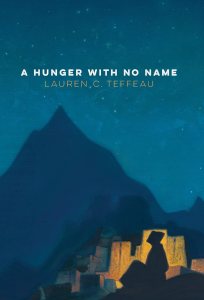
Zilla: Some stories are so real, so important, that we turn to fantasy and fable to give them life. Lauren C. Teffeau gives us a book like this in her environmental fantasy novella A Hunger with No Name. Lauren, can you tell us a bit about your book?
Lauren: A Hunger with No Name is a coming-of-age tale with an environmental focus featuring an immersive fantasy setting inspired in part by the high desert of New Mexico.
Thurava of Astrava is intended to become a herder, a most honored position for her dwindling community that clings to life on the banks of the Najimov, the river that’s the lifeblood of the high desert. But the Glass City on the horizon threatens the delicate balance the Astravans have managed to hold on to for centuries, polluting the air and water as the city grows bigger and bigger. The Glass City’s clockwork liaisons offer to bring the Astravans into the Glass City’s walls, but they will have to give up their ways and their precious herds to do so. Thurava must decide who she is without her animals, using the stars as her guide, putting herself on a collision course with the secrets the Glass City holds dear.
Zilla: Is there a visual image that inspired this book?
Lauren: I had a dream of a young woman staring off toward the horizon and being both horrified and fascinated by what she saw. When I woke, I started writing the story that ultimately became the book.
Zilla: Is your work more plot-driven or character-driven?
Lauren: No story is exactly the same, but I seem to have developed two writing modes: possession projects and battle projects. Battle projects are usually idea- or world-forward in that I have an idea or story world I want to explore in a narrative way. The trick is finding the right point-of-view character to bring that idea or world to life. That process can often feel like a battle as I try to fit all the pieces together into a cohesive whole and find a compelling character to chart the way. My debut novel Implanted was like this—I had a very ambitious idea for a world, but it took a while to settle on my main character.
In contrast, possession projects like A Hunger with No Name are story ideas that are more character-forward. And once I know the character, I usually have an idea of how the story should be structured to best capture their arc. Once those pieces are in place, the writing process often feels like the story is possessing me until I fully get it out of my system and onto the page.
Zilla: I love that description of writing projects—I relate to that a lot. Who did you imagine reading your book as you wrote it?
Lauren: I was thinking of my daughter and things I wanted to know about how the world worked when I was growing up. The book examines a lot of different types of female relationships: mothers and daughters, female friendships, encounters with women from different generations, and I hope the book provides some insights on how to navigate those relationships. It’s too early to know who will read the book as it’s only been out a few weeks, but I hope it finds readers interested in folklore, science fantasy, automatons, and the high desert.
Zilla: Thanks for sharing your story and your process. We’re looking forward to reading! Where can the Night Beats community find you and your book?
Lauren: You can find me at my website, or on Instagram, Bluesky, or Linktree. My book is for sale at the press website, as well as Amazon, Barnes and Noble, and on Bookshop.
 Night Beats Extended Universe