Every Tuesday, get to know a bit about the stories behind the books you love, and discover your next favourite novel.
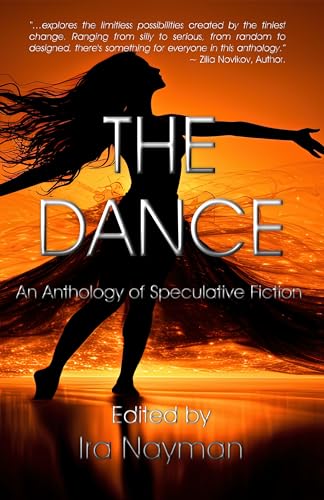
Zilla: One of my favourite stories in the science fiction anthology The Dance was Eli K.P. William’s tale of duality, “The MachineGarden”. So I asked Eli to come here and answer some questions for me!
Without getting too spoilery about worldbuilding, I fell in love with the duality of the machine side of the world vs the garden side. As a queer person, I instantly jumped to a trans reading of the story, particularly when Eos explains the, “gap between me and myself was there all along.” Did you intend or consider a trans reading as you wrote the story? If not, was there another type of duality intended?
Eli: I think that’s an interesting way to read “The MachineGarden.” The crisis for Eos is that, due to a rare variety of insight she possesses, she experiences her body as swinging between the two poles of a binary. However, this is a binary of ontology, rather than sex or gender, and it convulses all of (post)human existence, rather than any individual body, faster than the mind can follow.
Zilla: You are not the first author to explore the dichotamy of built vs grown, though I’ve never read your particular take on them before. As I read your story, Mass Effect and This Is How You Lose The Time War both came to my mind. What stories inspired you as you wrote your own?
Eli: I could give you a long list of authors who influenced me when writing the Jubilee Cycle trilogy: George Orwell, William Gibson, Ursula le Guin, Haruki Murakami, and China Mieville to name just a few. However, for “The MachineGarden,” I intentionally tried to break away from the influence of past writers because I wanted to unlock a new vision of the future that is rooted in the zeitgeist of the 2020s as opposed to in an earlier age. I don’t think I was entirely successful, but I hope to make further attempts in the coming years. Cultivating a radical new movement in science fiction is, I believe, the central challenge that the current generation of authors must rise to.
Zilla: I have the usual complaint of a reader who finished an excellent short story–I need more. Are you done with Eos, Arata, and particularly with the MachineGarden world, which feels like a character in its own right? Or do you think there are more stories to be told in this ‘verse or with these characters?
Eli:
I think there’s enough narrative and conceptual potential in “The MachineGarden” for it to be extended to novel length, but I’m happy leaving it as is, for now, so I can work on other books. I’m currently seeking an agent to represent a hard-to-classify novel set in two alternate versions of Toronto, and for the past few years, I’ve been gradually building a world for a near future novel about alien communication that takes place mostly in the upper atmosphere. I’m also busy doing research for a non-fiction book on Japanese science fiction. (You can read my first stab at the topic here.)
However, there are threads in “The MachineGarden” I hope to pick up in other stories, such as the built-versus-grown dichotomy you mentioned, which I began to explore in A Diamond Dream, the final book of the Jubilee Cycle. I also have vague plans to run with the IntelSchism idea and use it as the core conceit for a full novel.
Zilla: Thanks for sharing your story and your process. We’re looking forward to reading! Where can the Night Beats community find you and your book?
Eli: You can get The Dance here. You can learn more about me here, follow me on Twitter @Dice_Carver, or join my fledgling Substack Almost Real.
 Night Beats Extended Universe