Every Tuesday, get to know a bit about the stories behind the books you love, and discover your next favourite novel.
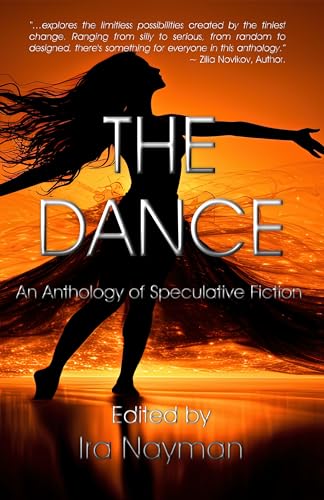
Zilla: Rachel A. Rosen, Night Beats founder and writer extraordinare, has written another piece of literary glass to pierce my heart. Her newest short story “Do You Love the Colour of the Sky” can be found in the anthology The Dance.
The story starts with a poignant image–the protagonist circling the sky between a thumb and forefinger, trying to memorize the colour so it can be stored, temporarily, in memory rather than lost immediately. The story is about two characters who deeply love beauty dealing with its loss. The way I’ve made my own peace with loss is to say the transience itself is part of the beauty. But then, publishing a story about loss is a way of building permanence out of that feeling. How do you handle the space between permanence and transience within art?
Rachel: Everything I write will be forgotten.
There’s a strange contradiction where everything you say on the internet is forever, but the chances of any single thing you say being immortal is infinitesimally small. I am not Shakespeare, nor am I Nanni writing to Ea-nāṣir. This might bother me more if I were the sort of person who thought much about her legacy, but for the most part I’m not. If I can capture a fleeting emotion, put it down on paper, and shove it into someone else’s mind for however many minutes or hours they’re reading about it, that is cool and magical and good.
Zilla: The links between the Sunken Museum and the British Museum are obvious–the story reminds me of the debates about whether it’s best to keep stolen artworks “safe” in the the UK or return them to their war-torn homelands, with the British studiously avoiding the question of why those homelands are so war-torn in the first place. Curators are regularly confronted by the archivist’s conundrum. I assume you’re on the side of repatriation, but do you see any nuance in that question?
Rachel: I’m of course on the side of repatriation/rematriation—the Archivist’s arguments are intended to be understandable and sympathetic, but ultimately wrong—and it’s a theme that I often address in my day job as a teacher of both Visual Arts and Indigenous literatures. This story was inspired in part by a workshop I attended by Leslie McCue, an Anishinaabe arts educator who works with the Royal Ontario Museum on addressing some of the historical wrongs that the museum’s curatorial practice has perpetrated. She talked about some of the complexity in identifying poorly categorized objects and tracing ownership and belonging. I think there’s nuance in the how of returning cultural artifacts, art, and ancestors to their peoples and homelands, and that in itself is a fascinating discussion, but I don’t think there’s a lot of room for nuance when it comes to the should.
Zilla: Is it possible for a story like this one to have a happy ending?
Rachel: I think it is, though ultimately mine doesn’t have one. Besides memory and impermanence, this is a story about change—in order for the ending to be happy, the Archivist has to change in a manner that is in many ways a death. At least one of the alternate pathways suggests that this is something she’s capable of doing, and the choice that she ultimately makes isn’t by any means necessarily the end to her character arc. But ultimately, the story was inspired by melancholic works—in particular the works of Walter Benjamin—so a melancholic ending seemed most fitting.
Zilla: Are you prepared to share the story behind the title? Or is that an Easter egg that if you know, you know?
Rachel: It’s an Easter egg for a subset of extremely online depressed Millennials who spent too much time on Tumblr. Years ago, there was a meme entitled that, featuring a comically long image gradient of the sky throughout a 24-hour cycle. Its popularity points to the Dadaist humour that Tumblr is absolutely fantastic at, but I also see something tender in it, about the meditative pause that it enforces while doomscrolling. Of course, it refers more literally to the Archivist’s habit of mentally “preserving” the sky (also a habit I had as a child that I of course have grown out of and never find myself doing) but thematically, it’s about the desire to capture something transient by its nature.
Zilla: Thanks for sharing your story and your process. We’re looking forward to reading! Where can the Night Beats community find you and your book?
Rachel: They can get The Dance here, and all my social links are here.
 Night Beats Extended Universe