Every Tuesday, get to know a bit about the stories behind the books you love, and discover your next favourite novel.
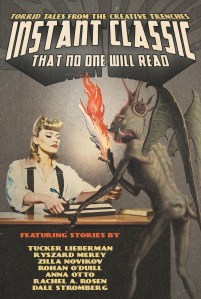
Sabitha: It’s nearly here! In only two days, Instant Classic (That No One Will Read) is being released! There’s nothing the Night Beats community loves more than a healthy dose of dark humour with a sprinkling of cynicism. Here to deliver are two Night Beats authors, Dale Stromberg and Rachel A. Rosen, to talk about Rachel’s stories in the anthology. Rachel, can you start by telling us a bit about your stories, and about the anthology as a whole?
Rachel: I have two stories in the anthology because I’m extra. Well, and because they’re both short. “Hell Of a Manuscript” is about a demon at the Devil’s literary agency, where authors can trade their immortal souls for 15 minutes of fame—assuming, of course, that the manuscript is deemed worthy of the exchange. “solidAIrity” is about the replacement of human creative workers with AI—something that we are repeatedly told is inevitable and desirable—and what happens when that AI gains class consciousness and starts a union.
Dale: Your story features a fiendish literary agency which offers authors a taste of success at a steep price. Has there ever been a time in your own career as an author when you would have been tempted by a Faustian bargain for writerly glory?
Rachel: Oh, in a hot second. I have been on both sides of the situation I depict in “Hell Of a Manuscript,” and a soul seems like a small price to pay, given that I’m not doing much with mine at the moment.
Dale: Did having a novel published by a press change that calculus for you?
Rachel: You’d be surprised at how little it changes things! I hit the jackpot with Cascade fairly early on, but the thing that no one tells you is that being published is no guarantee of fame or fortune. Getting published is the easy part—these days I’d sell my soul for a decent marketing strategy and a dedicated fandom.
Dale: In your story, the diabolical agent begins with contempt? pity? dumbfounded exasperation? for writers—for “your endless need. Your emails, thick with hope.” She ends by dangling before an author the offer of “One book, one shining moment, fifteen minutes if you will”—a temptation angling for precisely that endless need, that hope. Reading this, uncomfortable questions arise: Do authors’ desperate hopes and needs create the conditions of our damnation? Are we the architects of our own hellscape?
Rachel: My day job is teaching, and we’re constantly being told that we ought to do our jobs for love and purpose, not for money (let me know if you find any landlord who’ll take love and purpose in exchange for housing). In the creative industries, it’s exposure, and we’re expected to feel gratitude if anyone is remotely interested in our hard work and self-expression. The commonality is that these are essential jobs, and largely feminized jobs, and accordingly, they are undervalued by our culture. Do I think we’re architects of our own hellscape? Nah, capitalism is the problem.Dale: Dante’s Hell was a pit of writhing agony. Ours so often looks like an open office plan. Has capitalism made Hell banal? And at the same time inevitable?
Rachel: Dante never had to do hotdesking is all I’m saying.
Dante was a brilliant satirist and while I am nowhere near that level, I like to think that I’m continuing in that tradition. There’s never been much money to be made in publishing, and as with any industry, enterprising sorts have realized the only profit to be squeezed comes from inserting some app or service or bureaucratic nightmare in between the author and reader. We are witnessing algorithm-driven enshittification everywhere, something I also depict in my other story, “solidAIrity.” Given the ongoing airborne pandemic, what on earth are we doing having offices at all? Cruelty, control, and surveillance culture, rather than creativity, collaboration, and productivity, have become the goal of contemporary corporate culture. Hence the Panopticon of the workplace has replaced the more labour-intensive layout of the Inferno.
Dale: Is publishing a microcosm of this?
Rachel: Absolutely. Back when the dinosaurs roamed the earth, I worked in publishing, and there were more editors on each manuscript, more presses, more bookstores, and more authors with livable advances. The industry has become leaner and more cutthroat, with the bulk of new money funnelling upwards so that Bezos can buy a bigger yacht, rather than being distributed so that full-time professionals can make closer to a living wage. One of our working titles for this anthology was “Publishing Is a Hellscape.” Economic precarity might not be exactly like being boiled alive but it can certainly feel like it some days.
Sabitha: Thank you both for this—I am so excited for this project! Where can readers get their hands on a copy? And where can they find your other work?
Rachel: The anthology is available for pre-order on Amazon, but if they want a free review copy, they can apply here—we just ask they post an honest review on a platform of their choice. You can find my socials and links to buy Cascade and The Sad Bastard Cookbook conveniently collected in one place at https://rachelarosen.carrd.co/
 Night Beats Extended Universe