Every Tuesday, get to know a bit about the stories behind the books you love, and discover your next favourite novel.

Sabitha: Happy Halloween! This spooky Tuesday brings us an unconventional kind of ghost. Ghost Signs: A London Story tells history through photography. Sam Roberts, can you tell us about your fascinating project?
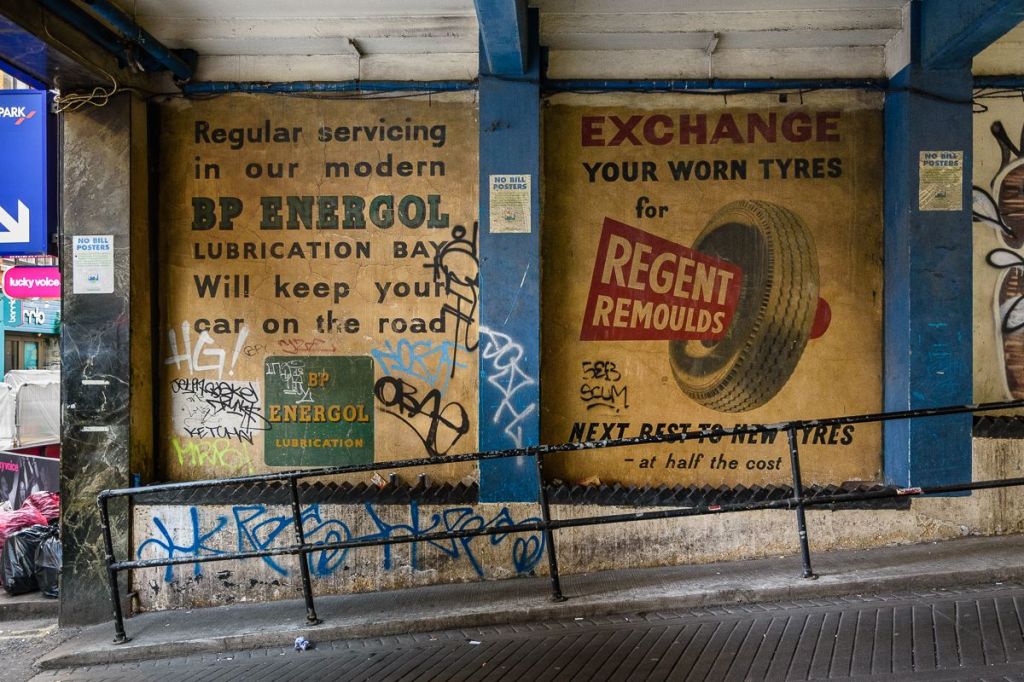
Sam: Ghost Signs: A London Story explores London through its ‘ghost’ signs, fading painted signs on brick walls. Imposing yet hidden in plain sight, they are London’s history written on to the contemporary cityscape. They reveal fascinating stories of everyday life in the capital and each sign has its own tale to tell – not just of the business it represents and the people behind it, but of its own improbable survival.
The book was a collaboration with Roy Reed, who took the vast majority of the photographs inside, and is a feast of history, typography and the urban environment. It showcases London’s most impressive and historically significant faded painted signs, located, photographed and presented with archival and other contextual images. It is split across the two sections: the first shares insights into topics such as production techniques, economics and preservation. This is then followed by themed chapters that take on subjects including building, clothing, entertaining, branding and, ultimately, burying the city.
Sabitha: What inspired you to create this book?
Sam: Since 2006, I have been documenting and researching the phenomenon of ‘ghost’ signs, those fading painted signs on brick walls. I always felt there was a book in me, and the pandemic gave me the necessary time and space to create something that would do justice to the topic.
Sabitha: Do you have a playlist for your book?
Sam: While writing the book I discovered The War on Drugs from Philadelphia. Many of the songs from their albums A Deeper Understanding (2017) and Lost in the Dream (2014) made it onto a playlist, which was more or less on rotation. Their album Live Drugs (2020) then came out while working on the book, with lots of my favourites on it.
I especially like An Ocean In Between the Waves (the bass when it comes in!) and You Don’t Have to Go, which is much more mellow. Overall the music struck a chord at that particular moment in my life and work, and somehow enabled me to escape the ravages of the pandemic and focus on researching and writing the book.
Sabitha: What books do you tell all your friends to read?
Sam: I tend to read more non-fiction, and some books that have influenced me include: Working Identity by Herminia Ibarra, which helped me navigate a career change; How to Be Free by Tom Hodgkinson which made me reappraise my material consumption; and Doughnut Economics by Kate Raworth which chimed with my understanding of global climate change and what we should do about it. As for fiction, I most recently read Carter Beats the Devil by Glen David Gold, and thoroughly enjoyed the intrigue and twists that fill its pages.

Sabitha: How much research did you need to do for your book?
Sam: Research probably made up about 75% of the work on the book. Each of the 250 featured signs has their story told, and then there were another 50 or so that were researched but not included in the final edit. Research involved many different approaches, from historical documents and picture archives, to google streetview and the wisdom of crowds on social media, especially Twitter (RIP).
Sabitha: Do you have any suggestions to help people in our community become better writers? If so, what are they?
Sam: I think that the main thing is to write, whether that’s by hand in a journal, on your desktop, or via a blog. Getting your work in front of people is important. So is analysing writing that you enjoy, to see what you can learn from it and bring into your own work.
Sabitha: What’s your next writing project?
Sam: I am currently developing my latest initiative which is a magazine, BLAG, serving the international sign painting community. In addition to writing content myself for publication in print and online, I am also gaining experience of editing the work of others. In particular, I enjoy helping to shape the texts without losing the writer’s voice, a new stage in my own personal and professional development as a writer and editor.
Sabitha: Thanks for sharing your story and your process. We’re looking forward to reading! Where can the Night Beats community find you and your book?
Sam: You can find Ghost Signs: A London Story here. You can also read me in BLAG (Better Letters Magazine).

 Night Beats Extended Universe